Can Gouramis Live Alone?
As an Amazon Associate we earn from qualifying purchases.
Can gouramis live alone? In a suitable tank, a single gourami can be kept without another fish, but the sources opened for this guide do not say that gouramis do better alone or that a solitary life suits them. The answer depends on the species, the tank volume, and whether the fish has room to have its own territory. The sources give tank-size minimums and a territory principle, and they say nothing about social preference. This guide covers those points and marks what remains unverified.
Quick answer
- The sources opened for this guide do not say that gouramis need company or that they are unhappy alone. The question of social needs is not verified here.
- FishBase gives a “minimum aquarium size 120 cm” for Trichogaster leerii (pearl gourami). A solo fish still needs that much room.
- Merck says that a tank’s capacity depends on “the territory available for the fish,” not only on the number of fish.
- If a gourami is kept alone, the tank must be large enough for the species, filtered, and kept free of the stress and crowding that Merck links to disease.
What the species pages say about space
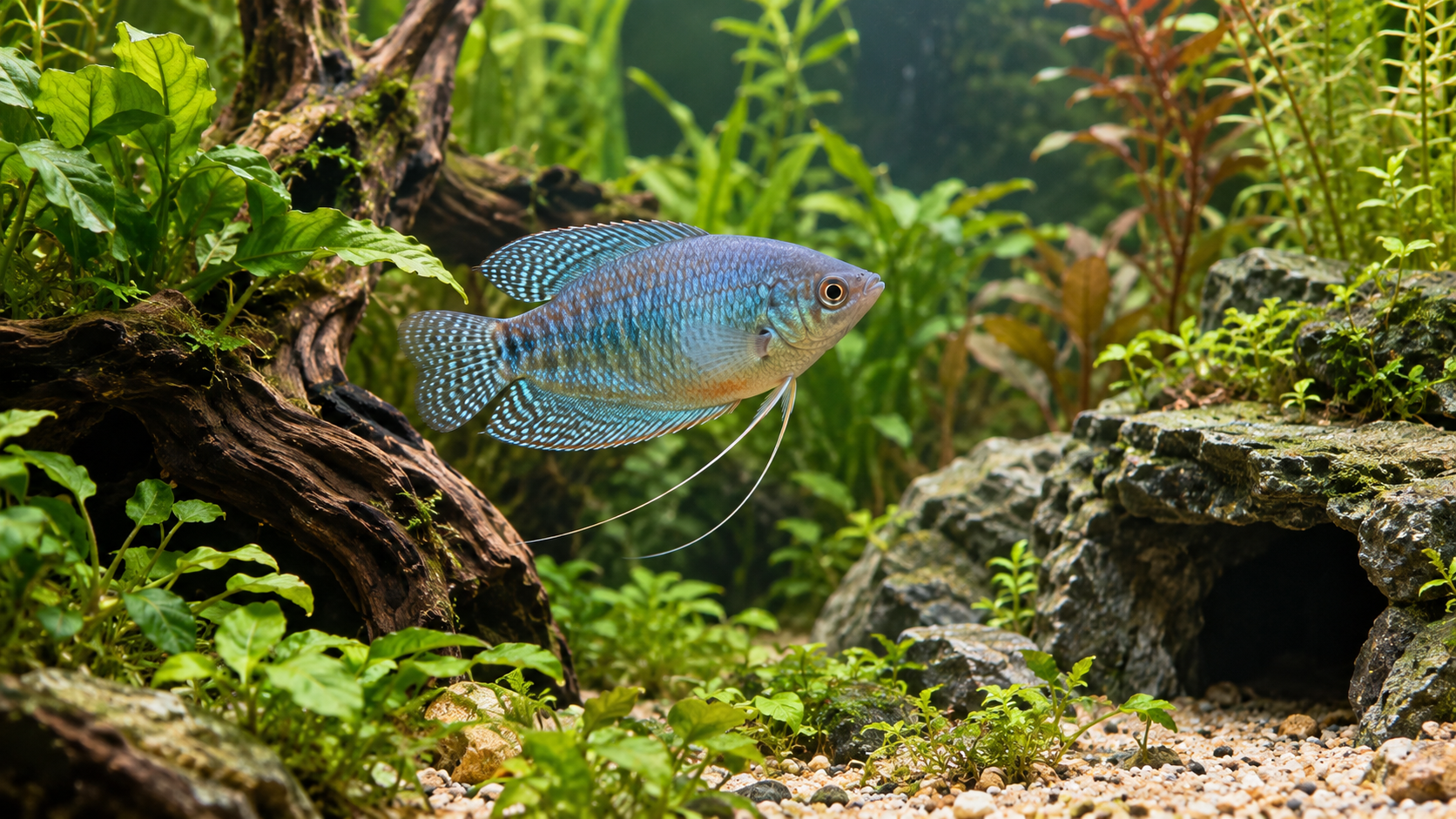
FishBase is a non-retail species database. Its entries for the two gouramis used in this guide give habitat and minimum aquarium size. For Trichogaster leerii, the entry says the species occurs in swamps and streams, “usually among dense vegetation,” and that the aquarium keeping minimum is 120 cm. The entry for Trichogaster trichopterus describes the species as an obligate air-breather from lowland wetlands with “a lot of aquatic vegetation.” It gives a tropical temperature range and a pH range of 6.0 to 8.0.
These records tell a keeper two useful things. Gouramis in the wild live among plants, so a bare tank is not the natural setting described by the source. And the minimum size is given in centimetres, which means the tank needs real length, not just a small footprint. A solo fish in a tank below the listed minimum is outside what the source describes, whatever the reason for keeping it.
The air-breathing detail matters for a different reason. An obligate air-breather needs access to the surface, which affects lid choice and how the tank is set up. The sources do not say how that trait changes social behaviour, so it is a husbandry point rather than a reason to keep the fish alone or with company.
What the Merck Veterinary Manual says about territory
The Merck Veterinary Manual’s page on providing a home for fish explains how capacity is set. It says that “Ultimately, the carrying capacity of your aquarium is based on the filtration capacity (which can be determined by testing water quality) and the territory available for the fish.” This is the most useful sentence for a solo gourami, because it shows that a tank’s limit is not just a count of fish.
The same page says decorative objects “help ‘divide’ the aquarium and allow fish to have their own territory.” For a single gourami this means that a tank can feel crowded even with one fish if there is little cover or structure. Plants, rocks and other features give a fish space to rest and move out of sight. Merck is writing about aquarium design in general, not gouramis specifically, so the principle applies by analogy rather than as a sourced rule for this species.
Merck also makes a point about stress. Its disorders page says that “Preventive steps include minimizing stress and crowding.” A solo fish is not automatically a crowded fish, but a small tank with too little cover is a stressor in the broad sense. The page does not describe gouramis in that context, so the link is a general one.
Practical setup for a single gourami
The following points are general guidance drawn from the sources above. They are not product recommendations, and they do not claim that a solo gourami is healthier than one kept with others.
- Check the minimum size for the species before buying a tank. For Trichogaster leerii, FishBase gives 120 cm as the minimum aquarium size.
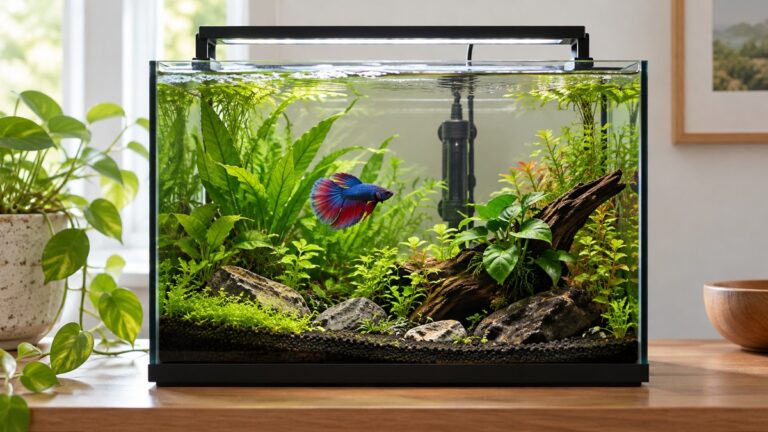
- Plan the tank around territory. Use plants and structure so the fish can rest and move out of view. The Merck page’s point about territory applies here.
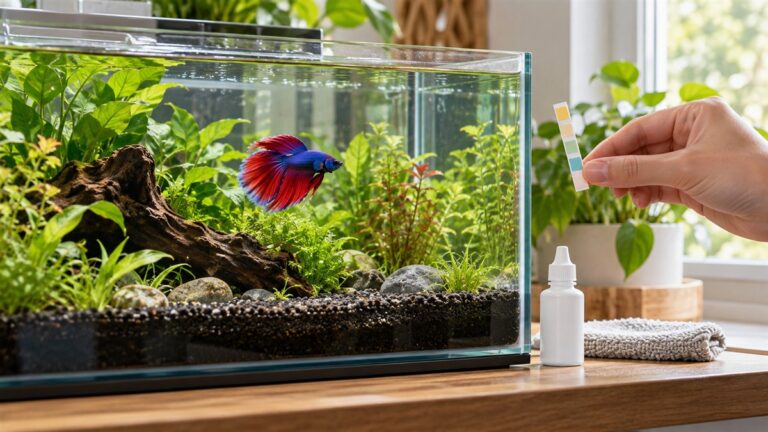
- Keep the water tested. Merck ties carrying capacity to filtration and water quality, so a single fish in a poorly filtered tank is still a water-quality problem.
- Choose a lid that allows air access if the species is an air-breather. FishBase describes both species as air-breathing, so surface access should be planned from the start.
- Watch for signs of stress. Merck names stress and crowding as preventive concerns. A fish that hides constantly, refuses food or shows changes in colour should prompt a check of the water and the tank before anything else.
Choosing a tank also means reading the listing carefully. The guide on what size tank a betta needs explains how to compare a tank’s stated capacity with its usable water volume, which applies to any species. The guide on filters for betta fish covers flow and filtration choices that carry over to other small fish.
How we chose
The question was checked against two non-retail species pages and one veterinary reference, all opened on 2026-10-24. FishBase was chosen for species data: habitat, air-breathing status and the minimum aquarium size for each gourami. The Merck Veterinary Manual was chosen for its page on carrying capacity and territory. Retail listings, product pages and shop advice were not used. No tank, filter or accessory was evaluated, and no price, rating or brand is given.
The guide keeps to the two species named in the FishBase entries and to the general aquarium principles in the Merck page. It does not extend those species facts to every gourami, because the sources do not cover the full range of gourami types kept in home aquariums.
What we could not verify
The sources opened for this guide do not say whether gouramis are happier alone or with other fish. They do not describe the social behaviour of either species in an aquarium. They also do not give a number of fish for a community, or a tank size that is safe for a solo fish of any particular gourami type beyond the minimum listed for Trichogaster leerii. Those points remain unverified here.
What the sources do not say
FishBase gives habitat, air-breathing, temperature, pH and minimum size. It does not say whether either gourami is territorial, peaceful or social. Merck’s page on providing a home discusses aggression and territory in general, and it names freshwater cichlids and larger freshwater species as examples. It does not discuss gouramis as a group. Where this guide describes a solo setup, it is describing husbandry in general, not reporting a sourced finding about gourami behaviour.
Frequently asked questions
Is a single gourami lonely?
The sources opened for this guide do not say that gouramis feel lonely, and they do not say they need company. Whether a solo gourami is content is not something the sources measure. A keeper should judge the fish by its behaviour and condition rather than assume a social need.
How big a tank does one gourami need?
FishBase gives a minimum aquarium size of 120 cm for Trichogaster leerii. The sources do not give a single figure for every gourami type, so check the species you have and the minimum listed for it. The usable water volume matters more than the advertised capacity.
Can a gourami live in a bowl?
No source opened for this guide describes a bowl as a suitable home for a gourami. The FishBase minimum for Trichogaster leerii is 120 cm, and the Merck point about territory points the same way. This site does not recommend bowls or vases as housing for any fish.
Do gouramis need plants to live alone?
FishBase describes both species as living among vegetation in the wild, and the Merck page says decorative objects help fish have their own territory. Plants and structure are therefore sensible for a solo fish, but the sources do not say that plants are required for survival.
What is the biggest risk for a single gourami?
The sources point to stress and crowding as the main preventive concerns, and to poor water quality as a route to disease. For a solo fish in a suitable tank, the most likely problem is water that has not been tested. A keeper should test and record water quality before blaming the fish’s social setup.
Sources
- FishBase, species summary for Trichogaster trichopterus, https://www.fishbase.se/summary/Trichogaster-trichopterus.html, opened 2026-10-24. Non-retail species database.
- FishBase, species summary for Trichogaster leerii, https://www.fishbase.se/summary/Trichogaster-leerii.html, opened 2026-10-24. Non-retail species database; minimum aquarium size.
- Merck Veterinary Manual, “Providing a Home for Fish,” https://www.merckvetmanual.com/all-other-pets/fish/providing-a-home-for-fish, opened 2026-10-24. Veterinary reference; carrying capacity and territory section.