Can Betta Fish and Tetras Live Together
As an Amazon Associate we earn from qualifying purchases.
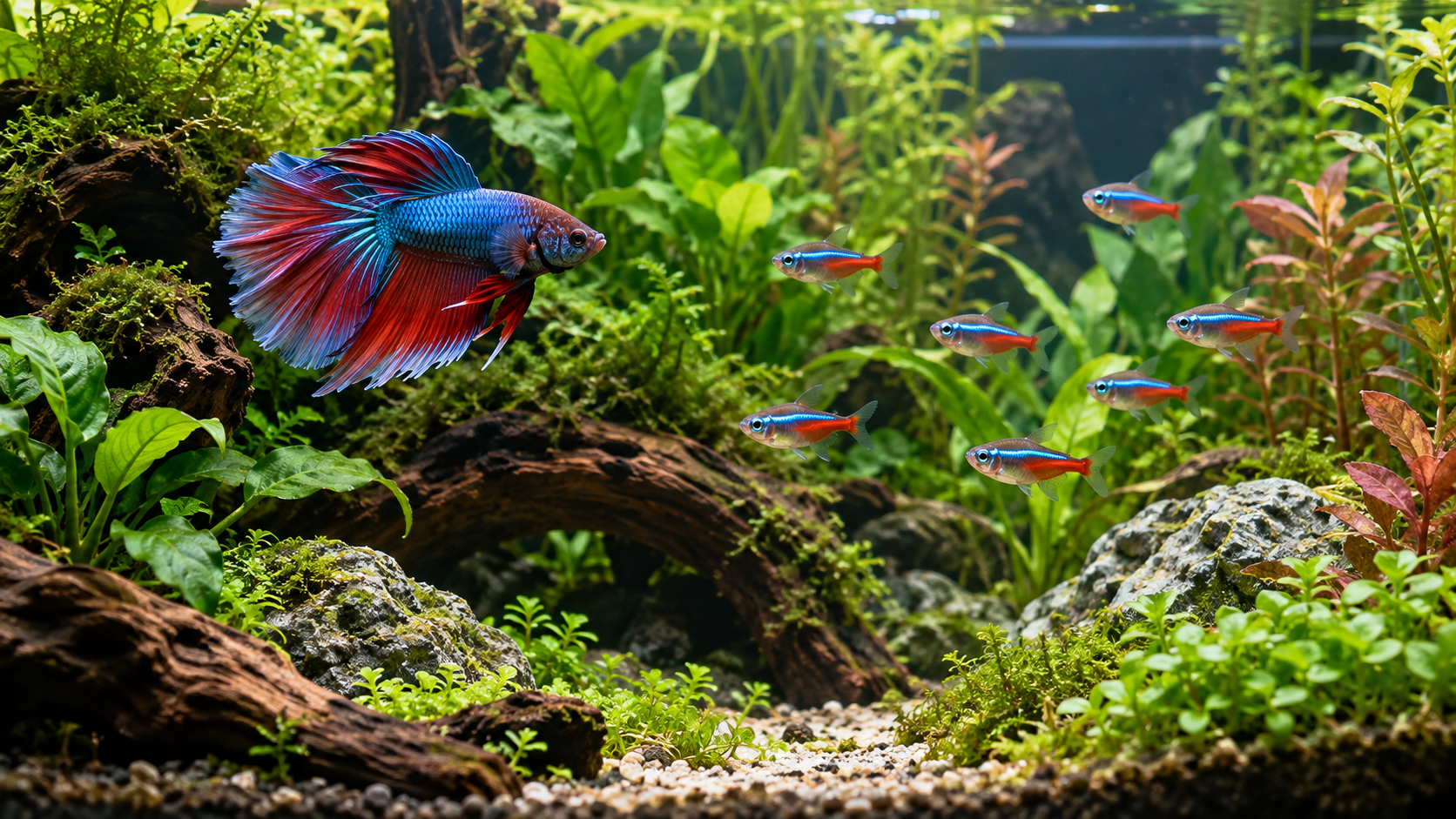
Can betta fish and tetras live together? The sources we opened do not give a simple yes or no for a betta housed with tetras. They do give each species’ listed water range, diet and group needs, and those numbers show where a shared tank would be hard to meet. Whether it works in practice depends on the tank size, the tetra species, and how the individual betta behaves.
Quick answer
- No source we opened says bettas and tetras are a good match. Each species page lists its own needs, and a shared tank has to meet both sets.
- FishBase advises keeping neon tetras in groups of “5 or more individuals” and gives a “minimum aquarium size 60 cm.”
- FishBase notes that “Males will fight each other,” and says sexes should be “kept separate unless for mating.”
- The listed pH ranges overlap only between 6.0 and 7.0, and the listed dH ranges do not overlap at all.
What the species pages list
FishBase species pages give habitat, climate, diet and aquarium-keeping notes in one place. The two species below are the pair named in the keyword. The values are copied from the pages, not measured.
- Betta splendens: “Freshwater; benthopelagic”; pH range 6.0 to 8.0; dH range 5 to 19; “Tropical; 24°C – 30°C.” Diet: “Feed on zooplankton, mosquito and other insect larvae.”
- Paracheirodon innesi (neon tetra): “Freshwater; pelagic”; pH range 5.0 to 7.0; dH range 1 to 2; “Tropical; 20°C – 26°C.” Diet: “Adults feed on worms, small insects, crustaceans and plant matter.”
Where the listed ranges overlap
A comparison of the two listed ranges gives a narrow shared window. This is arithmetic on the listed numbers, not a finding from a trial. The pH ranges overlap from 6.0 to 7.0, so a tank held in that band sits inside both listed ranges. The dH ranges do not overlap: neon tetra is listed at 1 to 2 and betta at 5 to 19. The temperature ranges overlap from 24°C to 26°C.
The sources do not say how strictly each range must be kept, or how a mixed tank should be balanced when the ranges separate.
Tank size and group size
The neon tetra page advises keeping the fish “in groups of 5 or more individuals” and gives a minimum aquarium size of 60 cm. That figure is a length, so check the tank’s footprint and not only its gallon label. A 60 cm tank is about 24 inches long. A tank sized for a betta can be too short for a tetra group, and the reverse can also be true.
The betta page says that “sexes should be kept separate unless for mating.” For a wider look at companion options, see betta tank mates for a 20 gallon tank.
Water preparation for a mixed tank
The Merck Veterinary Manual says that most city water “is treated with chlorine or a combination of chlorine and ammonia (known as chloramine), both of which are toxic to fish and to the necessary bacteria that grow in your aquarium.” It adds that “Additives (dechlorinators) are available to remove both chlorine and chloramine from the water and should be used to treat any new water that goes in the aquarium.” Treat every new batch of water before it goes into the tank, whichever fish you keep.
Merck also states that “A heater is necessary for both freshwater and saltwater tropical fish.” Neon tetra and betta are both listed as tropical, so a heater is a reasonable part of the plan for either species. Merck adds that “Filters, pumps, heaters, and lights should not be turned on until after the tank is filled with water.”
Feeding a mixed tank
Overfeeding is the feeding risk the sources name most directly. The Merck page says that “Overfeeding can lead to health problems as well as a dirty tank.” It gives maintenance diets at “1% to 2% of body weight per day” and growth diets at “3% to 5% of body weight per day.” The page adds that “Feeding methods and rates vary with species, age, system, and water temperature.”
The two species pages list different natural foods. Betta is listed on insect larvae and zooplankton, while neon tetra is listed on worms, small insects, crustaceans and plant matter. A single food may not cover both lists well. This is an inference from the two lists, not a finding from a feeding study. Merck also says that “Feeding vegetables a few times a week as a supplement provides an excellent source of B and C vitamins.”
A decision checklist
- Start with the tetra group. Plan for 5 or more fish and a tank long enough for the 60 cm minimum on the FishBase page.
- Treat the betta question as individual. The sources warn that males will fight each other, but they do not say how a betta behaves toward tetras.
- Compare the water before you buy. The dH ranges do not overlap, so the sources cannot give one water setting that fits both species.
- Plan feeding for the lower maintenance figure and avoid overfeeding, as the Merck page describes.
- If either fish looks unwell or injured, ask an experienced fish keeper or an aquatic vet. This post does not give treatment advice.
This site does not recommend bowls or vases as a home for a betta. This site recommends heated, filtered tanks of 5 gallons or more for a betta, and the sources we opened do not describe a bowl as suitable for tetras.
How we chose
We chose sources that give species-level data. We used FishBase species pages for betta and neon tetra, and a Merck Veterinary Manual page on providing a home for fish. We opened each one with curl on 2026-10-24. Retail listings were not used, and no prices or ratings appear here. The values above were copied from those pages, and the overlap figures were calculated from them.
What we could not verify
The keyword asks about a pairing, and none of the sources we opened covers that pairing. The points below remain open.
What the sources do not say
- Whether a specific betta accepts tetras. Temperament varies by fish, and the sources do not describe a compatibility test.
- Which tetra species, if any, are a safe match for a betta. Only the neon tetra page was used.
- A minimum tank size for a mixed betta and tetra setup. The 60 cm figure applies to the neon group only.
- Signs of stress or conflict in either species. Ask an experienced fish keeper or an aquatic vet if a fish looks unwell.
Frequently asked questions
Can a betta live with neon tetras in a 10 gallon tank?
The neon tetra page gives a minimum aquarium size of 60 cm for a group of 5 or more. Check the tank’s length against that figure, not only its gallon rating. The sources we opened do not give a tank-size rule for a betta and tetras together, so the answer depends on the dimensions of the tank you have.
Do bettas and neon tetras need the same temperature?
Not exactly. FishBase lists neon tetra at 20°C to 26°C and betta at 24°C to 30°C. The two ranges overlap from 24°C to 26°C. A heater setting in that band fits both listed ranges, but the sources do not say that one setting is ideal for either fish.
Are male bettas safe with other fish?
The sources do not say. FishBase warns that “Males will fight each other,” which concerns male bettas against each other. It does not describe their behavior toward tetras, so this post cannot give a yes or no.
Can a betta and tetras share a bowl?
No. Bowls are not a setup this site recommends for a betta. The sources we opened do not describe a bowl as suitable for tetras. The Merck page mentions goldfish bowls and betta tanks only as small aquariums that may not need filtration or a heater, and it does not recommend them as a shared home.
What should I do if one fish stops eating or looks unwell?
Do not treat the fish based on this post. The sources we opened do not cover treatment for a betta and tetra mix. Contact an experienced fish keeper or an aquatic vet, and describe the tank size, the water tests and the feeding routine. For feeding basics, see how many pellets to feed a betta.
Sources
- FishBase, Betta splendens species page, https://www.fishbase.se/summary/Betta-splendens.html (opened 2026-10-24)
- FishBase, Paracheirodon innesi (neon tetra) species page, https://www.fishbase.se/summary/Paracheirodon-innesi.html (opened 2026-10-24)
- Merck Veterinary Manual, Fish: Providing a Home for Fish, https://www.merckvetmanual.com/all-other-pets/fish/providing-a-home-for-fish (opened 2026-10-24)