Can Guppy Fry Eat Flakes?
As an Amazon Associate we earn from qualifying purchases.
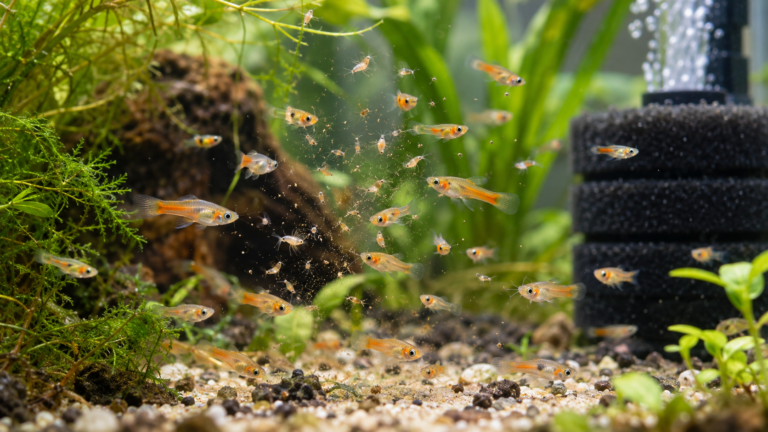
Can guppy fry eat flakes? Yes, according to the general fish guidance in the Merck Veterinary Manual, which says “Small live or frozen food and crushed flakes are good for feeding fry.” That line is written for fry in general, not for guppies specifically. The FishBase guppy page describes what adult guppies eat in the wild but does not mention fry or flakes. This guide explains what the sources support, what they leave open, and how to feed guppy fry without overfeeding them.
Quick answer
- Merck lists “crushed flakes” as good for feeding fry, alongside “small live or frozen food.”
- Guppies are livebearers, so the young are born as fry. Merck says they are “fully formed and functional young called fry.”
- Remove the fry from adults. Merck says fry “should be separated from adults because the adults (including the parents) tend to eat them.”
- Do not overfeed. Merck says “Overfeeding can lead to health problems as well as a dirty tank.”
What Merck says about fry food
The Merck section on breeding and reproduction covers livebearers and egg-laying fish. For feeding, it is brief. It states that “Small live or frozen food and crushed flakes are good for feeding fry.” The guidance does not rank flakes against other foods, and it does not give a grain size, a daily amount or a feeding schedule for fry of a particular species.
Merck also explains why livebearer fry are different from fry that hatch from eggs. “Livebearers give birth to fully formed and functional young called fry.” It adds that “Most livebearers have fewer and larger fry than egg layers because the fry need to be more developed and large enough to fend for themselves after birth.” Guppies are livebearers, so a guppy fry is already a small, active fish when it leaves the mother. That is why the question of what it can eat matters early.
What the guppy page adds
FishBase describes the guppy (Poecilia reticulata) as a fish whose adults feed on natural foods. Its page reads, “They feed on zooplankton, small insects and detritus.” FishBase lists the natural temperature range as “Tropical; 18°C – 28°C” and gives an aquarium housing note of “in groups of 5 or more individuals; minimum aquarium size 60 cm.” None of these lines mention fry or flakes. The adult diet tells you what the species eats in nature, but it is not a direct answer for fry in a home tank.
The FishBase page also describes the parents’ behavior toward their young. It reads, “No parental care is exercised and parents may even prey on their young.” That line supports the Merck advice to separate fry from adults. It is a short, direct warning, and it is the strongest safety point the two sources share.
How to feed guppy fry with flakes
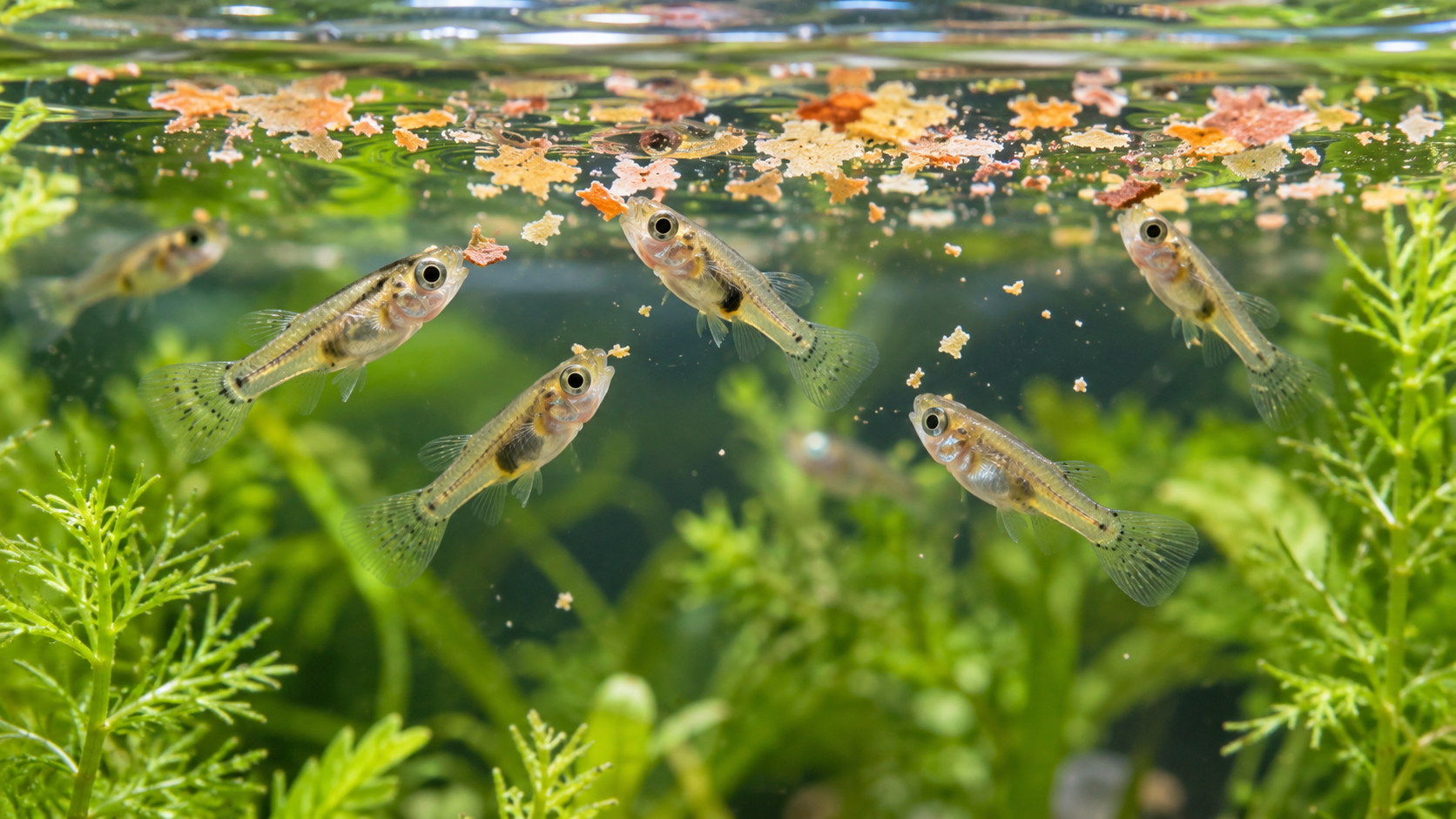
Merck says flakes are good for fry, but flakes must be prepared for the mouth of a small fish. The phrase “crushed flakes” in the Merck text points to breaking flakes into small pieces rather than feeding them whole. The sources do not say how small the pieces should be or how to judge that. Crush a pinch between your fingers or in a clean container, then look at the particle size in the water. If a piece is too large to fit in a fry’s mouth, crush it further.
The amount is the harder part. Merck gives feeding guidance for fish in general, not for fry. It says that “Feeding methods and rates vary with species, age, system, and water temperature.” It also gives a range for adult fish: “maintenance diets are fed at a rate of 1% to 2% of body weight per day, and growth diets at 3% to 5% of body weight per day.” Fry are growing, so growth-diet logic may apply, but the sources do not say that a fry should follow that range. Use it as a reference, not a fry target.
Feed small amounts, several times a day, and remove any food that is not eaten. This is general guidance, not a figure from the sources. For betta portion sizes, see how many pellets to feed a betta, and for small community species see small colorful freshwater aquarium fish. Merck links overfeeding to health problems and a dirty tank, so a small amount that gets eaten is safer than a large amount that sinks into the gravel.
Keeping fry safe while they feed
Separate the fry from adult guppies before feeding begins. The Merck breeding section says the adults, “including the parents,” tend to eat their young. A breeding tank with a divider, a separate tank, or a fry-safe area with dense plants can give the young a place to eat. The sources do not compare these options, so choose the one that fits your tank, and check the fry often.
Water quality affects how the fry do. Merck states that “Poor water quality is the most common cause of environmental-related diseases in fish.” Remove leftover food, and test the water if the tank looks cloudy or smells wrong. The sources do not give a testing schedule for fry tanks.
If fry look unwell, see an experienced fish keeper or an aquatic veterinarian. The sources we opened do not describe signs of illness in guppy fry, and they give no treatment advice for this post to pass on.
Keep in mind that flakes are one food among several. Merck’s guidance pairs crushed flakes with “small live or frozen food.” Choosing one food does not replace the other, and the sources do not say which mix works best for guppy fry.
How we chose
This guide relies on two non-retail sources. The Merck Veterinary Manual breeding section is a veterinary reference that covers livebearer fry and feeding in general. FishBase is a species database that records the guppy’s natural diet, temperature range and aquarium housing note. We chose these because each gives statements that can be quoted and checked. We did not use retail flake labels, product pages, prices or ratings. Where a claim lacked a source, it is labelled as general guidance or left out.
What we could not verify
The main question is answered only in general terms. The Merck line about flakes is written for fish in general, not for guppy fry. The FishBase guppy page is about adults and does not mention flakes or fry feeding. Neither source gives a fry size at which flakes become suitable, a feeding frequency, or a list of flake brands and their ingredients.
What the sources do not say
The sources do not say how old a guppy fry must be before it can eat flakes. They do not give a grain size for crushed flakes, a daily amount, or a feeding schedule. They do not say whether a particular flake food is a complete diet for guppy fry. Those points remain open, and this guide does not fill them with unsourced figures.
Frequently asked questions
Can guppy fry eat flakes right after they are born?
Merck lists crushed flakes as good for feeding fry, but it does not give an age for a guppy fry. The sources do not say when a newborn guppy can take flake pieces, so watch the fry and crush the flakes finely.
Should I crush flakes before feeding guppy fry?
Merck’s wording, “crushed flakes,” points to breaking flakes into small pieces. The sources do not give a size. Crush the flakes until the pieces are small enough for the fry to take in, and check that the fry are eating them.
Do guppy parents eat their fry?
FishBase says “parents may even prey on their young.” Merck says fry “should be separated from adults because the adults (including the parents) tend to eat them.” Separate the fry from the adults.
How often should guppy fry be fed?
The sources do not give a feeding frequency for fry. Merck gives a general rate for maintenance and growth diets, but it does not say that fry should follow it. Feed small amounts and remove uneaten food.
Can flakes replace live food for guppy fry?
The sources do not say that flakes replace live food. Merck lists crushed flakes and small live or frozen food together as good for fry, so the sources do not treat flakes as a replacement.
Sources
- Merck Veterinary Manual, Breeding and Reproduction of Fish (opened 2026-10-24)
- FishBase, Poecilia reticulata (guppy) species summary (opened 2026-10-24)