What Temperature Do Betta Fish Like?
As an Amazon Associate we earn from qualifying purchases.
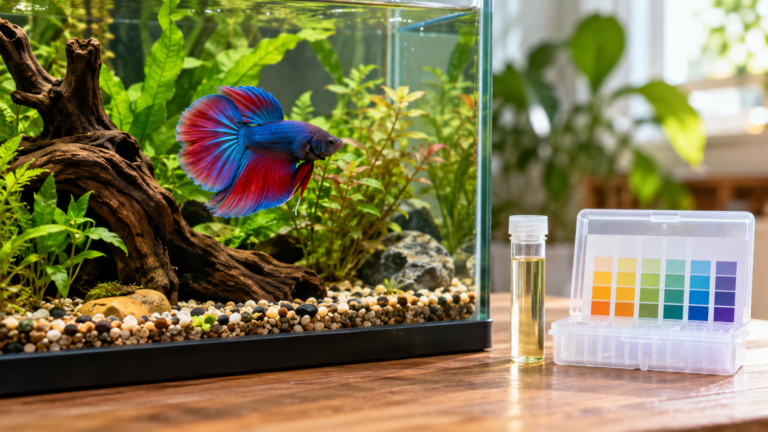
What temperature do betta fish like? Betta fish like warm, steady water. The sources we opened point to a tropical range: the Merck Veterinary Manual says “Tropical fish need water kept near 77°F (25°C),” and a University of Florida extension publication on betta biology says bettas “thrive in warmer water and do not do well in cold water.” A betta does not need a precise number to live well, but it does need a heater or a warm room, a thermometer you can read, and a temperature that stays put from day to day. This guide explains what the sources say, what they leave out, and how to keep a betta tank in that warm, stable range.
Quick answer
- The Merck Veterinary Manual gives a tropical target of about 77°F (25°C) for tropical fish in general.
- A University of Florida (UF/IFAS) publication says bettas do not do well in cold water and should be kept warm.
- The wild betta habitat described in the UF/IFAS publication averaged about 86°F (29.9°C), with a range of 27.0 to 31.5°C.
- Stability matters as much as the number. Use a heater with a thermostat and a separate thermometer, and keep the tank out of direct sunlight.
What the sources say about betta temperature
The UF/IFAS publication FA212, “Evolution, Culture, and Care for Betta splendens,” describes where bettas live in nature. It reports that in Thailand the betta population it studied lived in water with a temperature of “29.9°C (about 86°F on average; range from approximately 27.0 to approximately 31.5°C).” Those are field readings from shallow, warm ponds and rice paddies, so they show the environment the species is adapted to. They are not a home-aquarium setting. Still, they point in one direction: bettas are built for warm water.
The same publication makes the point directly in its care section: “As mentioned, bettas thrive in warmer water and do not do well in cold water.” It also gives a room-level figure for a tank with no heater. If a betta is kept in “an unfiltered, unheated container,” the publication says the air temperature of the room “should be maintained at no less than 22°C (71.6°F).” That is a floor for an unheated room, not a target for the water. A tank in a room at the minimum air temperature would still run cooler than the fish’s native habitat.
The Merck Veterinary Manual gives the broader rule for all aquarium fish. In its special considerations page, the authors write: “Tropical fish need water kept near 77°F (25°C), while species from more temperate areas do better at lower temperatures.” Betta is a tropical species, so the 77°F figure is the closest sourced target for a betta tank. The Merck page on providing a home for fish adds that “maintenance of the water temperature in an appropriate range for the fish species you are keeping is critical to their health.”
Why temperature affects more than comfort
Temperature changes how the water behaves. A UF/IFAS publication on ammonia, FA031, explains that “the portion of un-ionized ammonia increases with increasing pH and/or temperature.” Un-ionized ammonia is the more toxic form for fish. So a warmer tank with a high pH carries more risk from ammonia than a cooler one at the same ammonia reading. This is one reason a betta tank needs regular water checks, not only a heater. A tank that drifts up and down can stress the fish, and a tank that runs hot can make a small ammonia problem worse.
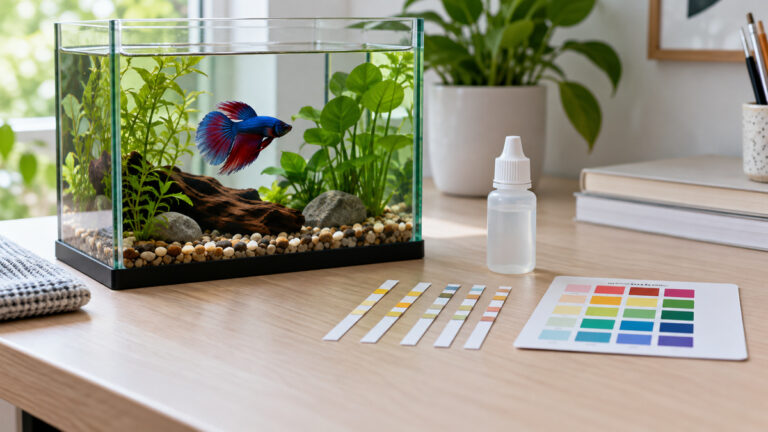
Stability is the goal. As general guidance, sudden swings are the thing to avoid. For a betta owner, the practical meaning is simple: aim for one steady temperature, check it with a thermometer, and avoid big swings from a cold room, a sunny window, or a heater that turns on and off erratically.
Heaters, thermostats and thermometers
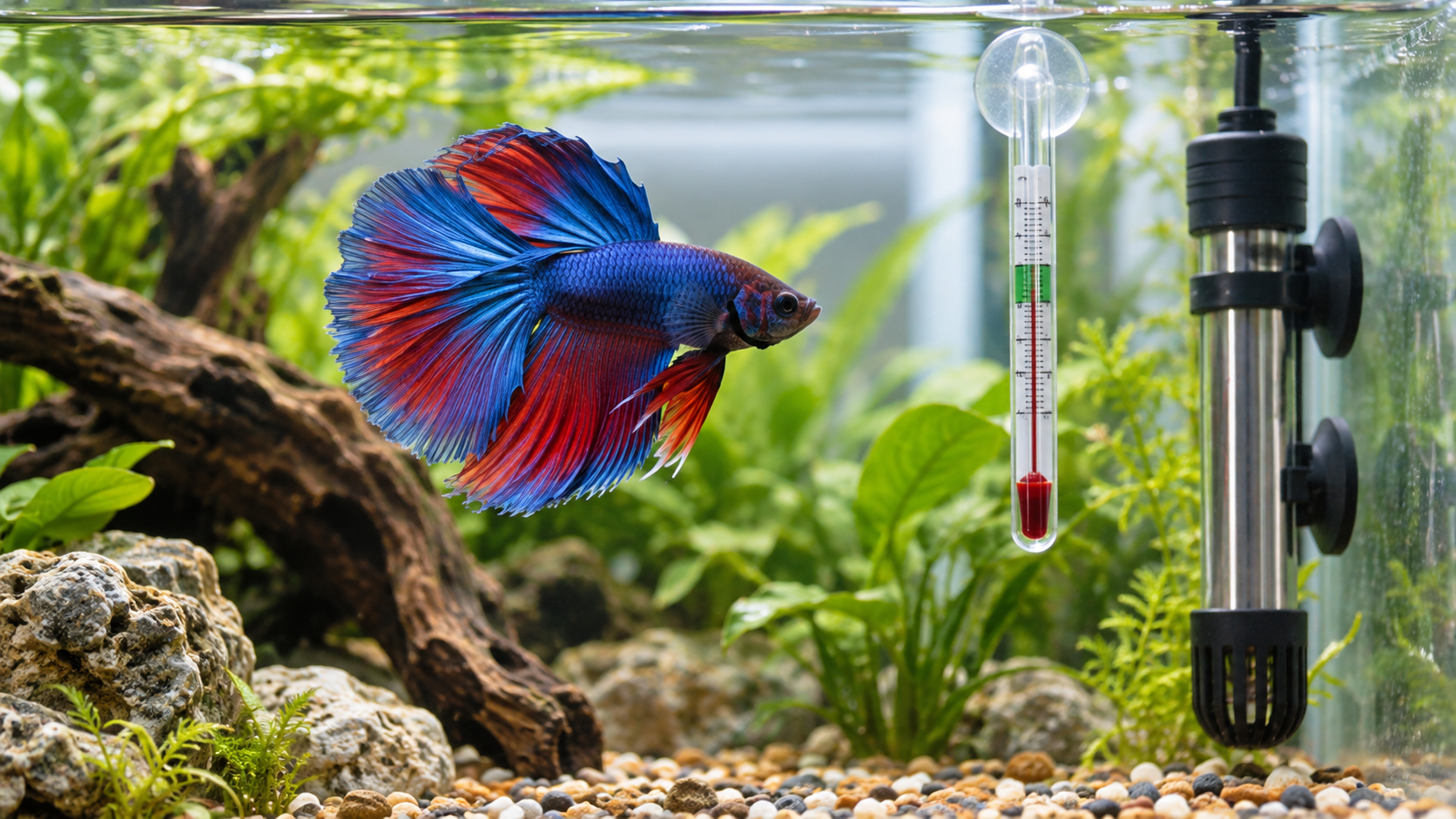
The Merck page on providing a home for fish covers the equipment. It says a heater “will typically have a programmable thermostat that you can set to control the water temperature.” It also advises a second instrument: “You should also have a separate thermometer in the tank to monitor water temperature independently from the heater.” The reason is that a heater’s own dial or light does not prove the water is at the setting. A separate thermometer gives an independent reading.
The same page warns about glass heaters: “Most heaters are in a glass tube that may shatter if not surrounded by water.” So the heater should be fully submerged before it is switched on, and it should be placed where the water can circulate around it. The Merck page also notes that “Direct sunlight can also cause the water temperature in the tank to rise.” A tank near a sunny window can climb past its target on a bright day, so placement matters as much as the heater itself.
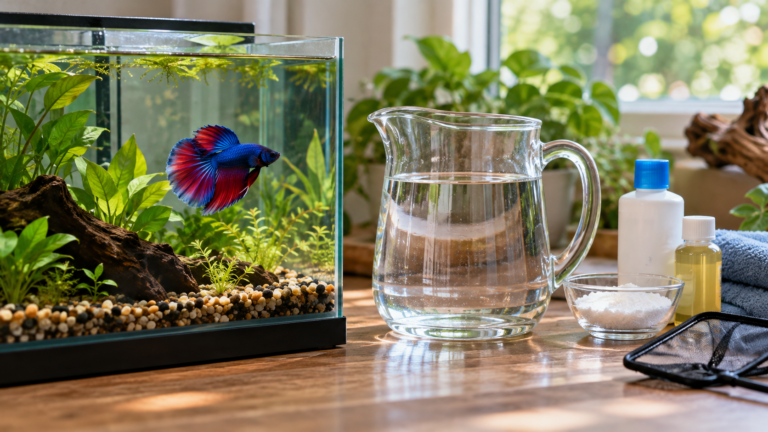
If you are choosing a heater for a betta, the sources support a few plain rules. Use one with a thermostat you can set. Keep a separate thermometer in the tank. Place the tank out of direct sun. For the wattage and size match of a particular heater, check the product label or the manufacturer page, because the sources here do not cover heater models. The heater question is covered in do betta fish need a heater, and the sizing question is covered in how big of a tank do betta fish need.
A practical temperature plan
Start with the sourced target: near 77°F (25°C) for a tropical fish, with the UF/IFAS point that bettas do poorly in cold water. Add a thermostat-controlled heater, a separate thermometer, and a placement away from direct sun and drafts. Check the thermometer at a fixed time each day, and write down any reading that falls outside your target. In a cold room, the UF/IFAS point about cold water is a reason to keep the heater running rather than relying on room air.
Many hobby guides give a wider range, often about 76 to 82°F. The sources we opened do not give that range, so treat it as general guidance. Whichever range you use, keep the tank steady. As general guidance, a small steady deviation is easier on a fish than a large swing. If a betta looks listless, stays at the bottom, or stops eating, check the temperature first, but do not treat that as a diagnosis. The sources say disease and health problems should be handled with help from a fish veterinarian, and that drug or chemical treatments “can do more harm than good if they are used inappropriately.”
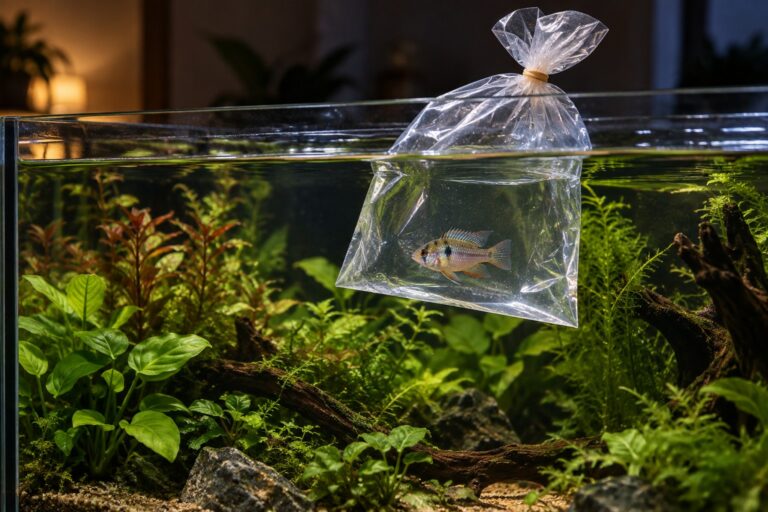
Water changes can also change the temperature. A large cold change can shock a fish. The Merck page on adding new fish recommends floating the bag to equalize temperature, for about 20 to 30 minutes, before release, because adding fish “directly, without a gradual equalization of temperature, can cause shock and stress.” The same logic applies when you add new water to a betta tank: match it to the tank before pouring.
How we chose
We limited this guide to sources that address the question directly and that a reader can open. The primary sources are a University of Florida (UF/IFAS) publication on betta biology and care, and two pages from the Merck Veterinary Manual, a veterinary reference. We did not use retail pages, product listings, or blog posts for any factual claim, and we did not use product prices or ratings. Where a point came from general hobby practice rather than a source, we say so in the text.
What we could not verify
The sources cover the habitat and the general principles of temperature, but they do not give a single betta-specific home-tank target. They also do not cover the temperature behavior of specific heater models, thermostat accuracy, or how much a particular room changes the water. The 76 to 82°F range that many guides quote is not in the sources we opened, so it is labelled as general guidance above.
What the sources do not say
The sources do not give a betta-only aquarium temperature. The Merck figure of 77°F is for tropical fish as a group, and the UF/IFAS figures describe wild habitat. Neither source gives a safe upper limit for a home tank. They also do not say how quickly a betta tolerates a temperature change, or how a betta responds to a temperature that is too high for long periods.
Frequently asked questions
What temperature do betta fish like best?
The sources point to warm water. The Merck Veterinary Manual gives about 77°F (25°C) as a target for tropical fish, and the UF/IFAS publication says bettas do not do well in cold water. Many hobby guides give a wider range, but that range is not in the sources we opened.
Can a betta fish live without a heater?
The UF/IFAS publication says that for an unheated container, the air temperature of the room should be kept “no less than 22°C (71.6°F).” That is a minimum for the room, and it does not guarantee a steady water temperature. The sources do not say a betta can live well without a heater, so a heater with a thermostat is the safer choice.
Is 80 degrees too hot for a betta?
The sources do not give an upper limit for a betta home tank. The wild habitat averaged about 86°F, which suggests bettas handle warm water. The safer reading is to keep the temperature steady and near the sourced target rather than pushing it higher.
Is a separate thermometer needed if the heater has a dial?
Yes. The Merck page says to keep “a separate thermometer in the tank to monitor water temperature independently from the heater.” A dial setting does not confirm the water temperature.
Why does temperature matter for ammonia?
The UF/IFAS ammonia publication, FA031, says the share of un-ionized ammonia “increases with increasing pH and/or temperature,” and that the un-ionized form is the more toxic one for fish. A warmer tank therefore needs more attention to water quality.
Sources
- UF/IFAS EDIS FA212: Evolution, Culture, and Care for Betta splendens (opened 2026-10-24)
- UF/IFAS EDIS FA031: Ammonia in Aquatic Systems (opened 2026-10-24)
- Merck Veterinary Manual: Providing a Home for Fish (opened 2026-10-24)
- Merck Veterinary Manual: Special Considerations for Fish (opened 2026-10-24)