How to Keep Betta Water Warm: Heater Setup for Small Tanks
As an Amazon Associate we earn from qualifying purchases. Details
How to keep betta water warm comes down to three habits: choose a heater sized for your tank, keep it fully underwater, and check the temperature with a separate thermometer. Bettas are native to Mainland Southeast Asia, so a steady tank temperature is a sensible goal for any betta setup. This guide covers the setup steps, the spec lines worth comparing on each listing, and which heaters in this list fit a tank of 5 gallons or more. It also explains why a thermometer belongs in the kit.
Quick answer
To keep betta water warm, pick a submersible heater whose stated range covers your tank, fully submerge it before you plug it in, and set the target with a thermometer you trust. For a 5-gallon tank, a heater rated for 1 to 6 gallons or 5 to 10 gallons can fit, while the 6-to-15-gallon model does not. Choose an external controller if you want to adjust settings without reaching into the water. Unplug the heater before every water change, and allow the cool-down time in the manual before you remove it.
At a glance
Figures below are the ones stated in this post.
| Item | Stated figure | Note |
|---|---|---|
| Tank for one betta | At least 5 gallons | Site recommendation for a single betta |
| Heater rating that fits a 5 gallon tank | 1 to 6 gallons or 5 to 10 gallons | Check the heater’s own range |
| New biofilter build time | Six to eight weeks | Needed before ammonia and nitrite drop |
Match the heater’s rated range to your tank volume.
Why steady temperature and water testing go together
Water temperature changes how ammonia behaves, so it affects more than comfort. According to UF/IFAS, the toxic un-ionized share of ammonia rises as pH and temperature rise. A warmer tank can therefore carry more of the toxic form at the same ammonia reading, which is why temperature and water testing belong in one routine.
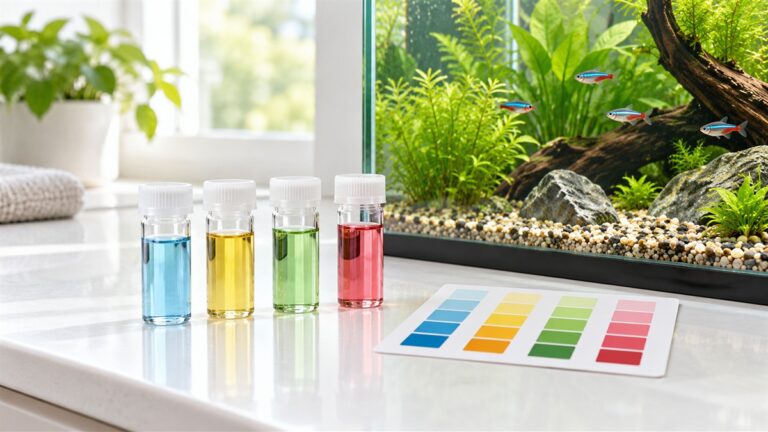
Ammonia is colorless and odorless even at levels that harm fish, so a test is the only way to know whether it is present. A good ammonia test kit includes a TAN test, a pH test and a thermometer, because the toxic share depends on pH and temperature. The thermometer in that kit is the same tool you need for checking your heater. If you are choosing a kit, see the best aquarium water pH test kit guide.
A heater does not clean water. A new biofilter takes six to eight weeks to build enough bacteria to reduce ammonia and nitrite, and nitrite is toxic to fish at levels as low as 0.10 mg/L. Test for both while your heater runs, especially during the first weeks of a new setup.
The UF/IFAS guide suggests testing ammonia once a week in a production system, and immediately any time fish appearance or behavior changes, including reduced feeding. A home tank is a different setting, but a change in your betta’s color, posture or eating is still the signal to test the water and check the heater.
What you need before you start
- A tank of at least 5 gallons. This site recommends at least 5 gallons for a single betta. Tank sizes in listings can describe total capacity rather than the water you fill, so measure the water you add. For sizing background, see is a 5 gallon tank good for a betta.
- A submersible heater whose range covers that tank. Compare the gallon range on the listing with your tank’s water volume.
- A separate thermometer. A heater display is useful, but the listings give accuracy figures such as ±3°F and ±2°F, so a second reading helps.
- A cover, if you have one. One listing says a covered tank heats more efficiently.
Step-by-step: setting up a heater
- Match the heater to the tank. Read the gallon range and compare it with the water you will fill. Pick a model whose range includes your tank.
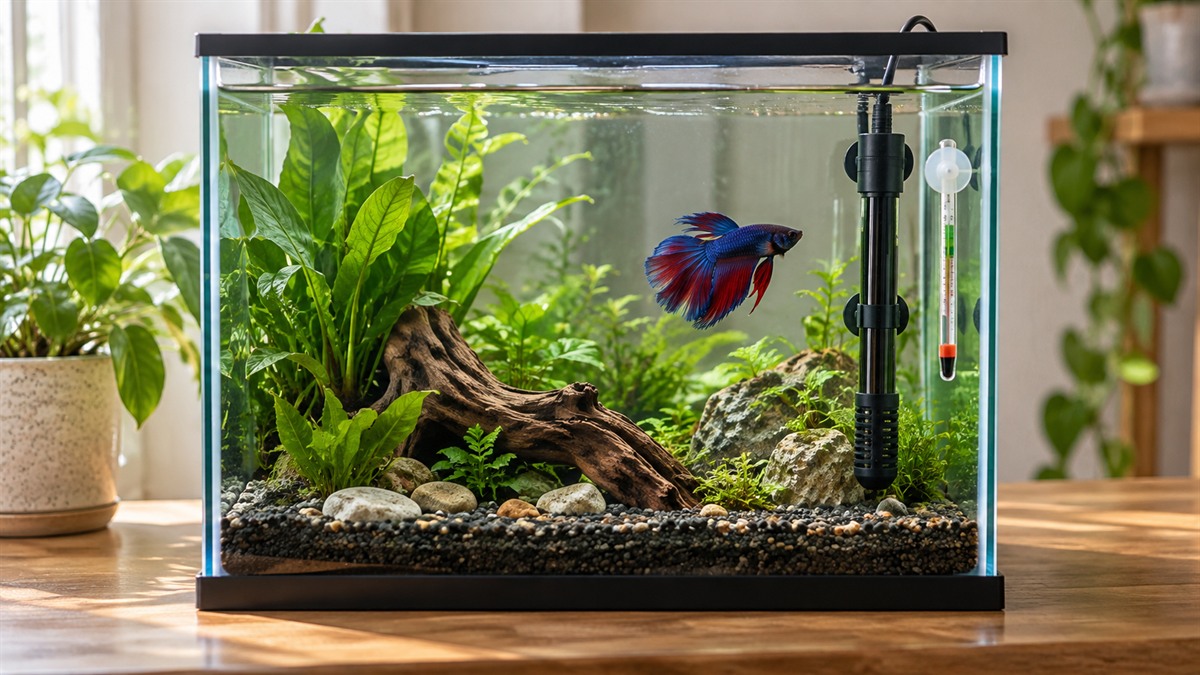
- Fully submerge the heater before you plug it in. The Orlushy listing says to make sure the heater is 100% submerged before plugging in the power.
- Mount it with the suction cups. Several listings describe suction cups that hold the heater on the glass. One listing recommends a water circulation area and says a water pump is recommended.
- Set the target. Some heaters come with a preset, such as the 78℉ preset in several listings. Others have an adjustable knob or a controller. Follow the manual for how to change the target.
- Let it run, then read the thermometer. Watch the indicator light. On one listing a red light shows heating and a green light shows it has stopped. Compare the separate thermometer with the target once the water has had time to settle.
- Unplug before maintenance. Several listings say to unplug the power before a water change. Let the heater cool for the time the manual gives before you take it out. The Orlushy listing gives 10 to 20 minutes.
Placement and power
Keep the power cord clear of splashes and follow the manual for the outlet. Cord length varies by listing. The SEAOURA listing gives a 4.2 FT cord, and the HiTauing listing gives a 47.24 inch cord, so measure the distance from the tank to the outlet before you buy.
Heater wattage varies across this list, from 10W to 50W. None of the listings gives a universal wattage-per-gallon rule, so use the gallon range on each listing rather than working out your own wattage math.
Handling and cleaning
Unplug the heater before you clean the tank or change water, and do not reach in while it is plugged in. The HiTauing listing says not to touch the glass tube with your hands, and to remove the heater and let it cool for 15 minutes first. Dry the outside of the unit before you put it back in the tank, and check that the suction cups still grip the glass.
Reading the thermometer over time
Read the thermometer at the same time of day for a few days. A steady reading near your target shows the setup is holding. A gap between the setting and the reading is normal within the stated accuracy: the Orlushy listing gives ±3℉ and the HITOP 50W listing gives ±2°F. A bigger gap points to placement, sizing or thermometer trouble, so check each one before you change the target.
Reading the numbers on a listing
Heater listings pack several numbers into a few lines, and each one means something different. The gallon range tells you which tank the heater is meant for. A temperature range, such as the 68 to 93 °F span on the HITOP 50W listing, shows the settings you can choose from. It does not describe the temperature your tank will hold. Accuracy figures, such as ±3℉ on the Orlushy listing, show how far the reading can sit from the true temperature.
Wattage tells you how strong the heater is. No listing here offers a rule that converts wattage into gallons, so follow the gallon range on each listing and treat wattage as a secondary figure. When a listing gives a preset, such as 78℉, read it as the manufacturer’s default, not as a target chosen for your fish.
Products that fit this
The cards below show heaters from this list. Each card’s specs and notes come from its listing.
1. UPETTOOLS 50W Mini Aquarium Heater, Digital Fish Tank Heater (Best for 5 to 10 gallons)
Specs from the listing (checked 2026-10-11):
- Size: 50W(5-10Gallon)
- Directions: Half year warranty
- Included Components: Aquarium heater, LED Display
Pros
- The listing says the heater is ideal for 5 to 10 gallon tanks, so a 5-gallon tank sits at the bottom of its range.
- The controller shows the water temperature on a clear two-digit red LED, and the listing says you can set it without getting your hands wet.
- The listing gives a range of 68 to 93 degrees Fahrenheit with a °F or °C display.
Cons
- The listing gives a half-year warranty, the shortest warranty stated among the heaters in this list.
- The title calls it a mini heater while the size is 50W for 5 to 10 gallons, so rely on the gallon range rather than the word mini.
Best for: Tanks of 5 to 10 gallons where you want a digital controller and a clear temperature display.
Skip if: Your tank is under 5 gallons, or you need the one-year warranty that several other heaters here state.
View on Amazon (affiliate link)
2. HITOP 50W Adjustable Aquarium Heater, Submersible Fish Tank Heater Thermostat with Suction Cups (Best for 6 to 15 gallons)
Specs from the listing (checked 2026-10-11):
- Product Dimensions: 7.87 x 0.98 x 0.98 inches
- Item Weight: 8.1 ounces
- Manufacturer: Haisen
Pros
- The listing gives an adjustable range from 68 to 93 °F, so you set the target yourself.
- The listing describes a 2mm thickened quartz glass body that it calls 33% thicker than 1.5mm normal fish tank heaters.
- The package includes three suction cups (two plus one spare) and a sticker thermometer.
Cons
- The listing gives a 6 to 15 gallon range, so a 5-gallon tank falls below it.
- The listing shows no brand, and the manufacturer field reads Haisen.
Best for: Tanks of 6 gallons or more that need an adjustable setting and a sticker thermometer.
Skip if: Your tank is 5 gallons, because the stated range starts at 6.
View on Amazon (affiliate link)
3. Orlushy 25W Small Submersible Aquarium Heater, Constant Temperature Betta Fish Tank Heater (Best preset option)
Specs from the listing (checked 2026-10-11):
- Item Weight: 4.6 ounces
- Item Package Dimensions L x W x H: 5.47 x 3.62 x 1.77 inches
- Item model number: 25W
Pros
- The listing says the preset temperature is 78℉ and the heater starts heating on its own when powered on.
- The listing gives an accuracy of ±3℉ and a 1-year warranty.
- At 4.7 inches long, the listing says it fits easily in a small tank and hides well.
Cons
- The listing mentions no display or external controller, so a separate thermometer is your only check.
- Its listing gives no cord length, so measure the distance from the tank to the outlet before you buy.
Best for: A 5-gallon tank where a fixed 78℉ target is what you want.
Skip if: You want to choose a target other than the preset or read the temperature from a controller.
View on Amazon (affiliate link)
4. SEAOURA Small Aquarium Heater, 25W Fish Turtle Betta Tank Heater, 1-6 Gal (Best with a controller)
Specs from the listing (checked 2026-10-11):
- Size: ≤ 6 Gal Tank
- Item Weight: 7.4 ounces
Pros
- The listing says the 25W heater is suitable for a 5 gallon fish tank.
- The LED external controller shows the heating temperature, and the listing gives a sensor accuracy of ±1°F.
- Overheat protection stops heating and shows HH once the water passes 99℉, according to the listing.
Cons
- The listing says the heating rod must be fully immersed, so placement leaves no room for error.
- The listing gives a 4.2 FT power cord, which sets how far the outlet can sit from the tank.
Best for: A 5-gallon tank for a keeper who wants an external controller with a clear temperature display.
Skip if: Your tank is well above 6 gallons, since the listing's range stops at 6.
View on Amazon (affiliate link)
How to choose by tank size
- Choose a 5-to-10-gallon heater if your tank sits at the bottom of that range, such as 5 gallons. The UPETTOOLS listing names 5 to 10 gallon tanks.
- Choose a 1-to-6-gallon heater if you want a smaller unit for a 5-gallon tank. Several models in this range come preset to 78℉.
- Choose a 6-to-15-gallon heater only when your tank is 6 gallons or larger.
- Choose an external controller if you want to set and read the temperature without reaching into the water. The UPETTOOLS and SEAOURA listings both describe controllers.
- Choose a preset model if the preset suits your plan, and an adjustable one if you want a different target.
For more heater options, see the best aquarium heater for betta fish guide, and for tank sizing see how big of a tank do betta fish need.
Worked example: a 5-gallon tank
You compare Heater A, rated for 1 to 6 gallons, with Heater B, rated for 6 to 15 gallons.
- Heater A: the top of its range is 6 gallons. The gap between that top and your 5 gallons is 6 – 5 = 1 gallon, so your tank sits inside the range.
- Heater B: the bottom of its range is 6 gallons. The gap between your 5 gallons and that bottom is 6 – 5 = 1 gallon, so your tank sits below the range.
Heater A fits this tank, and Heater B does not. Measure your real water volume before you buy, because listed capacity can differ from what you fill.
Common mistakes
- Plugging in before the heater is submerged. The Orlushy listing warns about this directly.
- Choosing a heater for a smaller tank. A 1-to-6-gallon model is a poor fit for a tank above 6 gallons, and a 6-to-15-gallon model does not match a 5-gallon tank.
- Trusting the display alone. The accuracy figures on listings mean the display and the water can differ, so check with the thermometer.
- Skipping the unplug step. Unplug before water changes and before handling the heater.
- Treating the tank size on the box as the water you fill. Listed capacity can describe total volume, so measure the water you add before choosing a range.
- Expecting a heater to fix water quality. Heating does not remove ammonia or nitrite. Keep testing, and remember that a biofilter needs six to eight weeks to establish.
When to call a professional
If your betta shows signs of illness or injury, consult an experienced fish keeper or an aquatic vet. This guide does not give medication or dosing advice, and a heater setting does not treat illness.
FAQ
What temperature should I aim for?
Several heater listings come preset to 78℉, but that is a manufacturer setting, not a care guideline. Pick a target from an aquarium society or university extension page, then confirm it with a thermometer.
Do I need a thermometer if my heater has a display?
Yes. The listings give accuracy figures such as ±3℉ and ±2°F, and a separate thermometer lets you check the water itself.
Can I use a heater in a bowl?
This site does not recommend bowls or tanks under 2.5 gallons as a home for a betta. Heat a tank of at least 5 gallons instead.
Why did my heater stop?
Some listings describe protection that stops heating when the water gets too hot or the level drops too low. The SEAOURA listing, for example, shows HH above 99℉. Unplug the heater, check the water level, and follow the manual before you restart it.
How long should I wait before I trust the reading?
Give the heater time to reach your target, then read the thermometer. Use the indicator light as a guide: on one listing, red means heating and green means stopped.
Does a cover help?
One listing claims a covered tank heats more efficiently. A cover does not replace a heater that matches your tank size.
Can a heater help a sick betta?
No. A heater supports a stable tank but does not treat disease, so questions about symptoms belong with a professional.
How often should I check the heater?
Check the thermometer whenever you change the water, move the tank, or see an alarm from the heater. Between those times, a quick look on a regular schedule keeps the setup on target.
Bottom line
For a 5-gallon tank, choose a heater whose range starts at 5 gallons or lower, submerge it fully before you plug it in, and confirm the temperature with a thermometer. Choose a 6-to-15-gallon model only when your tank is 6 gallons or more. Keep ammonia and nitrite testing on the same schedule as your heater checks, because warmer water changes the toxic share of ammonia.
Sources
- UF/IFAS, Ammonia in Aquatic Systems (FA31): ammonia toxicity rises with pH and temperature, the test kit thermometer, nitrite level and biofilter time
- Siamese fighting fish, Wikipedia: native range in Mainland Southeast Asia
Bài viết liên quan: Best Betta Water Heater for 5-Gallon Tanks, Best Water Conditioners for Betta Tanks, Best Aquarium Rock Decor for Betta and Small Fish Tanks.