How to Tell if Your Betta Fish Is Happy
As an Amazon Associate we earn from qualifying purchases.
How to tell if your betta fish is happy is a question the sources checked for this guide do not answer directly. None of the pages define happiness for a betta or describe a contentment test. What they do describe is stress and illness: changes in swimming, changes in the color or condition of the body and fins, and conditions that push a fish beyond what it can tolerate. A betta that swims normally, eats, and shows no sign of stress is the practical target. This guide sets out those signs and the tank conditions that the sources link to them.
Quick answer
- The sources do not define happiness for bettas, so this guide looks for the absence of stress and illness instead.
- Merck lists “changes in swimming behavior” and “noticeable changes in the color or condition of the body and fins” as general signs of illness.
- UF/IFAS defines stress as “a condition in which an animal is unable to maintain a normal physiologic state.”
- Water flow, light cycles and temperature are the conditions the sources connect with stress, so check them first.
Signs the sources link to illness
The Merck routine health care page gives the broadest list. It says, “Some general signs of illness include changes in swimming behavior and noticeable changes in the color or condition of the body and fins.” That sentence is the closest the sources come to a checklist. A betta whose swimming changes, whose fins look ragged or faded, or whose body condition looks worse than usual has a sign the page treats as worth investigating.
The Merck disorders page gives more specific behavior for one parasitic disorder that affects the gills and skin. It lists “Behavioral signs include lethargy, poor appetite, piping (swimming near the surface, trying to gulp air), flashing (scratching), and overall weakness and loss of condition.” These signs are tied to that disorder in the source, not to a general mood. They are still useful to know, because piping at the surface and scratching are behaviors a keeper can see and report.
The UF/IFAS betta publication, FA212, adds a practical step. It says, “Proper diagnostics will be facilitated by working with a fish veterinarian.” For any sign of illness or injury, the sources point toward a fish veterinarian rather than a home fix. The sources do not give treatment doses, and this guide does not either.
Stress and the tank environment
The UF/IFAS stress publication, FA005, defines the condition. “Stress is a condition in which an animal is unable to maintain a normal physiologic state because of various factors adversely affecting its well-being.” It adds that “Stress is caused by placing a fish in a situation that is beyond its normal level of tolerance.” For a betta, the tank is the main place where that line is crossed or not.
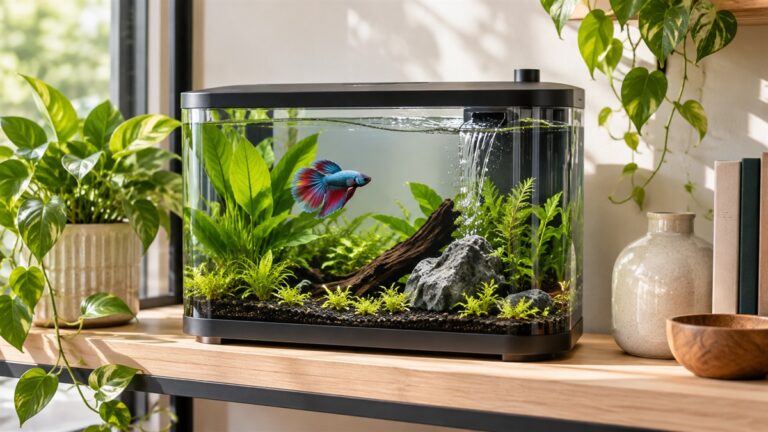
Water flow is one of the clearest conditions the sources name. UF/IFAS states that “Bettas prefer calm water as shown by research using flow as a stressor, so heavy filtration may actually be harmful to a betta’s health and welfare.” A tank with a strong current is therefore a tank a betta may not enjoy, even if the water chemistry is correct. Look for a filter whose flow can be adjusted or that is gentle by design, and check the product listing for that detail.
Light is another condition the sources mention. Merck states that “Leaving the lights on 24 hours a day, 7 days a week stresses fish, leaving them more susceptible to disease.” A regular day and night cycle is a simple way to avoid that stress, although the sources do not give a specific number of light hours for bettas.
Moving a fish is also a stress point. The Merck providing-a-home page warns that “Adding the fish directly, without a gradual equalization of temperature, can cause shock and stress.” A betta that arrives in a bag should be floated in the tank until the temperature matches, as the page describes, before it is released.
Normal betta behavior the sources describe
Some behavior that looks alarming is normal for male bettas, according to the UF/IFAS page. It says that males “will almost immediately display aggressive behaviors—spreading their fins and flaring out their gill covers—when they encounter another male.” A flared male facing another male is showing a species trait, not a happy or unhappy mood. The page explains that early selection favored males for their aggression, so the display is part of the breed’s history.
Bubble nests are another behavior that is easy to misread. The UF/IFAS page describes them as part of spawning, with the male building the nest and tending eggs. It says, “Males will tend to the fertilized eggs and add bubbles to the nest when needed.” A nest is a breeding behavior in the source, so it should not be read as a sign of contentment on its own. The sources do not say that a nest-building betta is happier than one that does not build.
Checks a keeper can make (general guidance)
These steps are general guidance, not findings from the sources. Each one ties back to a sign the sources describe:
- Watch the fish at feeding time. The sources do not describe appetite for healthy bettas, but Merck lists poor appetite among illness signs, so a sudden change is worth noting.
- Compare the fins and color with the fish’s usual look each day. Changes in color or condition of the fins are the sign the Merck routine page names.
- Watch for piping, scratching and lethargy. These are the behaviors Merck lists for the parasitic disorder, and they call for a closer look, not a guess.
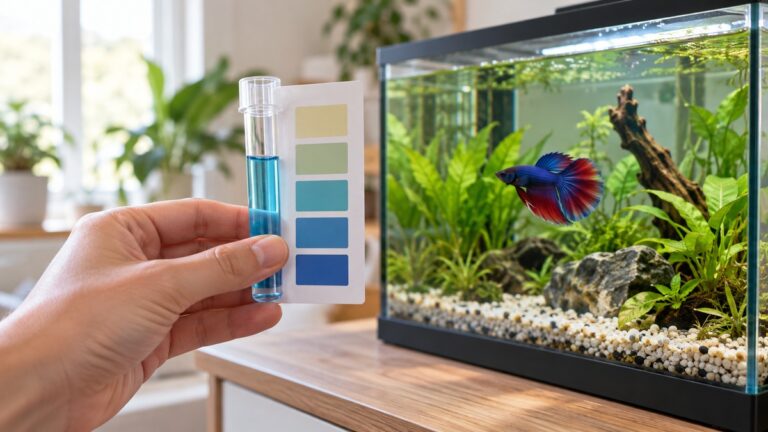
- Check the tank temperature and water quality, since the sources link stress to the environment.
How we chose
The sources checked for this guide are two Merck Veterinary Manual pages on fish health and disorders, one Merck page on providing a home for fish, and two UF/IFAS publications, one on betta biology and care (FA212) and one on stress in fish (FA005). These are veterinary and university sources, and they were chosen because they describe stress and illness in fish. Retail pages were not used. Statements about happiness are limited to what those pages state, and general guidance is labelled as such.
What we could not verify
The sources do not define a happy betta, and they do not offer a scale or survey that measures contentment. They describe illness and stress, which is a different thing. Whether color, appetite or play are reliable signs of a contented fish is outside what these pages say.
What the sources do not say
- The sources do not describe a healthy betta’s normal appetite, color or activity level.
- The sources do not say that a bubble nest shows contentment.
- The sources do not describe enrichment, toys or hiding places as a route to a happier betta.
- The sources do not give light hours or a feeding schedule for bettas.
Frequently asked questions
Does a betta blowing bubbles mean it is happy?
The sources do not say so. The UF/IFAS page links bubbles to the nest a male builds during spawning, and it says males add bubbles “when needed.” A bubble nest is a breeding behavior in that source, not a mood signal.
Why is my betta staying near the top of the tank?
The sources do not explain this for a healthy betta. Merck lists piping, which means swimming near the surface and trying to gulp air, as a behavioral sign tied to a parasitic disorder. Surface behavior with other changes, such as poor appetite or scratching, should be checked by a fish veterinarian. The UF/IFAS page describes air breathing as part of the betta’s natural adaptation, so time near the surface alone is not proof of illness. For tank size and setup, see Is a 5 Gallon Tank Good for a Betta.
Is flaring a sign that a betta is happy?
No. The UF/IFAS page describes flaring as an aggressive display that males use when they meet another male. It is a species behavior, and the sources do not describe it as a happy signal.
Should a betta be seen by a vet if it looks off?
The sources recommend working with a fish veterinarian when there are signs of illness, because diagnosis is more reliable with an expert. Merck and UF/IFAS do not give treatment doses, so this guide does not either.
Does a betta need toys or enrichment to be happy?
The sources checked for this guide do not address enrichment or toys. For a betta’s basic setup and size, see How Big Can a Betta Fish Get, which covers the tank needs that the sources do describe.
Sources
- Merck Veterinary Manual, “Routine Health Care of Fish,” https://www.merckvetmanual.com/all-other-pets/fish/routine-health-care-of-fish (opened 2026-10-24)
- Merck Veterinary Manual, “Disorders and Diseases of Fish,” https://www.merckvetmanual.com/all-other-pets/fish/disorders-and-diseases-of-fish (opened 2026-10-24)
- Merck Veterinary Manual, “Providing a Home for Fish,” https://www.merckvetmanual.com/all-other-pets/fish/providing-a-home-for-fish (opened 2026-10-24)
- Watson, C., et al., “Evolution, Culture, and Care for Betta splendens,” University of Florida IFAS Extension, FA212, https://edis.ifas.ufl.edu/publication/FA212 (opened 2026-10-24)
- Francis-Floyd, R., “Stress – Its Role in Fish Disease,” University of Florida IFAS Extension, FA005, https://edis.ifas.ufl.edu/publication/FA005 (opened 2026-10-24)