Can Betta Fish Live in Tap Water? What the Sources Say
As an Amazon Associate we earn from qualifying purchases.
Can betta fish live in tap water? Usually yes, once the water has been treated. The Merck Veterinary Manual says that most city water is treated with chlorine or chloramine, and both are toxic to fish. Tap water from a well can need different treatment, and its pH varies from place to place. This guide explains what the sources say about tap water for a betta tank, what treatment means in practice, and where the sources stop.
Quick answer
- Tap water can be used for a betta tank when it is treated before the fish goes in.
- Most city water contains chlorine or chloramine, which Merck lists as toxic to fish and to the bacteria that live in an aquarium.
- Treat new water, including water for changes, with a dechlorinator, as the Merck routine care page advises.
- The sources do not give a betta pH or hardness target, so this guide cannot settle the chemistry of your tap water.
Why tap water needs treatment
The Merck fish husbandry page gives the main reason. In its words, “Most city water is treated with chlorine or a combination of chlorine and ammonia (known as chloramine), both of which are toxic to fish and to the necessary bacteria that grow in your aquarium.” That sentence describes two separate problems. The first is direct harm to the fish. The second is the biological filter, the bacteria that help break down fish waste. If untreated water is added during a change, it can harm those bacteria as well as the betta, and the tank can lose the balance it needs to process ammonia.
The source of the water also changes what treatment is needed. Merck says, “Depending on its source (city or well), tap water will probably require treatment in one or several ways.” A home on a well supply may face different water chemistry than a home on city supply. The sources do not list the steps for each case in a betta setting, so a local water report is the place to check what your supplier adds.
How to treat tap water before a betta goes in
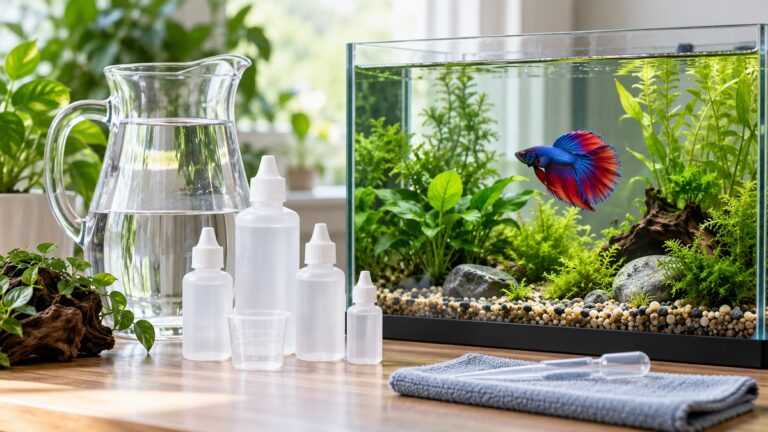
Merck describes the product type that handles this job. “Additives (dechlorinators) are available to remove both chlorine and chloramine from the water and should be used to treat any new water that goes in the aquarium.” The point to notice is that the treatment has to address chloramine as well as chlorine, because the source sentence names both. Read the label of any dechlorinator you buy and confirm that it lists both chlorine and chloramine.
The same rule applies to water changes. The Merck routine care page states, “Any new water should be dechlorinated before it is added to the aquarium or pond.” In general guidance, not from the sources, many keepers treat the water in a separate container before pouring it into the tank, so the water going in is already safe. Dose by the label for your tank volume, and do not guess.
Temperature matters at the same moment. When a new fish arrives, Merck advises a slow match. “Float the bag with the new fish until the water temperature has acclimated and then release the new fish.” It also warns that “Adding the fish directly, without a gradual equalization of temperature, can cause shock and stress.” Treated tap water is only one part of the job. The water going in should be close to the tank’s temperature before the fish is released.
A new tank is the case where this matters most. Water has to be treated, the temperature has to be matched, and the filter needs time to build its bacterial population. The sources checked for this guide do not give a schedule for that process in a betta tank. The steps above are general guidance and should be read alongside the product label and your heater’s instructions.
What the sources say about pH and hardness
The Merck page notes that “pH level (the level of acid) of tap water varies greatly from well to well or city to city.” That means a test result from a neighbor’s house, or from a city report, does not tell you what your tank water will do. The most direct check is a test of the water in the tank itself.
The UF/IFAS publication FA212 gives pH figures, but they describe wild bettas, not tank targets. It reports “pH of 5.47 (range from approximately 5.28 to approximately 5.80)” for one wild population in Thailand. That is a field measurement from a shallow, low-oxygen habitat. It should not be read as the pH a betta needs in a home tank, and the same page does not give a home-tank pH.
Hardness is a separate question. The sources opened for this guide mention pH and temperature, but they do not give a hardness range for betta tanks. If your local water is very hard or very soft, the sources do not say how that affects a betta, so this guide does not make a claim about it.
Filtered water as an option
The Merck page also describes filtered water. “Filtered water has generally been passed through media to remove particulate matter, over activated carbon to remove chlorine and other chemicals and minerals, and possibly through or over another medium that may remove other compounds.” Activated carbon is one route to chlorine removal. The sources do not say whether a home filter also removes chloramine, so check the filter’s stated scope before relying on it. For a comparison of conditioner products, see Stress Coat vs Tap Water Conditioner.
Filtration has a second side for bettas. UF/IFAS states that “Bettas prefer calm water as shown by research using flow as a stressor, so heavy filtration may actually be harmful to a betta’s health and welfare.” A filter that solves the chemistry problem can still create a current the fish does not want, so the choice of filter and the choice of water treatment are separate decisions.
Common mistakes (general guidance)
These points are general guidance, not findings from the sources:
- Pouring straight tap water into the tank during a change without treating it first.
- Using a conditioner that does not list the chemical your water actually contains.
- Assuming a clear-looking tap water sample is free of chlorine or chloramine.
- Adding a new fish straight from the bag without matching the temperature.
How we chose
The sources checked for this guide are two veterinary and university pages that cover tap water treatment and betta husbandry. The Merck Veterinary Manual is a veterinary reference. The UF/IFAS publication is an extension document on betta biology and care. Retail pages were not used. Claims about tap water are limited to what the opened pages state, and any advice beyond those pages is labelled as general guidance.
What we could not verify
The sources do not give a betta-specific pH, hardness, or chlorine level for home tanks. Local water reports, product labels, and dosing rates were outside the sources opened for this draft, so the steps above describe the principle, not a dose.
What the sources do not say
- The sources do not give a tank pH or hardness target for bettas.
- The sources do not state how much dechlorinator to add for a 5-gallon or 10-gallon tank.
- The sources do not say whether boiling or letting water stand removes chloramine.
- The sources do not compare bottled water with treated tap water for bettas.
Frequently asked questions
Is tap water always unsafe for a betta?
No. Merck does not say tap water is always unsafe. It says tap water “will probably require treatment in one or several ways,” depending on its source. Treated tap water is the approach the sources describe, while untreated water is what they warn against.
Can tap water be used for a water change?
Yes, once it has been dechlorinated. The Merck routine care page says that “Any new water should be dechlorinated before it is added to the aquarium or pond.” The sources do not set a fixed schedule for water changes in a betta tank, so this guide does not set one either.
Does boiling tap water remove chlorine?
The sources checked do not address boiling. The method they describe is a dechlorinator that removes both chlorine and chloramine. Boiling is outside the scope of this guide.
Why does the pH of my tap water matter?
Merck says tap water pH “varies greatly from well to well or city to city,” so it can differ from one home to the next. The sources do not give a betta pH target for home tanks. A test of the tank water itself is the most direct way to see what the fish is living in.
Should a betta tank use filtered water instead of tap water?
The Merck page describes filtered water that has passed over activated carbon to remove chlorine. The sources do not say that filtered water is required for bettas, and they do not say which filters remove chloramine. Read the filter’s stated scope before relying on it. For a broader view of tank choices, see Is a 5 Gallon Tank Good for a Betta.
Sources
- Merck Veterinary Manual, “Providing a Home for Fish,” https://www.merckvetmanual.com/all-other-pets/fish/providing-a-home-for-fish (opened 2026-10-24)
- Merck Veterinary Manual, “Routine Health Care of Fish,” https://www.merckvetmanual.com/all-other-pets/fish/routine-health-care-of-fish (opened 2026-10-24)
- Watson, C., et al., “Evolution, Culture, and Care for Betta splendens,” University of Florida IFAS Extension, FA212, https://edis.ifas.ufl.edu/publication/FA212 (opened 2026-10-24)