Aquarium Carbonate Hardness
As an Amazon Associate we earn from qualifying purchases.
Aquarium carbonate hardness, often shortened to KH, is the part of water hardness that relates to carbonate and bicarbonate. It matters because the buffer it provides helps keep pH steady and supports the bacteria that clear ammonia and nitrite from the tank. The UF/IFAS page on ammonia uses the closely related term alkalinity, and it says the bacteria need alkalinity to work. For a betta owner the practical question is whether the tank has enough buffer and how to measure it, which is what this roundup covers.
Quick answer
- Carbonate hardness is a buffer measurement. The UF/IFAS page treats alkalinity, made mostly of bicarbonate and carbonate, as the buffer that nitrifying bacteria use.
- To check it, use a strip or kit whose listing names carbonate hardness, KH, carbonate or total alkalinity. Ten listings in the research pool do.
- The sources give a warning threshold for total alkalinity, not a betta target. They do not give a betta-specific KH range.
- Two KH booster products in the pool were dropped. They change the water rather than measure it, and the sources give no guidance on dosing.
What the sources say about alkalinity
The UF/IFAS publication Ammonia in Aquatic Systems explains that “Alkalinity (primarily bicarbonate and carbonate) is also used by the nitrifying bacteria.” It adds that “Both groups of nitrifying bacteria (AOBs and NOBs) need oxygen and alkalinity to function.” The same page says that “Over time, alkalinity levels in water, particularly in recirculating tank systems, will decrease.”
The page also gives a number. It says that “At a total alkalinity less than 20 milligrams per liter (mg/L), common species of nitrifying bacteria do not function effectively.” It then warns that once alkalinity is depleted, pH can drop quickly. The publication is written for aquaculture and aquaria rather than for betta tanks, so the 20 mg/L figure is a general threshold and not a betta target.
Merck’s fish care pages take a broader view of water quality. They say water quality must be routinely monitored and tested before fish are added, but the page we opened does not name carbonate hardness or alkalinity as a parameter. The UF/IFAS betta publication says that water quality depends on “management and husbandry”, which points to measurement as the way to know what the tank contains.
What KH means in the listings
Several listings use different words for the same idea. Some say “carbonate hardness,” some say “KH,” some say “carbonate,” and others say “total alkalinity” next to a separate “total hardness” or “general hardness” reading. The sources we opened use alkalinity rather than carbonate hardness. This post treats the two terms as close but not identical, and the sources we opened do not give a conversion between them. A reader should compare each listing’s own label and not assume two labels are the same measurement.
Comparison table
The table lists every valid strip or kit in the pool whose listing names carbonate, KH or alkalinity. Each row uses only the specs and bullets of that listing. “Not stated” means the listing gives no pH range in its specs or bullets.
| Listing (ASIN) | Count listed | Carbonate or alkalinity wording in listing | pH range in listing | Other listed detail |
|---|---|---|---|---|
| FUNSWTM 7-in-1 (B08MZDLC15) | 100 | Carbonate and total alkalinity, plus hardness | 6.5 – 8.5 | Test tube and thermometer sticker |
| Veiraln 7-in-1 (B0GS1RXDNL) | 100 | GH hardness and KH carbonate hardness | Not stated | Listing says results in about 30 seconds |
| AKSBTEC 7IN1 (B0FR1PVMND) | 50 | Carbonate (CO3) and hardness (CaCO3) as separate parameters | 6.2 – 8.4 | Listing names PVC plastic as the material |
| AKSBTEC 11-in-1 (B0FH2D375P) | 150 | Total alkalinity and carbonate, plus hardness | 0 – 14 | Temperature strip included |
| Aquatic Eden 9-in-1 (B0D25HZ18B) | 100 | Carbonate hardness and total alkalinity, plus total hardness | 6.2 – 8.4 | Listing says results in 60 seconds |
| WHITE SHARK 9-in-1 (B0G2488PDN) | 100 | Carbonate and alkalinity, plus total hardness | Not stated | Listing says results in 60 seconds |
| DaToo 8+1 (B0CLTKX9M5) | 100 | Carbonate hardness and total alkalinity | Not stated | Extra thermometer included |
| 9IN1WATER 9-in-1 (B0D66F8ZZ8) | 100 | Total hardness and total alkalinity, plus iron, copper, nitrate, nitrite, chlorine | Not stated | Listing covers freshwater and saltwater |
| AAwipes 8-in-1, 250 count (B0F2B4QCH3) | 250 | Carbonate and alkalinity, plus pH | Not stated | Listing says indoor use |
| AAwipes 9-in-1 marine, 25 count (B0FB35C7ZZ) | 25 | Carbonate hardness, described for corals, plus alkalinity | 0.0 – 14.0 | Listing covers freshwater, saltwater and reef tanks |
How the count fits a schedule
The formula is strips listed divided by 52 equals years of weekly testing, assuming one strip per session. For KH, a weekly check fits the water change routine described in the sources. A 50-count pack covers about 0.96 years at that pace, a 100-count pack about 1.92 years, and a 250-count pack about 4.81 years. The 250-count AAwipes pack would last longer than most betta owners keep one tank, so its count is a better fit for a reader who tests across several tanks.
The strip count does not tell you how many separate KH readings a pack gives, because each strip tests several parameters at once. A reader who tests carbonate hardness on its own once a week will use one strip per week, and the formula above reflects that.
The picks
Six listings get full sections. Each section repeats only what the listing says, then gives a best-for and a skip-if line based on those facts. The other four valid listings appear in the table above.
FUNSWTM 7-in-1 Freshwater Test Strips, 100 count
- Listing facts: 100 strips, seven parameters including carbonate, total alkalinity, hardness, pH, nitrate, nitrite and free chlorine, with a listed pH range of 6.5 to 8.5.
- Best for: a reader who wants carbonate and total alkalinity named on the same strip as pH.
- Skip if: you need a pH range wider than 6.5 to 8.5.
- Gap: the listing does not say which of the two alkalinity readings is the KH value.
Veiraln 7-in-1 Fish Tank Water Test Strips, 100 count
- Listing facts: 100 strips, seven parameters including pH, nitrate, nitrite, total and free chlorine, GH hardness and KH carbonate hardness, and a listed use of water quality testing.
- Best for: a reader who wants KH named as KH carbonate hardness in the parameter list.
- Skip if: you need a pH range printed in the listing, because none is stated.
- Gap: the listing gives a result time but no colour chart detail beyond the bottle chart.
AKSBTEC 7IN1 Aquarium Test Strips, 50 count
- Listing facts: 50 strips, seven parameters with carbonate (CO3) and hardness (CaCO3) listed as separate items, and a listed pH range of 6.2 to 8.4.
- Best for: a reader who wants carbonate and hardness reported separately with a stated pH range.
- Skip if: you prefer a fiber-paper strip, because the listing names PVC plastic as the material.
- Gap: the listing covers both freshwater and saltwater, so it is not written for betta tanks alone.
AKSBTEC 11-in-1 Aquarium Test Strips Kit, 150 count
- Listing facts: eleven parameters including total alkalinity, carbonate and hardness, plus ammonia, nitrate, nitrite, pH, copper, iron and temperature, with a temperature strip included.
- Best for: a reader who wants carbonate and alkalinity inside a larger parameter set.
- Skip if: you want a freshwater-only kit, because the listing describes dual use for freshwater and marine tanks.
- Gap: the listed pH range is 0 to 14, so the listing does not give a narrower operating range.
Aquatic Eden 9-in-1 Aquarium Test Strips, 100 count
- Listing facts: 100 strips, nine parameters that include carbonate hardness, total alkalinity and total hardness, a listed pH range of 6.2 to 8.4, and a 60-second result time.
- Best for: a reader who wants carbonate hardness and total alkalinity reported as separate values.
- Skip if: you need an ammonia reading, because the listed parameters do not include ammonia.
- Gap: the listing does not explain how the two alkalinity readings relate to each other.
AAwipes 8-in-1 Aquarium Test Strips, 250 count
- Listing facts: 250 strips, eight parameters including carbonate, alkalinity and pH, fiber paper with non-bleeding colours according to the listing, and an indoor-use note.
- Best for: a reader who tests several tanks and wants a large pack.
- Skip if: you test one betta tank, because the formula above shows a 250-count pack lasts close to five years at a weekly pace.
- Gap: the listing does not state a pH range.
Testing carbonate hardness step by step
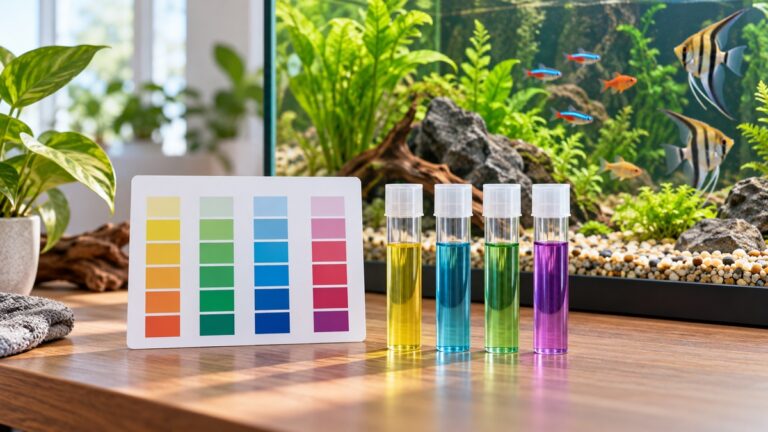
A dip strip gives a colour reading for each parameter on its pad, and the listing decides which pad means what. Start with the usage steps printed on the bottle or in the listing. Several pool listings describe the same basic routine: dip the strip into the sample for a short time, hold it flat, wait for the time the listing gives, and compare each pad with the chart. The Aquatic Eden listing gives a 60-second result time, while the Veiraln listing describes a read of about 30 seconds. Follow the time printed on your own bottle, because a different wait changes the colour you compare.
Take the sample before any other step changes the water. The Merck page says the water quality should be tested before fish are added, which makes the first reading in a new tank a baseline. A second reading during a routine water change shows whether the change moved the buffer. A third reading after a change to the substrate, filter medium or plant load shows whether that change affected the reading.
Record each reading with the date, the pad colour you saw, and the water change that day. UF/IFAS says that alkalinity is used up over time, particularly in recirculating systems. A betta tank is not a recirculating system in the commercial sense, but the same logic applies: a reading that drifts lower over several weeks tells you the buffer is being consumed. The sources do not say how fast that happens in a home tank, so the log is what shows the trend.
Compare the reading with the 20 mg/L figure from the UF/IFAS page only if your strip reports total alkalinity in mg/L. Many strips report results as colour bands rather than numbers, so the comparison may not be possible. The publication’s figure is a general threshold for nitrifying bacteria, not a KH target for a betta, and the sources do not say whether a given strip band matches it.
If the reading is low, the sources point toward a cautious approach rather than a quick fix. UF/IFAS warns that depleted alkalinity can cause pH to drop significantly and quickly, which is dangerous for fish. Merck says different causes of a problem should be checked before treating, and it recommends a fish veterinarian for diagnosis. A low reading is therefore a reason to retest, check the recent water changes and ask for advice, not a reason to change the water chemistry in one step.
Store the strips the way the listings describe. The A QUILA listing advises keeping hands dry, capping the bottle after each use, and storing the strips in a cool, dry place away from humidity. Strips exposed to moisture can read differently from fresh ones, and no source in this post tests how much that matters for KH.
Listings dropped from the pool
Two listings were dropped because they are not test products. The Continuum Aquatics FloraViv KH+ Carbonate Hardness Booster (B01C5L5JX4) and the Brightwell Aquatics Florin Delta KH+ (B00Y01L4AK) are both described as raising alkalinity or carbonate hardness in a tank. They change the water rather than measuring it. The sources we opened give no dosing guidance for any product of this kind, so this roundup does not recommend one. A reader who has a KH reading and wants to change it should ask an experienced fish keeper before dosing a betta tank.
How we chose
We kept listings whose parameter list names carbonate, KH, carbonate hardness or total alkalinity. We then dropped the two boosters because they are not measuring products. From the remaining set we picked six listings that differ in count, format, pH range and parameter coverage, and we left the other four in the table. Each pick gets a best-for and a skip-if line based only on the listing. We did not use prices or customer ratings in this post.
What we could not verify
Several listings give result times and accuracy language. The sources we opened do not test strips, so those claims stand as listing statements. We also could not verify whether any strip reads carbonate hardness and total alkalinity as the same measurement, because the listings do not give a method for converting between them.
What the sources do not say
- The sources we opened do not give a betta-specific KH range.
- They do not say how to convert the alkalinity value on a strip into a KH value.
- They do not give dosing guidance for any alkalinity or KH product.
- They do not say how often a betta tank’s KH should be checked.
FAQ
What is aquarium carbonate hardness?
Carbonate hardness is the part of water hardness linked to carbonate and bicarbonate. The UF/IFAS page uses alkalinity, which it says is primarily bicarbonate and carbonate, and it says nitrifying bacteria use it. For a betta tank, KH is the buffer that helps keep pH from dropping quickly, which is why many keepers test it alongside pH.
Why does carbonate hardness matter for a betta?
The UF/IFAS page says that once alkalinity is depleted, pH can drop significantly and quickly, and that nitrifying bacteria stop working at low alkalinity. Both points come from aquaculture and aquaria rather than betta research, so they explain the mechanism but do not set a betta target.
What KH value should a betta tank have?
The sources we opened do not give a betta-specific KH range. The only number they give is a general warning that total alkalinity below 20 mg/L stops common nitrifying bacteria working effectively. Use the strip’s own colour chart for the reading, and ask an experienced fish keeper if the reading is low.
Are KH boosters a substitute for testing?
No. A booster changes the water, and a test measures it. The sources give no dosing guidance, so a test reading comes first. If you add a product, a second reading after the change is the only way to confirm the result.
Do you need a separate KH test if your strip shows pH?
Not always, but it depends on the listing. Several strips in the table report pH and carbonate hardness together, so one dip can cover both. The sources do not say whether a combined strip reads KH as accurately as a dedicated kit, so the listings are the only evidence available here.
Bottom line
Carbonate hardness is the buffer that keeps a tank’s pH steady and supports the bacteria that clear ammonia. Test it with a strip whose listing names carbonate hardness, KH or alkalinity, record the reading with your pH log, and avoid dosing without a second test. For the other half of the testing picture, the GH and KH test guide compares dedicated kits, and the aquarium pH test kit roundup covers the pH side.
Sources
- UF/IFAS EDIS, “Ammonia in Aquatic Systems” (FA031), opened 2026-10-24: https://edis.ifas.ufl.edu/publication/FA031
- UF/IFAS EDIS, “Evolution, Culture, and Care for Betta splendens” (FA212), opened 2026-10-24: https://edis.ifas.ufl.edu/publication/FA212
- Merck Veterinary Manual, “Providing a Home for Fish”, opened 2026-10-24: https://www.merckvetmanual.com/all-other-pets/fish/providing-a-home-for-fish