Where Betta Fish Come From and Their Natural Habitat
As an Amazon Associate we earn from qualifying purchases.
Betta fish come from Southeast Asia. The wild species, Betta splendens, is native to the northern Malay Peninsula, central and eastern Thailand, Cambodia, and southern Vietnam, according to the U.S. Geological Survey. In the wild it lives in standing water with dense plants, such as shallow ponds, rice paddy fields, and puddles. Where betta fish come from and their natural habitat shapes many of the basic needs of a pet betta: warm water, calm flow, plenty of cover, and water that changes with the seasons.
Quick answer
- Wild bettas are native to Southeast Asia, mainly Thailand, Cambodia, Vietnam, and the Malay Peninsula.
- They live in shallow, standing water with heavy vegetation, not in fast-moving streams.
- Their habitat can have warm temperatures, low dissolved oxygen, and acidic water, and bettas are adapted to those conditions.
- Most pet bettas come from commercial breeding in Southeast Asia, and the wild setting is a useful guide to what a home tank should avoid.
Where wild betta fish live
The UF/IFAS betta publication describes the species as native to Southeast Asia and notes that it is one of a group of fishes called anabantoids, which occur in fresh waters of Africa and southern Asia. In the wild, the betta is typically found in standing waters, including shallow ponds, rice paddy fields, and even puddles. Rice paddies are a notable part of the story. The publication says that the wild betta is dull brown or green, while the bright colors and long fins of pet bettas were developed through selective breeding in captivity.
The USGS Nonindigenous Aquatic Species profile gives the native range in one line: Southeast Asia, including the northern Malay Peninsula, central and eastern Thailand, Cambodia, and southern Vietnam. The UF/IFAS publication adds that Southeast Asia is responsible for the majority of commercial culture of bettas globally.
How the wild water is described
The UF/IFAS publication includes field measurements from one betta population in Thailand. Those numbers describe that habitat only. They are not targets for a home tank. In that population, the average water pH was 5.47, with a range from about 5.28 to about 5.80. The average water temperature was 29.9 °C (about 86 °F), with a range from about 27.0 to about 31.5 °C. The average depth was about 5.0 cm (2 inches), with a range from about 2.0 to about 9.4 cm.
Oxygen was a notable feature. The publication reports that dissolved oxygen was often low, with an average of about 3.8 mg/L, and that it varied widely, from 0.0 to about 7.4 mg/L. The publication links this to typical daily cycles of dissolved oxygen in some tropical environments. Bettas in that study were found at low density, about 1.7 individuals per square meter, and the population had about 1.4 females for each male.
The publication summarizes these habitats as having heavy emergent vegetation, shallow water, low dissolved oxygen, high temperature, and an acidic pH. Those five features are the core of the wild setting.
Why the natural habitat explains betta biology
A betta can live in low-oxygen water partly because of its body. The UF/IFAS publication explains that the group’s evolutionary history led to air-breathing and a robust physiology. That adaptation allowed the betta to occupy shallow, warmer, low-oxygen environments where many other fish could not survive.
Adaptation to low oxygen does not mean a betta does well in any poorly kept water. The publication is clear that water quality is not dependent on the size of the container, but on management and husbandry. The point of the habitat story is that bettas handle some variation, not that they need stagnant water.
Calm water is another habitat feature that matters at home. The publication says bettas prefer calm water, as shown by research that used flow as a stressor. It adds that heavy filtration may actually be harmful to a betta’s health and welfare. The wild habitat the publication describes is standing water, so a strong flow from a filter is one of the clearest places where the natural habitat and a home tank can disagree.
Warmth matters too. The publication says bettas thrive in warmer water and do not do well in cold water. It also gives a case where a container is unfiltered and unheated, and says the room air should then stay at no less than 22 °C (71.6 °F). This site recommends a heated, filtered tank rather than that setup. For how heaters fit into a home setup, read do betta fish need a heater.
Plants and cover in the wild
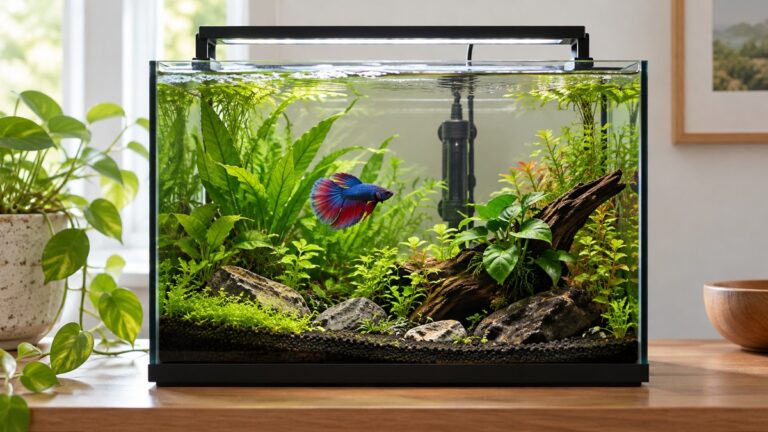
Heavy emergent vegetation is one of the main features of the wild habitat that the UF/IFAS publication describes. A home tank does not have to copy a paddy, but plants give the same kind of structure: cover, places to rest, and a way to break up open water. A betta that has a planted area to hold can be less exposed in a tank. For plant choices, see best live plants for betta fish tank.
How pet bettas came from the wild
The UF/IFAS publication says the modern betta is a product of almost 100 years of selective breeding. Early on, males were selected for aggression because fights between two males were popular in Thailand for gambling. Over time, selective breeding also produced the long fins and bold colors seen in pet stores. The same publication notes that the betta is one of the most popular aquarium species because of its hardiness.
Today most commercial bettas come from Southeast Asian production. The publication says that an estimated 100,000 plus male bettas are shipped each week by air freight, primarily from Thailand. The males are placed into small individual bags with about 90 percent of the volume reserved for air. This is a shipping practice, and the publication’s discussion of small containers is about commerce and breeding. It is not a recommendation for a home tank, and this site does not recommend bowls, vases, or small cubes as a home for a betta.
What happens when bettas leave their native range
Because of the pet trade, bettas have been released or escaped into other areas. The USGS profile lists observations in Florida from 1969 to 1990, and says the Florida records are the result of probable escapes from local ornamental fish farms. The profile also notes that Connecticut records are probably aquarium releases. The USGS page says the impacts of this species are currently unknown, because no studies have determined how it affects ecosystems in the invaded range, and it says more research is required before conclusions can be drawn.
For a home aquarist, the practical point is that the USGS record lists farm escapes and aquarium releases as the probable sources of the non-native observations. Releasing an unwanted betta into local waters is therefore not a safe option, and the profile does not show what such a release would do to local wildlife.
What this means for a home tank
Several features of the natural habitat translate directly into home care:
- Keep the water warm, since bettas thrive in warmer water and do not do well in cold water.
- Choose gentle flow, since bettas prefer calm water and heavy filtration may be harmful.
- Provide plants or other cover, because the wild habitat is heavily vegetated and plants offer the cover the wild setting provides.
- Manage the water with regular changes, since low oxygen is natural for the species but poor husbandry is not, and limited volume calls for frequent water changes.
The wild habitat is a guide for direction, not a set of exact numbers. Its pH and temperature readings come from one population, and a home tank is kept to different standards of management. The sources support the direction of these points more firmly than any exact value.
How we chose
This guide relies on two non-retail sources, both opened on 2026-10-24. The UF/IFAS publication on betta evolution, culture, and care provides the habitat, breeding, and husbandry details. The USGS Nonindigenous Aquatic Species profile provides the native range and the record of non-native observations. Retail product pages and listings were not used for any claim.
What we could not verify
The natural habitat question has useful answers, but several parts of it are beyond what these sources cover. This guide does not fill those gaps.
What the sources do not say
- The exact water targets for a home betta tank. The habitat readings describe one wild population and are not tank recommendations.
- Current wild population trends for Betta splendens in its native range.
- The exact share of wild habitats that remain in each country named in the native range.
- Whether the wild water data apply to every betta strain, since the pet strains were developed through selective breeding.
- Specific tank sizes, pH targets, or temperature ranges that a home betta should have.
Frequently asked questions
Where do wild betta fish live?
Wild bettas live in Southeast Asia. The USGS native range covers the northern Malay Peninsula, central and eastern Thailand, Cambodia, and southern Vietnam. They live in shallow standing waters such as ponds, rice paddies, and puddles.
Are betta fish native to the United States?
No. The USGS profile lists native range in Southeast Asia. The Florida records it describes are non-native observations, which the profile says are probably escapes from ornamental fish farms.
Do wild bettas live in fast-moving water?
The UF/IFAS publication describes wild bettas in standing waters, and says bettas prefer calm water. For that reason a strong current is a poor match for the species’ natural habitat.
What kind of water do wild bettas live in?
The measured population in Thailand had acidic water with a pH near 5.5, warm temperatures near 30 °C, low dissolved oxygen that varied widely, and heavy emergent plants in shallow water. Those readings describe one habitat, not a home tank target.
Why does the natural habitat matter for a home tank?
It explains why bettas do well in warm water, why they prefer gentle flow, and why plants provide useful cover. The habitat also shows why good management matters, since the species’ low oxygen tolerance is an adaptation, not a reason to skip water changes.
Sources
- University of Florida IFAS Extension, “Evolution, Culture, and Care for Betta splendens” (FA212), https://edis.ifas.ufl.edu/publication/FA212, opened 2026-10-24.
- U.S. Geological Survey, Nonindigenous Aquatic Species Database, “Betta splendens Regan, 1910” fact sheet, https://nas.er.usgs.gov/queries/FactSheet.aspx?speciesID=326, opened 2026-10-24.