Best Aquarium Filter Media Bags: 4 Empty Mesh Bags Compared
As an Amazon Associate we earn from qualifying purchases.
Searching for the best aquarium filter media bags? The answer depends on mesh size and on what goes inside. Four of the ten listings we collected are empty mesh bags, and this guide covers only those four. The other six are ceramic rings, bio media or media mixes, and some are already sealed inside bags. The listings do not say how each bag fits a particular filter, how long it lasts, or how it behaves in a betta tank, so the figures below come from the listings and the sources we opened.
Quick answer
- Choose an empty mesh bag if you want to pick your own media. Four listings are empty bags. Six are media itself, sold loose or already sealed in bags.
- Mesh is the main difference. Okxiri and DEPEPE list a mesh of about 1 mm, and LLTGMV and AQUANEAT list about 2 mm. The DEPEPE and LLTGMV listings say their mesh is not suited to finer particles.
- Bag size matters for fit. Okxiri and DEPEPE list the same bag size, about 7.8 by 5.9 inches. LLTGMV lists 6 by 4 inches, and AQUANEAT lists 5.5 by 8 inches.
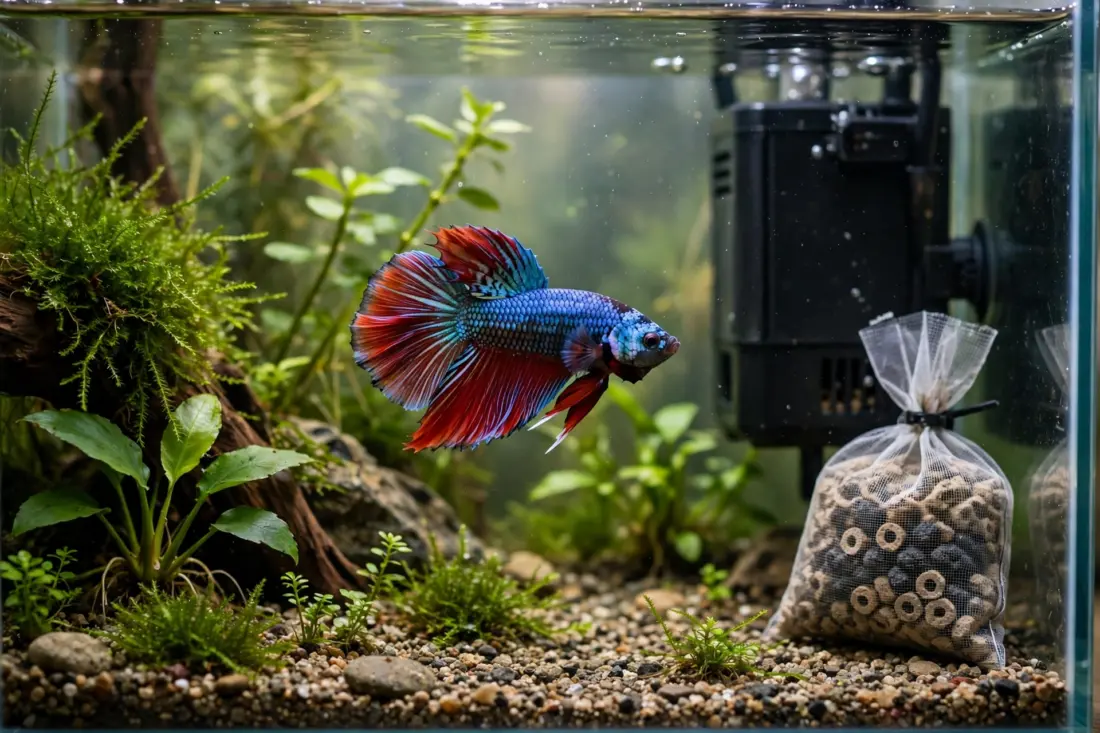
- A bag does not make a filter gentle. UF/IFAS says bettas prefer calm water and that heavy filtration may harm them, so set the filter’s flow first.
What a filter media bag does
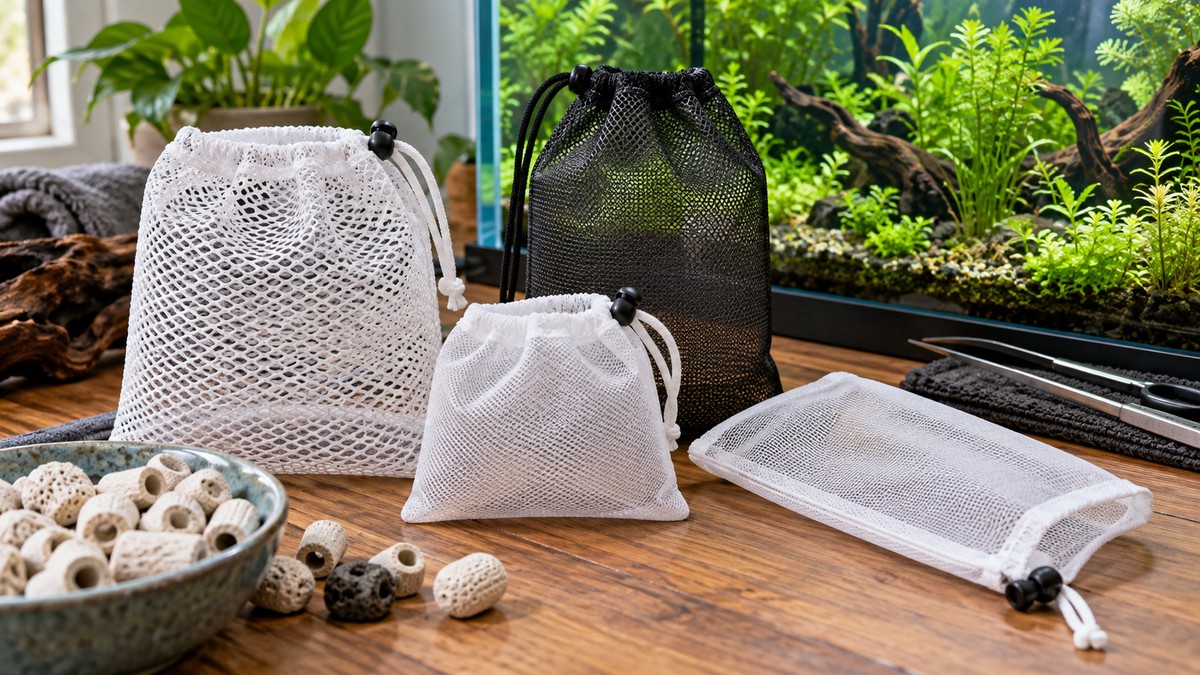
A filter media bag is a mesh pouch with a closure. It holds loose media in one place, so the media stays inside the filter and comes out together when you rinse or replace it. The bag adds no filtration stage of its own. The stages come from the media inside it.
Merck’s veterinary manual describes three basic types of filtration in aquatic life support systems: biologic, mechanical and chemical. Mechanical filters go before biologic ones, because large particles can clog a biofilter and cause channeling and areas without oxygen. Biologic media give nitrifying bacteria surface area to live on, and those bacteria need oxygen and a carbonate source. Activated carbon is a common chemical medium. Merck says it removes toxins and colored compounds, and that it can remove chlorine and chloramine from incoming water.
In practice, the contents of the bag decide its job. Floss or foam is mechanical. A biologic medium, in Merck’s terms, is one that gives nitrifying bacteria surface to live on, and the listings name ceramic rings and bio balls without stating how much surface they offer. Carbon is chemical. Some media do more than one job: Merck says sand and bead filters have both mechanical and biologic functions. If your question is about pads rather than bags, see our guide to fine filter pads for aquarium.
Mesh size decides what the bag holds
Mesh is the grid of openings in the fabric. Two sizes appear in the four listings: about 1 mm for Okxiri and DEPEPE, and about 2 mm for LLTGMV and AQUANEAT. Any piece of media smaller than the opening can pass through it, so the mesh should be smaller than the smallest media you plan to hold. The listings do not give the size of their own media, so check the size of your media before you choose.
Each listing names the media it suits. Okxiri names activated carbon, ceramic rings, bio balls, volcanic rock, coral sand and ceramic media. DEPEPE and LLTGMV name biological rings, activated carbon, volcanic rock, coral sand and ceramic rings. AQUANEAT names bio balls, zeolite, ceramic media, rock and crushed coral. The two 1 mm listings describe the same opening, but they describe small particles differently. Okxiri says its mesh traps small filter media. DEPEPE says its bags are not suitable for finer particles. Treat the two as different until you know the particle size you plan to use.
The four bags compared
The table uses only figures the listings state, plus one calculated column. Where a listing gives no figure, the cell says so.
| Listing (ASIN) | Bags per pack | Bag size (listed) | Mesh (listed) | Material (listed) | Face area per bag (calculated) |
|---|---|---|---|---|---|
| Okxiri (B0FLX5LGM9) | 16 (8 black, 8 white) | 7.8 x 5.9 in | 1 mm | Nylon | 46.02 sq in |
| DEPEPE (B07BLVF3YZ) | 10 (5 white, 5 black) | 5.9 x 7.8 in | About 1 mm | Polyester | 46.02 sq in |
| LLTGMV (B0CR6FG8NB) | 10 (white) | 6 x 4 in in the title and specs; 4 x 6 in in one bullet | About 2 mm | Polyester | 24.00 sq in |
| AQUANEAT (B08X9ZVPM3) | 10 (another field says 1 count) | 5.5 x 8 in | 2 mm | Not stated | 44.00 sq in |
Formula. Face area per bag = width x height, in inches, from the listed size. Pack area = face area per bag x bags per pack. Okxiri gives 46.02 x 16 = 736.32 square inches per pack. DEPEPE gives 46.02 x 10 = 460.20. LLTGMV gives 24.00 x 10 = 240.00. AQUANEAT gives 44.00 x 10 = 440.00.
Two things follow. The Okxiri and DEPEPE bags have about 1.9 times the face area of the LLTGMV bag (46.02 divided by 24.00 is 1.92). Pack area is a rough guide to how much mesh a pack gives you. It says nothing about how many bags your filter needs, because the listings do not give filter sizes. These are flat mesh areas. The listings give no depth, so none of these numbers is a volume, and none tells you how much media a bag holds.
The four picks
Each card uses only what its listing states. We did not rank the four. Each one has a reason, a limit and a “Skip if” line.
1. Okxiri 16-piece filter media bags, 1 mm mesh
Reason. This is the largest pack in the group, with 16 bags in black and white. The listing says the two colors help sort media types, and it names activated carbon, ceramic rings and bio balls as examples. Each bag is listed at 7.8 by 5.9 inches, with a zipper top and nylon mesh.
Limit. The listing says the bags are completely safe for fish and have no metal parts. The sources we opened do not cover bag materials, so treat that as the seller’s claim.
Skip if: you need 2 mm openings for coarse media, because this pack is 1 mm.
2. DEPEPE 10-pack filter media bags, 5 white and 5 black
Reason. The pack has two colors, and its listed size is the same as the Okxiri bag, about 7.8 by 5.9 inches. The bags are polyester with a plastic zipper. The listing names activated carbon, volcanic rock, coral sand, ceramic rings and biological rings as suitable media.
Limit. The listing says the mesh is not suitable for finer particles, so the bags do not suit fine material.
Skip if: your filter needs more than the 10 bags in the pack, or your media is fine.
3. LLTGMV 10-pack reusable mesh bags, white
Reason. This is the smallest bag in the group, at 24.00 square inches of face area. It has about 2 mm mesh, a plastic zipper and polyester fabric. The listing describes the bags as reusable and suited to tank filters and power filters.
Limit. The listing gives the size two ways: 6 by 4 inches in the title and specs, and 4 by 6 inches in one bullet. Check the compartment against both figures before you buy.
Skip if: your compartment needs a bag bigger than about 6 by 4 inches, or your media is fine.
4. AQUANEAT 10-piece mesh bags, 5.5 by 8 inches
Reason. This is the only listing in the group that says it suits both freshwater and saltwater. It has 2 mm holes and a plastic zipper. The listing names bio balls, zeolite, ceramic media, rock and crushed coral as suitable media, and it gives a 30-day warranty.
Limit. The listing gives both 10 items and a unit count of 1, and it does not state the material.
Skip if: you need the material stated, or you need 1 mm mesh for finer media.
Betta tanks: keep the flow gentle
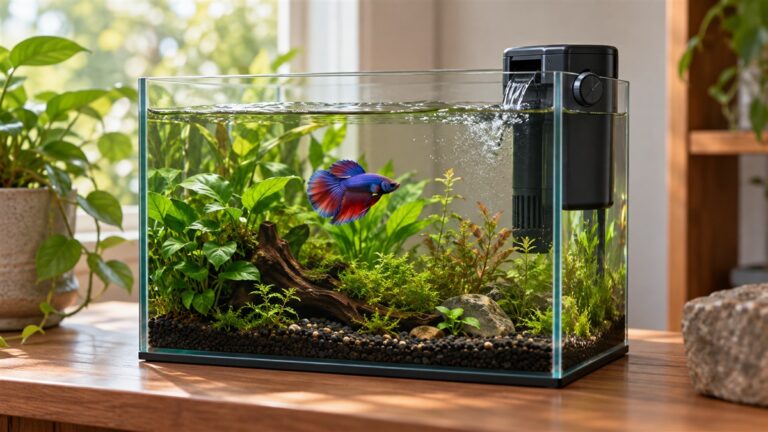
UF/IFAS’s betta publication, FA212, says bettas prefer calm water. It cites research that used flow as a stressor, and it says heavy filtration may harm a betta’s health and welfare. The same publication says that where filtration is reduced, frequent water changes keep uneaten food and ammonia from reaching harmful levels.
A media bag does not set the flow. In a hanging filter, Merck describes a small electric pump that draws water in through the intake and then through a replaceable cartridge, so the pump drives the water and the media sits in its path. Set the flow first, then choose media that fits it. For a gentler starting point, see our guide to the low-flow filter for betta, and for a wider range of filter types, the best water filter for betta fish guide.
None of the four listings states a flow rate for its bag. The sources we opened do not describe a sign that tells you a filter is too strong. After any change to media, watch how the fish moves around the tank. That is a general check, not a rule from those sources.
What the listings say goes in the bag
The listings name several kinds of media. Only some of them have a role that the sources we opened describe.
- Activated carbon. Merck describes it as a chemical medium that removes toxins and colored compounds, and as a way to remove chlorine and chloramine from incoming water. The sources we opened give no replacement schedule.
- Ceramic rings and bio balls. Merck’s sense of a biologic medium is one that gives nitrifying bacteria surface to grow on. None of the four bags lists the surface area of the media it holds, so the listings do not show how much surface a bag offers.
- Floss or foam. Merck calls these mechanical media, because they catch particles as water passes through.
- Volcanic rock, coral sand, zeolite and crushed coral. The listings name these. The sources we opened do not say what they do in a betta tank, so this guide makes no claim about them.
Decide the media first, then choose the bag by its mesh and size.
Cleaning and replacing the bag
Merck includes filter medium changes in routine water changes and cleanings. It also says dust can prematurely clog filters and damage water pumps, and it advises rinsing gravel thoroughly before it goes into a tank for that reason.
On rinsing, Merck says most city water is treated with chlorine, or with chlorine and chloramine. It says both are toxic to fish and to the bacteria that grow in an aquarium, and that dechlorinators remove both. Merck’s advice is to treat tap water with a dechlorinator that handles chloramine before it goes into the aquarium. The sources we opened do not give a method for rinsing a media bag, and they do not say whether tank water is better than treated tap water for that job. Follow the filter maker’s instructions.
The Okxiri, LLTGMV and AQUANEAT listings describe their bags as reusable, and the AQUANEAT listing says they are washable. The DEPEPE listing does not say. Replace a bag when the mesh tears or the zipper stops closing. None of the listings gives a lifespan.
Buying checklist
- Name the smallest media you plan to use, and pick a mesh smaller than it. The four listings offer only 1 mm or 2 mm.
- Measure your filter’s compartment, then compare it with the listed bag size. The listings do not give filter dimensions, so this step is yours to do.
- Check the material if it matters to you: nylon for Okxiri, polyester for DEPEPE and LLTGMV, and not stated for AQUANEAT.
- Check the water type. Only AQUANEAT lists both freshwater and saltwater use.
- Count the bags you need. The packs in this group hold 10 or 16 bags.
- Set the filter’s flow before you add media, using the betta note above.
If you are still choosing the filter itself, our guide to aquarium filters by tank size sets out the ranges, and the 10-gallon betta filter guide covers the options for that size.
Mistakes to avoid
- Buying a pre-filled bag when you want to choose the media. Six of the ten listings are media itself, and some of those come sealed in mesh bags.
- Assuming a bag suits fine material. The DEPEPE and LLTGMV listings both say their mesh is not suitable for finer particles.
- Expecting a bag to make a strong filter gentle. A bag does not set the flow, and UF/IFAS warns that heavy filtration may harm bettas.
- Treating the bag as a replacement for water changes. Merck and UF/IFAS both say water changes remain part of routine care.
- Rinsing media in untreated tap water. Merck says chlorine and chloramine are toxic to the bacteria in an aquarium.
How we chose
We began with the ten listings found for this keyword. The product details are dated October 21, 2026. Our first rule was whether a product is an empty mesh bag for holding media. Four passed. Six were dropped:
- B0D4DCJW9W (Sukh): ceramic rings and bio filter media. The title mentions 3 bags, but the listing does not say they are empty.
- B0C5HD5FFT (Timgle): three sets of mixed media, each with a mesh bag.
- B07233FQ9P (AQUANEAT): ceramic rings sold inside six mesh bags.
- B0FMJ1FM4P (FKSC): a 12-type bio media mix.
- B08VHKKWC5 (JIH): ceramic rings sold inside four mesh bags.
- B0FYWS8KVR (Sukh): ceramic bio media sold with two pre-filled mesh bags.
For the four that passed, we looked for four stated items: a count, a bag size, a mesh opening and a closure. All four listings state each of them. We then calculated the face area and pack area shown above. We did not rank the four. Listing figures can change, so check the live listing for current details before you buy.
What we could not verify
- Fit. None of the listings gives the dimensions of a filter compartment, so whether a bag fits your filter is not stated.
- Lifespan. The listings describe the bags as reusable or washable, but give no lifespan. The sources we opened give no replacement schedule for bags.
- Material safety. The Okxiri listing says its bags are completely safe for fish and free of metal parts. The sources we opened do not cover bag materials, so that remains the seller’s claim.
- Flow. No listing gives a flow rate for its bag.
- Water type. Only AQUANEAT says it suits saltwater. DEPEPE and LLTGMV list freshwater use, and Okxiri does not state a water type.
- Media effects. The sources we opened do not say what zeolite, coral sand, volcanic rock or crushed coral do in a betta tank.
- Rinsing. The sources we opened do not say whether tank water or treated tap water is the better rinse for the contents of a bag.
- Listing conflicts. LLTGMV gives its size as 6 by 4 inches in one place and 4 by 6 inches in another. AQUANEAT gives 10 items and also a unit count of 1. Okxiri lists “Food Allergies” as a use, which does not describe a filter product, so we did not rely on that field.
Frequently asked questions
Do I need a filter media bag?
Not always. A bag is for loose media, such as rings or balls. Merck notes that many hanging filters already have a medium to hold the nitrifying bacteria, so check what your filter contains before you add media to it.
Should I choose 1 mm or 2 mm mesh?
Choose by the smallest media you plan to hold. Okxiri and DEPEPE are the 1 mm listings, and LLTGMV and AQUANEAT are the 2 mm listings. The DEPEPE and LLTGMV listings say their mesh is not suitable for finer particles, so check your media size first.
Can a media bag clean the water by itself?
No. Merck describes three basic types of filtration, biologic, mechanical and chemical, and routine water changes remain part of care. UF/IFAS says that where filtration is reduced, frequent water changes are needed so that waste does not reach harmful levels.
Are these bags safe for a betta?
The Okxiri listing says its bags are completely safe for fish. The other listings do not make that claim in those words, and the sources we opened do not cover bag materials. For a betta, the more important check is flow. UF/IFAS says bettas prefer calm water, so set the filter gently before you add any media.
How should I rinse the media in the bag?
Merck says chlorine and chloramine in most city water are toxic to fish and to the bacteria in an aquarium, and that dechlorinators remove both. The sources we opened do not give a rinsing method for a bag, so follow the filter maker’s instructions.
Bottom line
Buy an empty mesh bag, match its mesh to the smallest media you plan to hold, and set the filter’s flow before you add anything. Of the four empty bags, the listings do not state enough to say which one fits your filter, so check your compartment size first.
Sources
- UF/IFAS, FA212: Evolution, Culture, and Care for Betta splendens. Page footer dated 2024. Opened 2026-10-21. Used for the calm-water and heavy-filtration statements and the water-change advice.
- Merck Veterinary Manual, Aquatic Life Support System Components. Full review May 2023, last updated September 2024. Opened 2026-10-21. Used for the filtration stages, surface area and carbon statements.
- Merck Veterinary Manual, Providing a Home for Fish. Full review February 2020, last updated April 2026. Opened 2026-10-21. Used for the hanging-filter cartridge, medium changes, dust, and chlorine and chloramine statements.
This post contains Amazon affiliate links. Purchases made through them may earn us a commission.