How to Keep the Water Clear in a Betta Fish Tank
As an Amazon Associate we earn from qualifying purchases.
The short answer on how to keep the water clear in fish tank care is to control what makes the water dirty: uneaten food, debris on the bottom, and ammonia that builds up when waste is not broken down. The University of Florida IFAS extension states that overfeeding is a major cause of high ammonia, and that debris on the bottom of a tank is an excellent medium for microbes. For a betta, that means smaller meals, regular debris removal, calm filtration, and steady water changes checked with a test kit.
Quick answer
- Feed only what the betta finishes, because uneaten food adds to ammonia and debris (UF/IFAS FA031 and FA212).
- Remove debris from the bottom during each water change, since organic debris supports microbes (UF/IFAS FA005).
- Choose calm, adjustable flow. The UF/IFAS betta publication says heavy filtration may be harmful to bettas (FA212).
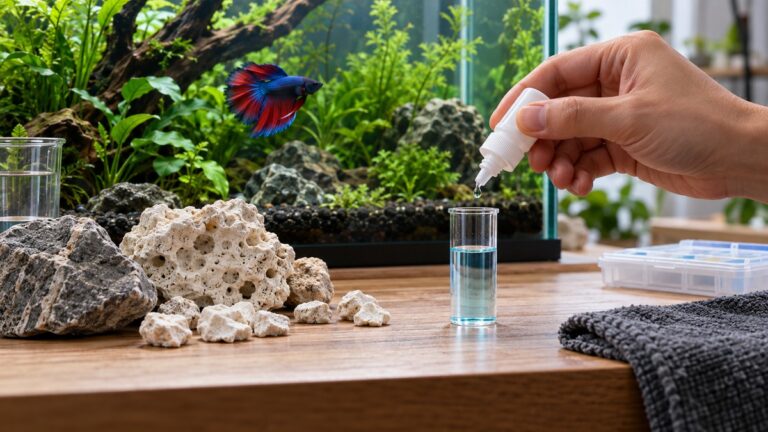
- Test ammonia rather than judging by eye, because ammonia is colorless and odorless at levels toxic to fish (FA031).
Clear water is not the same as safe water. A tank can look clear while ammonia is still building up. The steps below follow the University of Florida IFAS publications listed at the end of this page, and each one says where the sources stop.
Start with feeding
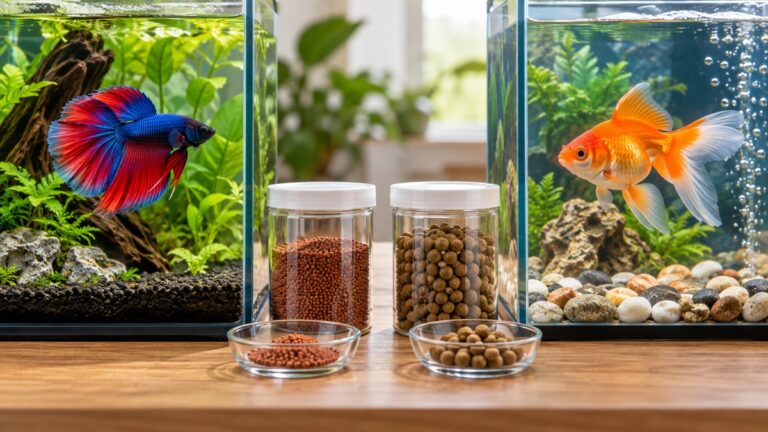
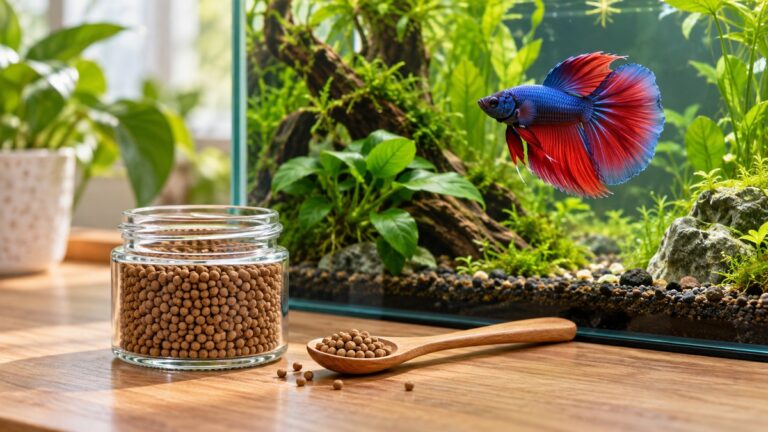
Food is the input you control most directly. The UF/IFAS betta publication discusses feeding regimens and says they should avoid “overfeeding and water fouling.” The ammonia publication explains the mechanism: “The more feed a fish is fed, the more ammonia the fish will produce.” Pellets or flakes that are not eaten sink, break down, and add to the waste the filter has to process. The same publication notes that fish may not eat during ammonia stress, and that uneaten feed will only make the situation worse.
The sources do not give a feeding amount or a number of feedings per day for a betta. As general guidance, feed a portion the fish finishes within a short time, and remove any food still on the bottom. If food regularly remains after feeding, the portion is probably larger than the fish needs.
Remove debris from the bottom
The UF/IFAS circular on stress and fish disease says: “Organic debris that accumulates on the bottom of tanks or vats is an excellent medium for reproduction of fungal, bacterial, and protozoal agents.” It adds: “Prompt removal of this material from the environment will help decrease the number of agents the fish is exposed to.” The circular describes routine removal of debris as part of sanitation, and it states: “The key to prevention of stress is GOOD MANAGEMENT.” That management is defined there as good water quality, good nutrition and sanitation.
In practice, that means removing visible waste during each water change, with a siphon or a gravel vacuum. A guide on how to gravel vac sand covers the technique, although the UF/IFAS sources do not describe siphoning themselves. Take care around plants and decor so the bottom is cleaned without tearing roots or knocking over hiding spots.
Use gentle filtration and a biofilter
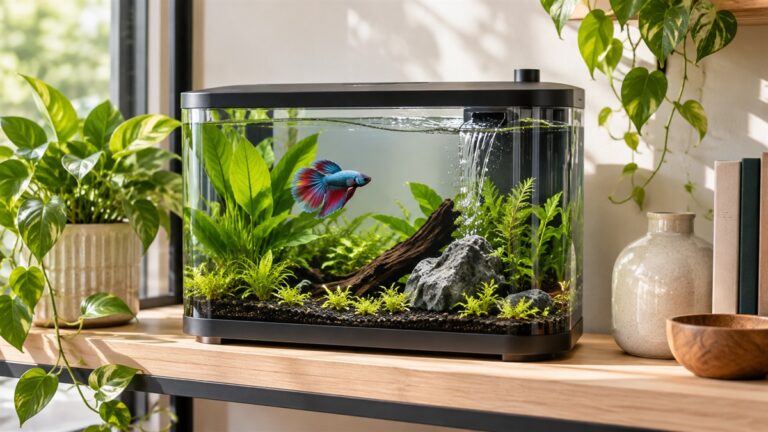
A filter removes particles, but the UF/IFAS betta publication warns about flow. It says: “Bettas prefer calm water as shown by research using flow as a stressor, so heavy filtration may actually be harmful to a betta’s health and welfare.” A filter that pushes strong current across the tank works against the fish, even if it moves a lot of water. Before buying, check whether the flow is adjustable. The guide to low-flow filters for betta tanks covers that choice in more detail.
The filter also matters for ammonia. The ammonia publication explains that a biological filter gives nitrifying bacteria a place to colonize, and that “A new biofilter requires six to eight weeks to build up sufficient bacteria to effectively reduce ammonia and nitrite levels.” A new tank, or a tank whose filter has just been replaced, therefore may not handle waste well for several weeks, even when the water looks clear. The same publication notes that the nitrifying bacteria need oxygen and alkalinity to work.
Water changes and testing
The ammonia publication says: “Because it is colorless and odorless at levels toxic to fish, the only way to know if it is present is to test for it.” It also says low levels of ammonia over time make fish more susceptible to bacterial infections, and that higher concentrations can kill fish. Clear water therefore does not prove the water is safe. A basic ammonia test helps; this site has a guide to ammonia test kits for aquariums.
The UF/IFAS betta publication says that frequent water changes keep “uneaten feed as well as ammonia and other dissolved wastes” from reaching harmful levels. The ammonia publication gives a specific example for tanks: “A 25% to 50% water change will help remove some ammonia, assuming the incoming water source does not contain ammonia.” It also says this approach is only feasible in tanks or very small ponds. The sources do not set a fixed water change interval for betta tanks, so the schedule depends on feeding, tank size and filtration. Treat any tap water with a conditioner according to its label before it goes into the tank; the sources opened for this article do not discuss conditioners.
Dissolved oxygen also matters. The UF/IFAS circular recommends “maintaining dissolved oxygen levels of at least 5 mg/L” for cultured fish. That is a figure from a fish production context, not a betta-specific target, and it is listed here because low oxygen limits the nitrifying bacteria.
How we chose
The sources were chosen because they are university extension publications that cover betta husbandry, ammonia, or stress and sanitation in fish. Retail product pages were not used, and no product prices, ratings or reviews are part of this guide. Each source was opened on 2026-10-24 with curl and returned HTTP 200. The quotations above were checked against the text of those pages before use. Where a source did not cover a point, this article says so instead of filling the gap.
What we could not verify
The sources opened for this article do not give a feeding amount, a debris removal schedule, or a water change interval for a 5 or 10 gallon betta tank. They do not name a clearing product, and they do not discuss how long a tank takes to clear after a change. The UF/IFAS betta publication also describes small containers and bowls as common housing for betta males. This site does not recommend bowls, and that description should not be read as an endorsement of them.
What the sources do not say
The sources do not explain every cause of a milky or hazy tank, and they do not name the particles or organisms behind a specific cloudy bloom. They do not describe fish illness signs in a betta. If a fish looks unwell, or if ammonia results are high and do not come down after a water change, consult an experienced fish keeper or an aquatic veterinarian rather than adding products to the tank.
Frequently asked questions
Does clear water mean the tank is healthy?
Not necessarily. The ammonia publication says ammonia is colorless and odorless at levels toxic to fish, so the only way to know whether it is present is to test. Use a test kit alongside visual checks.
How often should I change the water in a betta tank?
The sources do not give one fixed interval for betta tanks. The UF/IFAS betta publication says frequent water changes keep uneaten feed and dissolved wastes from reaching harmful levels, so the right interval depends on how much the fish is fed, the tank size and the filtration. Test ammonia to check whether the schedule is working.
Can a filter be too strong for a betta?
The UF/IFAS betta publication says bettas prefer calm water and that heavy filtration may be harmful to their health and welfare. Choose a filter with adjustable or gentle flow, and watch whether the fish is pushed around or avoids the current.
Should I feed more so the fish eats the debris?
No. The ammonia publication says overfeeding is a major cause of high ammonia concentrations, and that the more a fish is fed, the more ammonia it produces. Extra food adds to the waste that the tank has to process.
Will a clarifier fix cloudy water?
The sources opened for this article do not discuss clarifiers, so this article does not recommend or reject them. Test the water first, remove the likely sources of waste, and check the ammonia result before adding anything. If fish are unwell, consult an aquatic veterinarian.
Sources
- University of Florida IFAS Extension, FA212: Evolution, Culture, and Care for Betta splendens, https://edis.ifas.ufl.edu/publication/FA212 (opened 2026-10-24)
- University of Florida IFAS Extension, FA031: Ammonia in Aquatic Systems, https://edis.ifas.ufl.edu/publication/FA031 (opened 2026-10-24)
- University of Florida IFAS Extension, Circular 919/FA005: Stress, Its Role in Fish Disease, https://edis.ifas.ufl.edu/publication/FA005 (opened 2026-10-24)