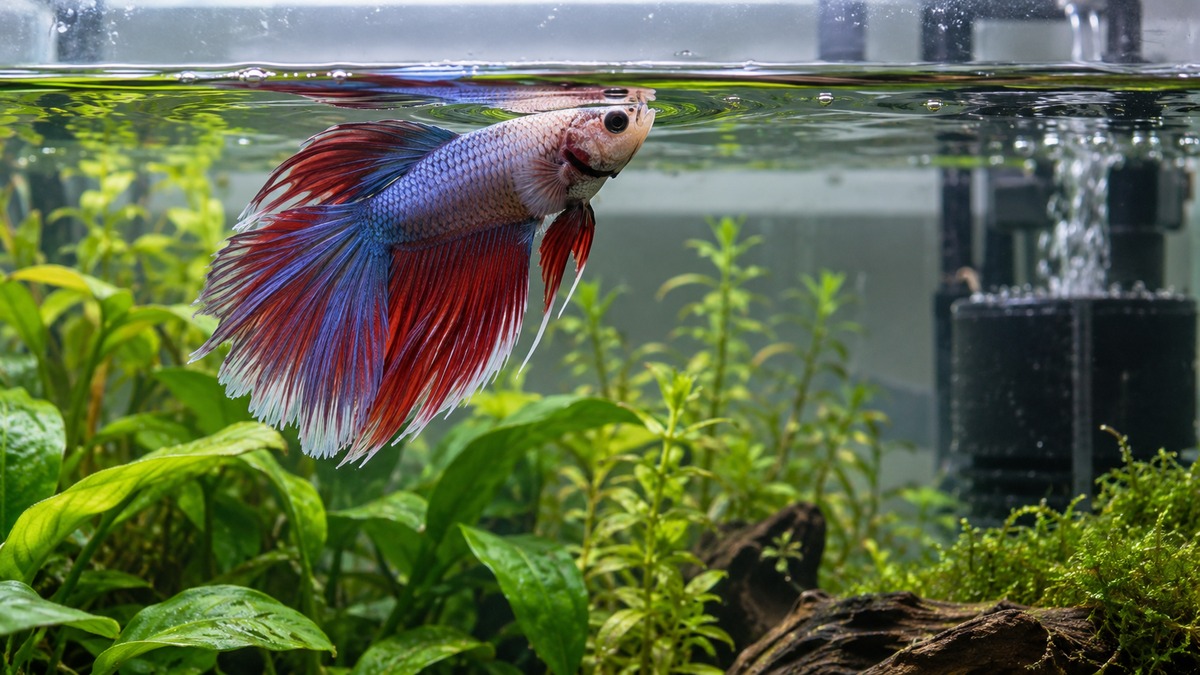
Why Does My Betta Keep Floating to the Top?
As an Amazon Associate we earn from qualifying purchases.
The person typing “why does my betta fish keep floating to the top” wants to know whether a betta that spends its time near the surface is normal or sick. The sources opened for this guide give part of the answer. The UF/IFAS betta publication says that many labyrinth fishes must breathe at the surface, so some time near the top has a biological basis. The Merck Veterinary Manual lists floating, drifting, or swimming erratically in unusual positions as a sign of illness, and it describes gas bubble disease as a condition that can stop a fish from swimming normally. The sources do not say how much surface time is normal.
Quick answer
- UF/IFAS says many labyrinth fishes are obligate air breathers, which means they must breathe at the surface to survive.
- Merck lists floating, drifting or swimming erratically in unusual positions as a sign of illness in fish.
- Merck describes gas bubble disease, which can leave a fish unable to swim normally, and links it to water that carries too much dissolved gas.
- The sources do not give a normal amount of surface time for a betta, so a change in behavior is the signal to check the fish and the water.
What the betta biology says about the surface
The UF/IFAS publication, “Evolution, Culture, and Care for Betta splendens,” explains that bettas belong to a group of fishes that do not rely mainly on the gills for breathing. It says that many labyrinth fishes are obligate air breathers, meaning they must breathe at the surface to survive. The labyrinth organ, a structure above the gills, allows these fish to take in air. That is why a betta will rise to the top, and why a betta that cannot reach the surface is in trouble.
The same publication describes the wild habitat of the betta as shallow, warm, standing water with low dissolved oxygen. It is a useful reminder that surface breathing is part of how the species copes with low oxygen. It does not say how often a betta in a home aquarium should rise to breathe, and it does not describe a normal resting position. A betta that rises for air and then returns to its usual spot is not the same case as a betta that stays at the top, looks weak or cannot hold its position.
Gas bubble disease and buoyancy
The Merck disorders chapter describes gas bubble disease as a condition caused by water that carries too much dissolved gas. It says that water that is very cold or that has been under pressure can become supersaturated with dissolved gases. When the temperature rises or the pressure drops suddenly, the gas can come out of solution in the fish’s body. The chapter notes that this can produce small bubbles that cause a great deal of tissue damage.
The effect on swimming is the part that matters for a floating betta. The chapter says that affected fish cannot swim normally because the gas-filled lesions affect their floating ability. Other signs of gas bubble disease include tiny bubbles in the fins or gills, and the chapter also mentions tiny gas bubbles in the cornea as a possible sign. The chapter gives pond examples: gas bubble disease in pond fish can come from filling a pond with well water through a submerged hose, and it has been linked to faulty pumps. The sources do not say that gas bubble disease is common in betta tanks, and they do not give a level of dissolved gas that is safe or unsafe for a betta.
The practical lesson is limited. Look at the fish for bubbles in the fins, gills or eyes, and check whether the water is very cold or has recently been changed in a way that could shift gas levels. If the fish has bubbles or cannot swim normally, see an aquatic veterinarian. The sources do not describe a home fix.
Other signs of illness
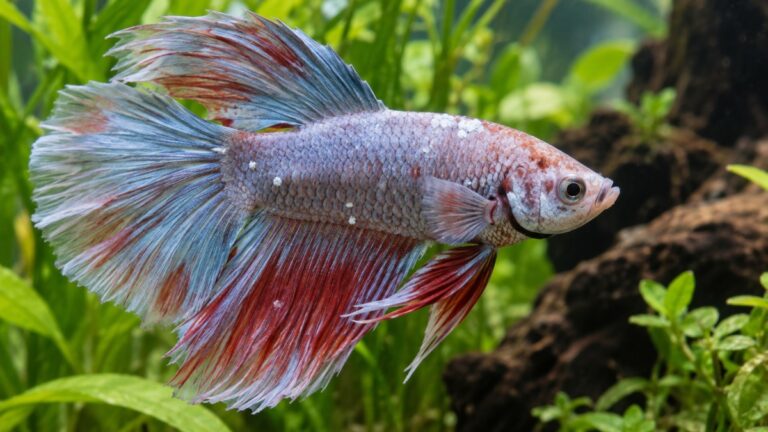
The Merck routine health chapter lists common signs of illness in fish. The list includes lethargy, not eating, slow or rapid breathing, loss of color, spots, ulcers, loss of scales, swelling or bloating, weight loss, and floating, drifting, or swimming erratically in unusual positions. Floating is therefore one sign on a list. It is not a diagnosis by itself, and a betta that floats along with any other sign on that list needs a veterinary check.
The Merck disorders chapter also lists rapid breathing, piping among the observations for certain disease conditions. Piping means swimming near the surface and trying to gulp air. A betta that is at the top and gulping may be showing that breathing is harder than usual, but the sources do not say what causes that in a home tank. Note the signs, and do not treat them on your own.
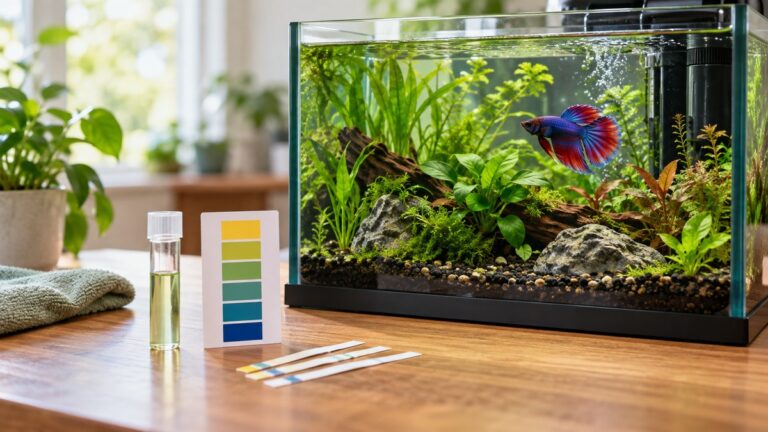
Water quality is part of the same picture. The UF/IFAS ammonia publication says that fish exposed to low levels of ammonia over time are more susceptible to bacterial infections. It also says that both ammonia and nitrite levels should be tested more frequently after applying a disease treatment, which is a reminder that the biofilter needs watching. A tank with unknown ammonia or nitrite levels cannot be ruled out as a stress source. A guide to testing for ammonia is best ammonia test kit for aquarium.
Temperature stress is also described in the Merck text. It says that temperature stress, particularly a sharp decrease in temperature, severely impairs the fish’s ability to quickly release antibodies against an invading organism. The chapter is written for fish in general, not bettas, but it shows why sudden temperature changes are a stress worth avoiding. A separate guide on keeping the water warm is how to keep betta water warm.
What to check before you call anyone
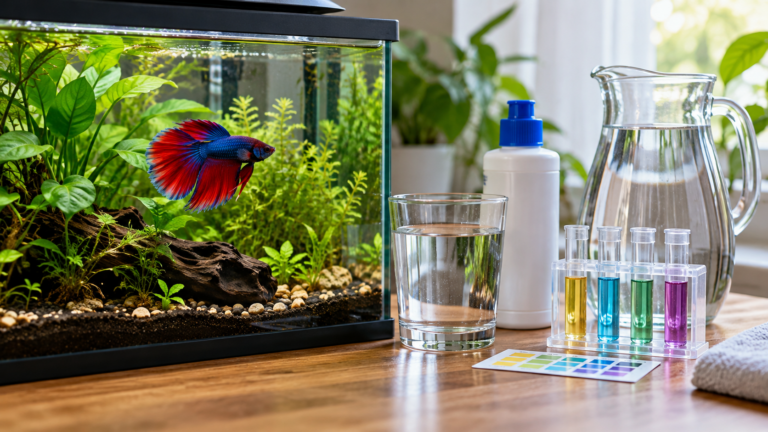
A short checklist can help you describe the problem clearly. Watch the fish for a few minutes at a time, and note whether it rises, floats in one spot, tilts, swims in circles or lies on its side. Check the fins, gills and eyes for bubbles or spots. Look at the water temperature, the last water change and whether the water was very cold or recently moved. Test the water if you can. Record how much food is given and how much is left after feeding.
The sources do not give a home treatment for a floating betta, and this guide does not give doses for any medication. If the fish keeps floating, cannot swim normally, stops eating or shows any of the other signs listed by Merck, describe the signs and the tank to an experienced fish keeper or an aquatic veterinarian. Bring the water test results and the timeline of changes.
How we chose
This guide uses only sources opened on 2026-10-24. The selection rule was to use university extension and veterinary references whose text covers fish biology, disease signs or water quality. Each quote was matched to the text of the source. Retail pages and product listings were not used, and no product is recommended. Where a source describes a general condition, the guide says it is general. Where a source does not cover floating in a betta, the guide says that too.
What we could not verify
The sources checked for this guide do not name a single cause of floating in a betta. They do not give a normal amount of surface time, and they do not say how common gas bubble disease is in a betta tank. The gaps below matter most to an owner who is worried about a fish.
What the sources do not say
- How much time a healthy betta should spend near the surface, or whether a betta that rests at the top is always unwell.
- Whether gas bubble disease occurs in home betta tanks, or what dissolved gas level is safe for a betta.
- What causes a betta to float in a home aquarium when the fish has no visible bubbles or other signs.
- Whether a particular filter, air pump or heater setting causes or prevents floating.
Frequently asked questions
Is it normal for a betta to float at the top?
The UF/IFAS publication says that many labyrinth fishes must breathe at the surface, so some time near the top is part of the species’ biology. The sources do not say how much time is normal. A betta that rises for air and then goes back to its usual spot is different from a betta that stays at the top, cannot hold position or looks unwell.
Can gas bubble disease make a betta float?
The Merck disorders chapter says that affected fish cannot swim normally because gas-filled lesions affect their floating ability. The chapter describes gas bubble disease in fish generally and gives pond examples. It does not say that the condition is common in betta tanks, so bubbles in the fins, gills or eyes are a sign to see a vet, not a sign to treat on your own.
Should I change the water if my betta is floating?
The sources do not give a rule for this situation. They do say that water that is very cold or under pressure can become supersaturated with gas, and that sharp temperature drops are a stress. Test the water and check the temperature before making a change, and avoid a large sudden change in temperature.
Does floating mean my betta is dying?
The sources do not say that floating always means a fish is dying. The Merck routine health chapter lists floating among signs of illness, which means it needs a check. Describe the other signs, such as not eating, rapid breathing or loss of color, to an aquatic veterinarian or an experienced fish keeper.
When should I take my betta to a vet for floating?
Call an aquatic veterinarian if the floating continues, if the fish cannot swim normally, if you see bubbles in the fins, gills or eyes, or if the fish shows other signs from the Merck list, such as lethargy, not eating, rapid breathing or swelling. Bring the water test results, the temperature, the tank size and a description of the signs.
Sources
- University of Florida IFAS Extension, “Evolution, Culture, and Care for Betta splendens” (FA212), https://edis.ifas.ufl.edu/publication/FA212, opened 2026-10-24.
- Merck Veterinary Manual, “Disorders and Diseases of Fish,” https://www.merckvetmanual.com/all-other-pets/fish/disorders-and-diseases-of-fish, opened 2026-10-24.
- Merck Veterinary Manual, “Routine Health Care of Fish,” https://www.merckvetmanual.com/all-other-pets/fish/routine-health-care-of-fish, opened 2026-10-24.
- University of Florida IFAS Extension, “Ammonia in Aquatic Systems” (FA031), https://edis.ifas.ufl.edu/publication/FA031, opened 2026-10-24.