Betta Fish Swim Bladder Trouble: Signs and Vet Care
As an Amazon Associate we earn from qualifying purchases. Details
Betta fish swim bladder trouble, shown as floating, sinking, or erratic swimming, is not described under that name in the sources checked for this guide. The Merck Veterinary Manual lists “Floating, drifting, or swimming erratically in unusual positions” as a general sign of illness in fish. That sign means a vet or an experienced fish keeper should examine the betta. The sources do not give a home fix for swimming problems, and this guide does not offer one.
Quick answer
- None of the sources checked for this guide describes a betta swim bladder disorder by name, so the term cannot be confirmed from them.
- Merck lists “Floating, drifting, or swimming erratically in unusual positions” among general signs of illness in fish.
- UF/IFAS FA212 explains that many labyrinth fishes, a group that includes bettas, “must breathe at the surface to survive.” It does not connect this to a swim bladder problem.
- A betta with abnormal swimming should be seen by a vet or an experienced fish keeper. Merck notes that emergency fish care is limited.
What the sources say about swimming problems
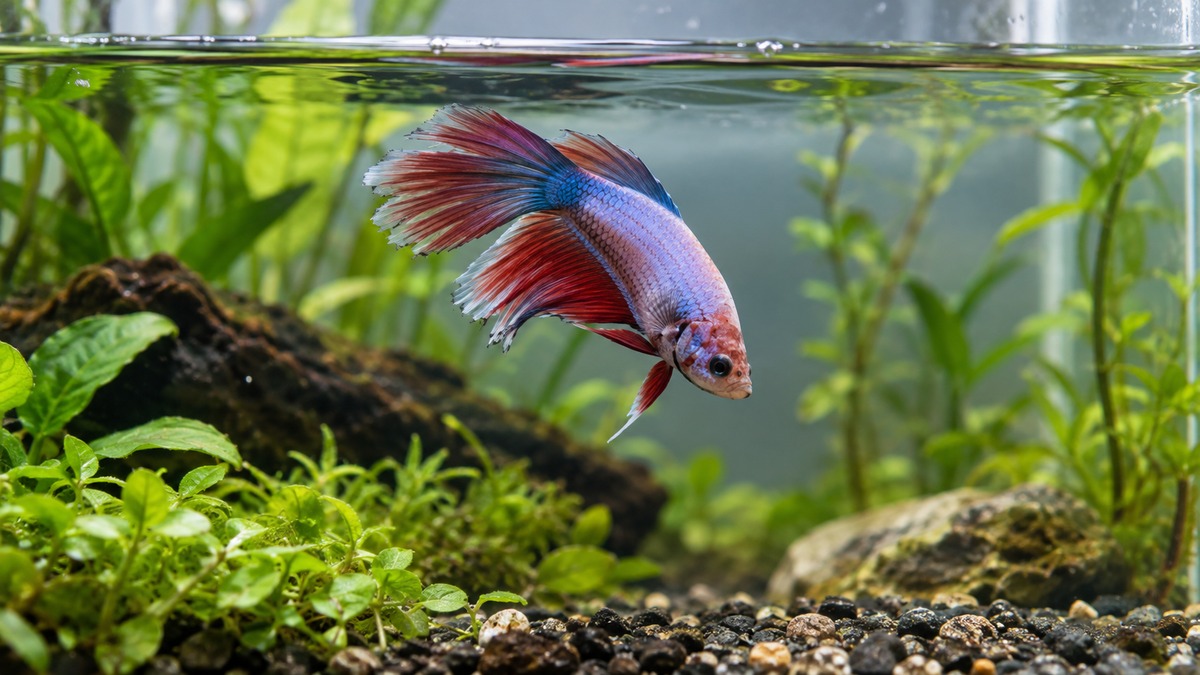
Merck’s signs of illness list includes “Floating, drifting, or swimming erratically in unusual positions,” and it says that “Some general signs of illness include changes in swimming behavior and noticeable changes in the color or condition of the body and fins.” These are general statements about fish. They do not name a cause, and they do not say whether a floating betta has a bladder problem, an infection, a water problem, or another issue.
Merck’s disease descriptions also mention swimming behavior in other contexts. Its description of Ichthyobodo lists behavior signs such as “lethargy, poor appetite, piping (swimming near the surface, trying to gulp air).” Its description of velvet describes fish that “scratch against rocks or other hard objects.” Those descriptions are for skin and gill parasites, not for a swim bladder disorder, and the sources do not say they explain floating or sinking.
The practical lesson from the sources is that an abnormal swimming pattern is a sign to report, not a diagnosis. Note how long it has lasted, how often it happens, and whether the fish can reach the surface and return to a resting spot.
Breathing and the labyrinth organ
Bettas belong to the labyrinth fish group. UF/IFAS FA212 explains that “The gills of labyrinth fishes are relatively small and primarily excrete the waste products ammonia and carbon dioxide.” It adds that “many labyrinth fishes are obligate air breathers, meaning they must breathe at the surface to survive.” The publication describes the labyrinth organ as “one of the most obvious traits” of the group, linked to air breathing.
These passages explain why bettas come to the surface, but the sources do not describe the labyrinth organ as a site of disease. They also do not say that a betta that struggles to reach the surface has a swim bladder problem. Breathing and swimming concerns should be shared with a vet, because a problem at the surface can have many causes.
Water and stress
Merck says many fish disorders “are the result of stress, poor water quality, overcrowding, and failure to quarantine any new or sick fish to avoid spread of disease.” The UF/IFAS stress circular says stress “is a condition in which an animal is unable to maintain a normal physiologic state because of various factors adversely affecting its well-being.” The same circular notes that “An animal is able to adapt to stress for a finite period of time,” and that a fish can look normal while its reserves are used up.
The betta publication says “Bettas prefer calm water as shown by research using flow as a stressor, so heavy filtration may actually be harmful to a betta’s health and welfare.” It also says bettas “do not do well in cold water,” and that an unheated container should have room air kept “no less than 22°C (71.6°F).” A water test can show whether the tank has a water quality problem that a vet should hear about. A guide to test kits is here: freshwater tank water test kit options.
A heater setup is part of the temperature question. For a guide on keeping water warm, see how to keep betta water warm.
What to do while you arrange a vet visit
The sources do not give a home treatment for a swimming problem, and they do not name a safe medicine dose for a betta. UF/IFAS FA212 warns that “Many drugs and chemicals can do more harm than good if they are used inappropriately.” Given that warning, the safest starting point is observation and a water test, not a guessed medicine.
Keep a written log. Record the date the swimming changed, what the fish does when it floats or sinks, whether it eats, whether its color or fins have changed, and what the water test shows. Bring the log and a short video of the swimming to the vet, because the movement is often hard to describe at a visit.
When to see a vet
See a vet or an experienced fish keeper when a betta floats, drifts, sinks, or swims erratically in an unusual position. Merck lists this under signs of illness, and FA212 says “If a disease outbreak does occur, proper diagnostics, including working with a fish veterinarian, will be key to successful management.” Merck also says “emergency medical treatment for pet fish is not as advanced or as readily available as it is for dogs and cats,” so it helps to find a vet early.
If a vet is not nearby, a local aquarium club or specialty shop may be able to point to an experienced fish keeper. For a broader look at tank size, which affects how much room a betta has, see how big of a tank do betta fish need.
How we chose
The sources for this guide were chosen for their subject: fish disorders, emergencies, stress, and betta biology. The Merck Veterinary Manual pages list general signs of illness and describe fish diseases. The UF/IFAS publications cover betta biology, breathing, and stress. All five sources are non-retail and were opened on 2026-10-24. Each quoted phrase was checked against the opened text, and no retail page was used.
The guide is written around the question a reader is likely to ask, which is what abnormal swimming means and what to do next. Because the sources do not name a swim bladder disorder, the guide reports what they do say and stops there.
What we could not verify
The sources checked for this guide do not describe a swim bladder disorder in bettas. They do not give a cause, a diagnosis method, or a treatment for floating or sinking. They also do not say how common abnormal swimming is in home bettas.
What the sources do not say
The sources do not use the term swim bladder for bettas, and they do not describe its signs, causes, or treatment for this species. They do not say whether a constipated or gas-filled betta floats, whether a betta can be fasted for swimming problems, or what medicine or dose would apply. The Merck material on gas bubble disease is about cold-water systems and supersaturated water, not about a betta swim bladder, and the sources do not link the two.
Frequently asked questions
Do the sources say a betta can have a swim bladder problem?
The sources checked for this guide do not name one. They list “Floating, drifting, or swimming erratically in unusual positions” as a general sign of illness in fish, which is enough to justify a vet check without naming a specific organ problem.
Why does my betta float at the top of the tank?
The sources do not give a specific reason for a betta floating at the top. FA212 says that labyrinth fishes “must breathe at the surface to survive,” which explains surface breathing as normal behavior. Persistent floating or struggling is different from normal surface breathing and should be checked by a vet.
Can a betta with swimming trouble recover without a vet?
The sources do not say whether recovery happens without help. Merck lists erratic swimming as a sign of illness and states that “Preventing disease is always preferable to treating it.” The sources do not support waiting it out as a plan, so an early vet check is the safer step.
Is a constipated betta the same as a swim bladder problem?
The sources checked for this guide do not mention constipation in bettas, so they cannot confirm whether the two are linked. A vet should decide what is going on.
Should I use medicine on a betta that is floating?
Ask a vet first. FA212 says “Many drugs and chemicals can do more harm than good if they are used inappropriately.” This guide does not give medicine names or doses.
Sources
- Merck Veterinary Manual, “Disorders and Diseases of Fish,” https://www.merckvetmanual.com/all-other-pets/fish/disorders-and-diseases-of-fish (opened 2026-10-24)
- Merck Veterinary Manual, “Routine Health Care of Fish,” https://www.merckvetmanual.com/all-other-pets/fish/routine-health-care-of-fish (opened 2026-10-24)
- Merck Veterinary Manual, “Emergencies of Fish,” https://www.merckvetmanual.com/all-other-pets/fish/emergencies-of-fish (opened 2026-10-24)
- UF/IFAS Extension, FA212, “Evolution, Culture, and Care for Betta splendens,” https://edis.ifas.ufl.edu/publication/FA212 (opened 2026-10-24)
- UF/IFAS Extension, Circular 919/FA005, “Stress: Its Role in Fish Disease,” https://edis.ifas.ufl.edu/publication/FA005 (opened 2026-10-24)