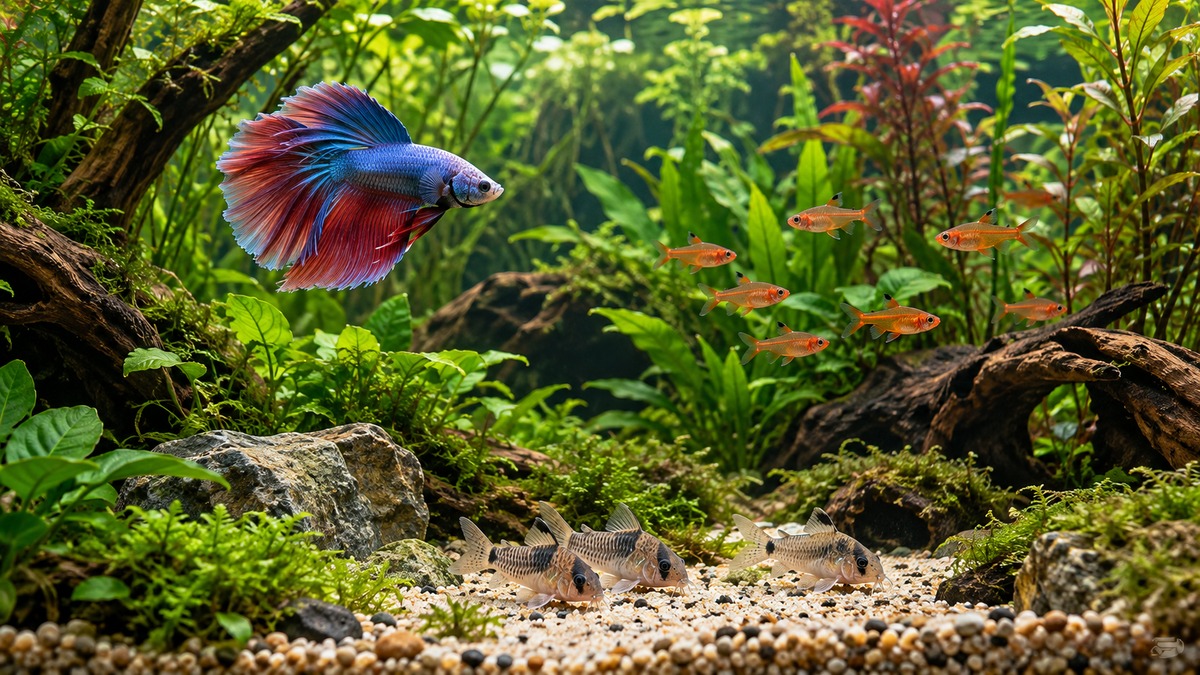
What Fish Get Along With Bettas?
As an Amazon Associate we earn from qualifying purchases.
The person typing “what fish get along with bettas” wants a short list of tank mates that will live peacefully with a betta and will not stress the fish or the tank. The sources opened for this guide do not supply that list. The University of Florida IFAS betta publication says betta males are among the most aggressive fishes kept in the hobby, and the Merck Veterinary Manual says that adding fish to an established aquarium carries a risk of introducing disease. The honest starting answer is that a betta often does best in a tank of its own, and any tank mate needs to be checked against the species, the tank size and the health signs described below.
Quick answer
- The sources checked for this guide do not name a list of fish that are safe to keep with bettas.
- UF/IFAS says betta males are among the most aggressive, and that males display aggression toward other males on contact.
- Merck says that every time new fish are added to an established aquarium, there is a risk of introducing disease.
- Merck gives a general freshwater stocking rule of 1 inch of fish for every 12 square inches of surface area. It is not a betta-specific rule.
Why the answer is not a simple list
Whether two fish can share a tank depends on more than the species name. Temperament, the size of the tank, the number of hiding places, water quality and the health of each fish all affect the result. A listing or a forum post that says a species is “betta safe” is making a claim that the sources in this guide do not test. A listing is a sales page, not a study of compatibility.
The UF/IFAS publication is useful because it explains why bettas behave the way they do. It describes the history of the species as a fighting fish, and it says that early on, males were selected for their aggression because fights between two males were popular in Thailand for gambling. The publication also says that males will almost immediately display aggressive behaviors, such as spreading their fins and flaring their gill covers, when they encounter another male. Those behaviors are the reason two male bettas should not be housed together as a general rule, and they are a clue that a betta may not tolerate other fish that look like rivals.
What the UF/IFAS betta publication says about temperament
The UF/IFAS publication, “Evolution, Culture, and Care for Betta splendens,” is written about the commercial betta, which is one of the anabantoids, or labyrinth fishes. The publication notes that the betta is one of the most popular aquarium species because of its hardiness and its bold colors and long fins. It also states that betta males are among the most aggressive, and that this trait is one reason the fish is popular in the hobby. The text is about males and about the species in general. It does not give a table of tank mates, and it does not say which fish are safe to add.
The publication also discusses the labyrinth organ, which lets these fish breathe air at the surface. That is useful for understanding why a betta spends time near the top of the tank. It does not answer the tank mate question.
What the Merck guide says about aggression and new fish
The Merck Veterinary Manual chapter on providing a home for fish says that aggressive behavior is stressful for all fish in the tank, so reducing aggression is good for every fish in the aquarium, not only the one that is attacking. The same chapter says that aggressiveness toward new fish is common among freshwater cichlids and other larger freshwater species. Bettas are not named in that statement. The statement does show that new fish can be chased or attacked by the fish already in a tank, and that is a risk to the newcomer.
The Merck chapter also explains the risk of adding fish gradually. It says that the disadvantage of gradual addition of fish is that any time new fish are added to an established aquarium, there is a risk of introducing disease. For a betta owner, this means a new tank mate is a new health risk as well as a behavior risk. Buying a healthy-looking fish does not remove the risk, and the sources in this guide do not describe a method that makes it zero.
Stocking math from the Merck rule
The Merck chapter gives a general freshwater guideline that is useful for any mixed tank: 1 inch of fish for every 12 square inches of surface area. The guideline is about the total length of fish that a tank can hold, measured against the water surface. It is not a betta rule, and it does not tell you whether a particular species is compatible. It is still helpful as a limit. The table below shows the arithmetic only. The surface areas are example values, not dimensions of any product.
| Surface area (square inches) | Total fish length allowed (inches) |
|---|---|
| 60 | 5 |
| 120 | 10 |
| 180 | 15 |
To use the rule, find the tank’s surface area in the manufacturer’s dimensions, not in the sales copy, and divide by 12 to get the total inches of fish that the rule allows. Then remember that a betta is not a fish you can add by size alone. Temperament and tank features matter more than the arithmetic. The listing may also describe total capacity rather than usable water volume, so check the dimensions before you calculate anything. A link to the basics of tank size is in how big of a tank do betta fish need.
Signs a tank mate is causing trouble
The Merck routine health guide lists common signs of illness in fish. They include lethargy, not eating, slow or rapid breathing, loss of color, spots, ulcers, loss of scales, swelling or bloating, weight loss, and floating, drifting, or swimming erratically in unusual positions. Any of these signs in a betta or a tank mate is a reason to check the water, look for injuries and call for help. Injuries from fin nipping or chasing are not described in detail in the sources checked here, so do not assume a fish is safe because it has no visible marks.
The Merck disorders chapter also lists piping, which means swimming near the surface and trying to gulp air, among the observations for certain disease conditions. It is not a diagnosis on its own. If a fish shows these signs and the cause is not clear, describe the signs to an experienced fish keeper or an aquatic veterinarian. Do not start a medication based on this guide. The sources do not give doses, and this guide does not give them.
Water quality is part of the same picture. The UF/IFAS ammonia publication says that fish exposed to low levels of ammonia over time are more susceptible to bacterial infections. A stressed tank with poor water quality makes any tank mate problem worse. For a separate guide on checking ammonia, see best ammonia test kit for aquarium.
How we chose
This guide is limited to what the sources opened on 2026-10-24 say. The criteria were simple. The source had to be a university extension publication or a veterinary reference, the claim had to appear in the text of the source, and the quote had to match the page word for word. Retail listings were not used as sources for compatibility, and no product was recommended. Where a source gives a general rule, the guide says that the rule is general. Where a source is silent, the guide says so.
What we could not verify
The sources checked for this guide do not give a list of species that are safe with bettas. They do not rank fish by how well they share a tank with a betta. They do not give a tank size that makes mixing safe. The points below are the gaps that matter most to a reader who wants a yes or no.
What the sources do not say
- Which specific fish, snails or shrimp are safe with a betta in any tank size.
- Whether a female betta behaves differently toward tank mates. The UF/IFAS text discusses male aggression in detail and does not give a comparable statement for females.
- Whether a betta needs a tank mate for its health or comfort.
- How a particular tank’s decor, plants or filter flow changes the risk of fin nipping.
Frequently asked questions
Can a betta live with snails?
The sources opened for this guide do not address snails. Snails are not named in the UF/IFAS betta publication or in the Merck fish chapters checked here. Without a source, no safe claim can be made, so check the species and the tank before adding any snail.
Can I keep two male bettas together?
The UF/IFAS publication says that male bettas display aggressive behaviors when they encounter another male, and that the species has been bred for aggression. The sources in this guide do not describe a case where two males live peacefully together, so they do not support keeping two males in one tank.
Does a betta need a tank mate?
The sources opened for this guide do not say that a betta needs a tank mate. They describe the fish as hardy and popular, and they describe the risks of adding fish to an established tank. A betta living alone is consistent with those sources, but the sources do not give a comparison of solitary and group life.
What should I do if a tank mate seems stressed?
Look for the signs listed in the Merck routine health chapter, such as lethargy, not eating, rapid breathing, loss of color or erratic swimming. Check the water and the tank for problems. If the signs continue or the cause is not clear, describe what you see to an experienced fish keeper or an aquatic veterinarian. Do not use a medication without advice.
Are shrimp a safe tank mate for bettas?
The sources opened for this guide do not say whether shrimp are safe with bettas. Shrimp are not covered in the UF/IFAS betta publication or the Merck chapters checked here. Treat any claim that shrimp are safe as unverified unless the listing or a source you can open says so.
Sources
- University of Florida IFAS Extension, “Evolution, Culture, and Care for Betta splendens” (FA212), https://edis.ifas.ufl.edu/publication/FA212, opened 2026-10-24.
- Merck Veterinary Manual, “Providing a Home for Fish,” https://www.merckvetmanual.com/all-other-pets/fish/providing-a-home-for-fish, opened 2026-10-24.
- Merck Veterinary Manual, “Disorders and Diseases of Fish,” https://www.merckvetmanual.com/all-other-pets/fish/disorders-and-diseases-of-fish, opened 2026-10-24.
- Merck Veterinary Manual, “Routine Health Care of Fish,” https://www.merckvetmanual.com/all-other-pets/fish/routine-health-care-of-fish, opened 2026-10-24.
- University of Florida IFAS Extension, “Ammonia in Aquatic Systems” (FA031), https://edis.ifas.ufl.edu/publication/FA031, opened 2026-10-24.