Why a Fish Tank Gets Cloudy and What to Check
As an Amazon Associate we earn from qualifying purchases.
The person typing “fish tank gets cloudy” wants to know why the water has turned hazy and whether the fish are in danger. The sources opened for this guide do not name one specific cause of cloudy water. What they do explain is how the nitrogen cycle works in a new tank, why overfeeding raises ammonia, and how algae grows in aquariums. Those are the most likely places to start when a tank looks cloudy, and each one has a clear check. If the fish are also acting sick, the cloudiness is a reason to call an experienced fish keeper or an aquatic veterinarian, not a reason to start a treatment on your own.
Quick answer
- The sources checked for this guide do not name a specific cause of cloudy water, such as a bacterial bloom.
- UF/IFAS says a new biofilter needs six to eight weeks to build up enough bacteria to reduce ammonia and nitrite.
- UF/IFAS says overfeeding is a major cause of high ammonia, so uneaten food is the first thing to remove.
- Merck says algae buildup makes it harder to spot health problems in the fish, so check the fish as well as the water.
Why the cause of a cloudy tank is hard to name
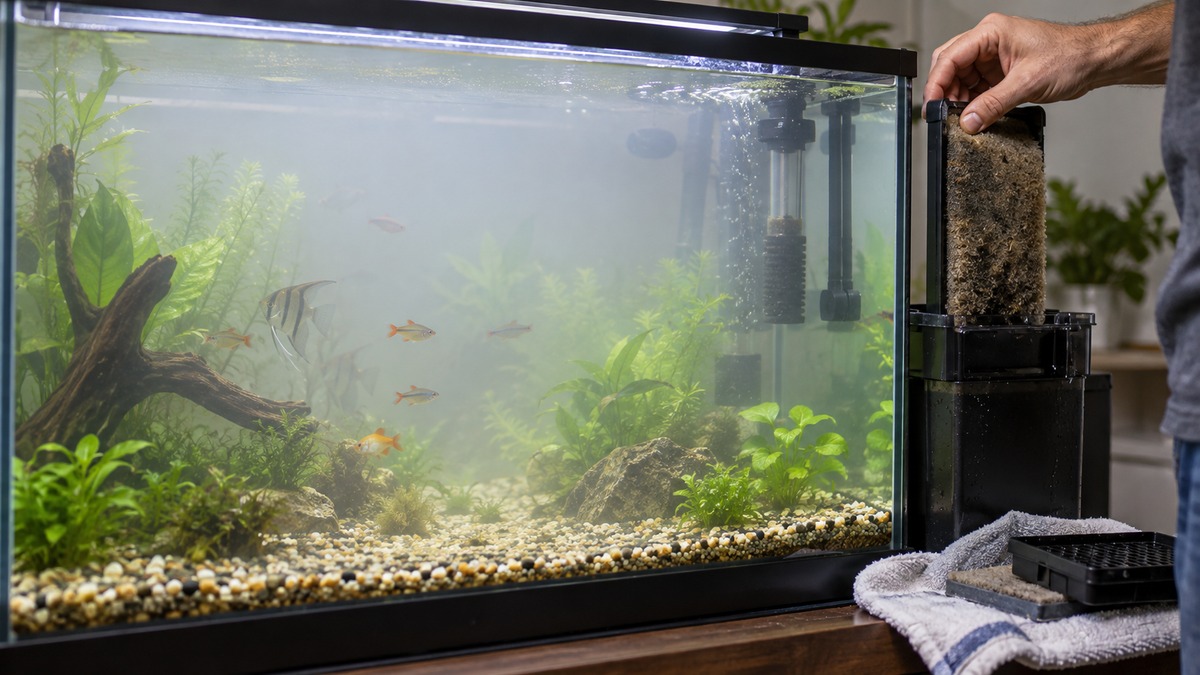
Cloudy water can come from several causes, including a new tank that has not finished cycling, too much food, a buildup of minerals or algae. The sources in this guide treat those possibilities as separate topics, and none of them links a particular look of cloudy water to a particular cause. That means a cloudy tank should be checked, not assumed to be harmless and not assumed to be an emergency. The steps below move from the most common and easiest checks to the less common ones.
Start by noting when the cloudiness began. A tank that clouded a few days after setup is a different case from a tank that clouded after a week of running well. Write down the date, the last water change, the last time the filter was cleaned, and how much food went in each day. Those details make it easier for an experienced fish keeper or an aquatic vet to help.
The nitrogen cycle in a new tank
The UF/IFAS ammonia publication explains that the nitrogen cycle is a biological process that removes ammonia from water. Fish produce ammonia, and the ammonia excreted by fish is converted to a compound called nitrite. A second group of bacteria then converts nitrite to a much less toxic compound, nitrate. The publication says that nitrification is an aerobic (oxygen required) process, which means the bacteria need oxygen to do the work. Its biofilter is the place where these bacteria live, and the publication is direct about the timing: a new biofilter requires six to eight weeks to build up sufficient bacteria to effectively reduce ammonia and nitrite levels.
This matters for cloudy water because a tank that is still cycling can have ammonia and nitrite levels that the owner cannot see. The publication also says that fish exposed to low levels of ammonia over time are more susceptible to bacterial infections. If a tank is new, or if the filter was recently replaced or cleaned very hard, testing the water is the only way to know where the tank stands. For one option to test with, see best ammonia test kit for aquarium.
The UF/IFAS text also says that both ammonia and nitrite levels should be tested more frequently after applying a disease treatment. Treatment is not the first step for a cloudy tank with no sick fish, but the point holds: a stressed biofilter needs watching.
Overfeeding and uneaten food
Overfeeding is one of the most common reasons for poor water in a small aquarium. The UF/IFAS ammonia publication states that overfeeding is a major cause of high ammonia concentrations. It also says that fish may not eat during periods of ammonia stress, and the uneaten feed will only make the situation worse. The Merck Veterinary Manual says the same thing in plain terms: overfeeding can lead to health problems as well as a dirty tank.
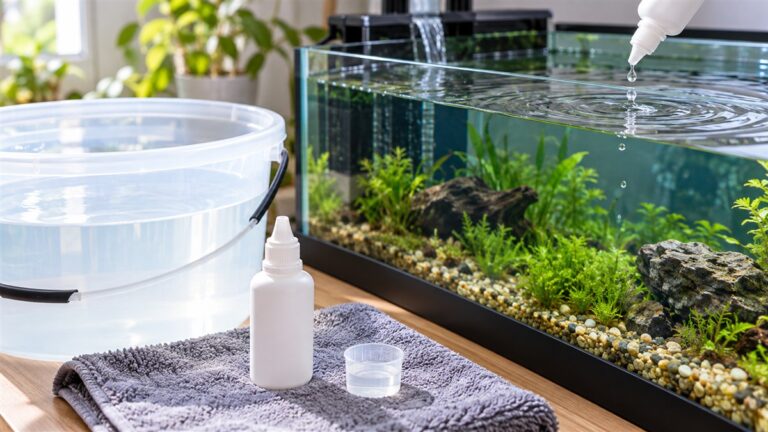
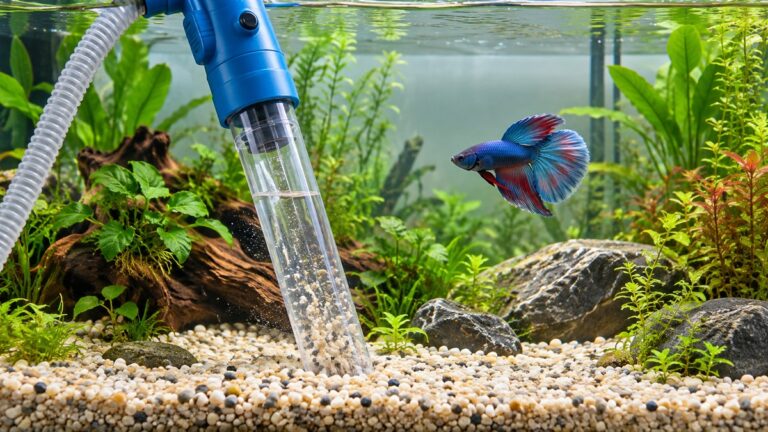
The Merck routine health chapter includes a daily task that is simple to follow: feed the fish and remove any uneaten food. The UF/IFAS betta publication also notes that aquariums of limited volume and reduced filtration should be managed to include frequent water changes so that uneaten feed as well as ammonia and other dissolved wastes are not allowed to reach harmful levels. A tank with a small volume and a small filter has less room for error. Food that is not eaten stays in the water and adds to the waste the filter has to handle.
The sources do not give a number of feedings per day or an amount of food per feeding. Use the food label and your own observation of what the fish eat, and remove what is left. Frequent water changes are the source’s own recommendation for limited-volume tanks. How often to change water for a specific tank is not given in the sources checked here.
Algae and dissolved minerals
Algae is a different cause of cloudiness. The Merck chapter on providing a home for fish says that dissolved minerals can also lead to excess algae growth. It also says that a buildup of algae on the glass or in the water is unsightly, and that the buildup makes it harder to spot health problems in the fish and their environment. The same chapter notes that aquatic plants also help prevent the growth of algae by absorbing nutrients that would otherwise feed the algae. Live plants can therefore help with algae, but the source does not say which plants or how many.
The sources do not describe how to tell algae haze from other cloudiness by appearance. A practical check is to look at where the cloudiness sits: a film on the glass and decor is a different observation from a haze suspended through the water. Either way, the check gives an observation, not a diagnosis.
Filter maintenance
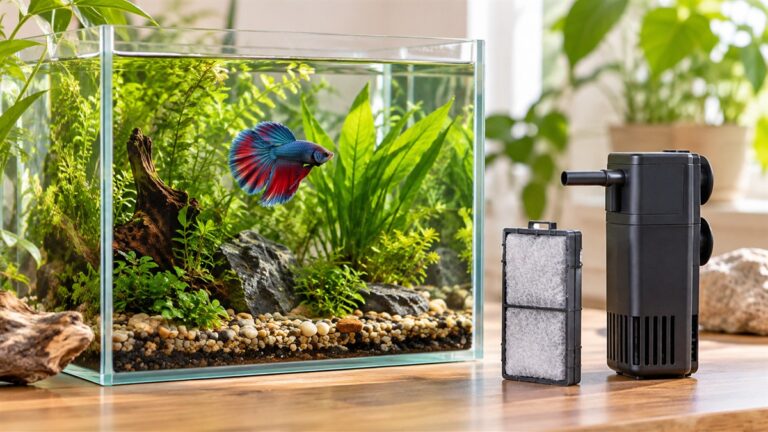
A dirty filter can make the water look worse, and a filter that is clogged may not move water through the biofilter as it should. The Merck routine health chapter says that replaceable cartridges should be changed once a month, and more often if the filter floss becomes clogged with wastes. The sources checked here do not give a cleaning method for sponges or other media, so use the manufacturer instructions for the filter you own. For a general cleaning routine, see best way to clean a betta fish tank.
Cleaning the filter removes wastes, and the sources warn that the bacteria in the biofilter are sensitive to some chemicals. The UF/IFAS ammonia publication states that some chemicals used to treat diseases in fish, especially antibiotics, can be detrimental to the nitrifying bacteria in the biofilter. That is one reason a cloudy tank should not be treated with a product without advice.
When to get help
Cloudy water with healthy fish is usually a water quality question, and it is a good time to test and to clean up food and filter habits. Cloudy water with sick fish is a different situation. The Merck routine health chapter lists common signs of illness, including lethargy, not eating, slow or rapid breathing, loss of color, spots, ulcers, swelling or bloating, weight loss and floating or swimming erratically in unusual positions. If any of these show up, describe the tank, the water test results, the feeding routine and the signs to an experienced fish keeper or an aquatic veterinarian. Do not add a medication based on this guide, because the sources checked here do not give doses, and this guide does not give them.
How we chose
This guide uses only the sources opened on 2026-10-24. Each claim was checked against the text of the source, and each quote was matched word for word. University extension and veterinary references were used because they describe the general biology and care of fish. Retail pages were not used, and no product is recommended. Where a source gives a general rule, the guide labels it as general. Where a source does not address a question, the guide says that too.
What we could not verify
The sources checked for this guide do not identify the cause of every cloudy tank. They do not describe the look of a bacterial bloom, and they do not list the particles that make water hazy. The gaps below matter most to a reader trying to fix a tank.
What the sources do not say
- A specific cause of cloudy water in a betta tank, or how to tell one cause from another by sight.
- How often a particular tank should be partly changed, or how many feedings per day a betta should have.
- Whether cloudy water is harmful to a betta on its own, without other signs.
- Whether a water clarifier or a filter media product clears the water or addresses the underlying cause.
- Which plants or how many plants would control algae in a given tank.
Frequently asked questions
Is cloudy water in a fish tank dangerous?
The sources checked here do not say that cloudy water is dangerous by itself. They do say that ammonia and nitrite can build up when the biofilter is new or overloaded, and that low levels of ammonia over time make fish more susceptible to infections. Testing the water is the only way to know whether ammonia or nitrite is part of the problem.
How long does a new tank take to clear up?
The UF/IFAS ammonia publication says that a new biofilter requires six to eight weeks to build up enough bacteria to reduce ammonia and nitrite. The sources do not give a fixed date for when cloudiness will end, because the timing depends on the tank, the filter and the feeding.
Should I do a water change if my tank is cloudy?
The UF/IFAS betta publication recommends frequent water changes for aquariums of limited volume and reduced filtration so that waste does not reach harmful levels. The sources do not give a schedule. Test the water before and after any change, and avoid changing large amounts at once if the tank is still cycling.
Can overfeeding cause cloudy water?
The sources say overfeeding is a major cause of high ammonia and can lead to a dirty tank. Uneaten food is one of the most common sources of waste in a small aquarium. Removing uneaten food after each feeding is a step the Merck routine health chapter describes directly.
When should I call a vet about a cloudy tank?
Call an aquatic veterinarian or an experienced fish keeper if the cloudiness comes with signs of illness, such as lethargy, not eating, rapid breathing, spots, ulcers, swelling or floating and swimming erratically in unusual positions. Bring the water test results, the tank size, the feeding routine and a description of the signs.
Sources
- University of Florida IFAS Extension, “Ammonia in Aquatic Systems” (FA031), https://edis.ifas.ufl.edu/publication/FA031, opened 2026-10-24.
- University of Florida IFAS Extension, “Evolution, Culture, and Care for Betta splendens” (FA212), https://edis.ifas.ufl.edu/publication/FA212, opened 2026-10-24.
- Merck Veterinary Manual, “Providing a Home for Fish,” https://www.merckvetmanual.com/all-other-pets/fish/providing-a-home-for-fish, opened 2026-10-24.
- Merck Veterinary Manual, “Routine Health Care of Fish,” https://www.merckvetmanual.com/all-other-pets/fish/routine-health-care-of-fish, opened 2026-10-24.
- Merck Veterinary Manual, “Disorders and Diseases of Fish,” https://www.merckvetmanual.com/all-other-pets/fish/disorders-and-diseases-of-fish, opened 2026-10-24.