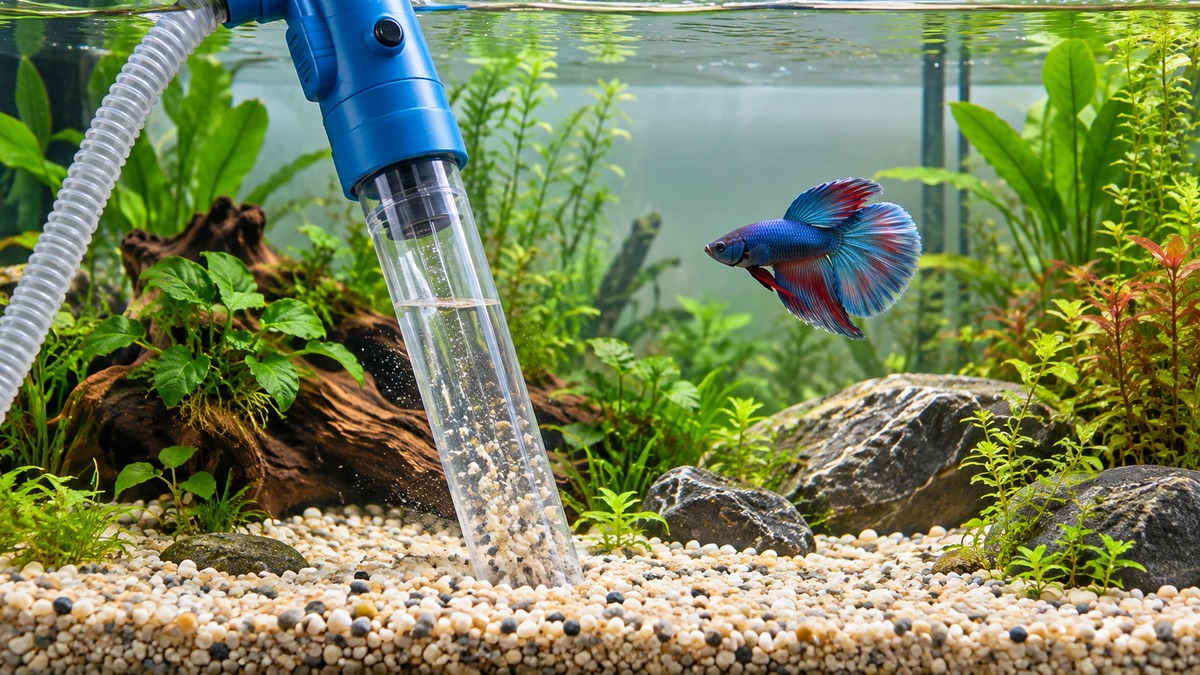
Upettools Aquarium Gravel Cleaner Review: Flow and Depth
As an Amazon Associate we earn from qualifying purchases. Details
If you are considering the Upettools aquarium gravel cleaner, the first question is whether its size and flow suit a betta tank. A gravel vacuum that moves a lot of water is a poor match for a small tank, and a tube that does not reach the gravel is no use at all. This review covers only what the listing states about flow, tube length, water depth, power, materials and warranty. It does not report any test of the cleaner in a tank, and it does not measure how well it removes debris. Use it to decide whether the listing matches your tank and your cleaning routine.
Quick answer
The Upettools cleaner is a blue corded electric gravel vacuum with a listed flow of 2,000 liters per hour in its specs and 1,700 liters per hour in its bullets. Its telescopic tube runs from 23.6 to 37.7 inches, and the listing gives a water depth range of 13.7 to 47.2 inches. The listing claims a 3-year warranty in its bullets, but the warranty field reads a slash. For a betta tank, the flow figure matters most, so check the setting and keep the flow gentle. Confirm the warranty before you buy.
What to check in a gravel cleaner for a betta tank
Four details decide whether this cleaner fits. Each one can rule it in or out.
1. Flow and suction. The specs give a maximum flow of 2,000 liters per hour, while the bullets give 1,700 liters per hour. The bullets say the cleaner can drain a 180-gallon tank in about 30 minutes, which is a figure for a much larger tank than a betta uses. A betta rests near the surface and takes in air there, so a strong suction near the gravel is less important than keeping the water movement calm. The listing describes a flow control valve, so use the lowest setting that moves debris.
2. Tube length and water depth. The listing gives a telescopic tube from 23.6 to 37.7 inches, and water depths from 13.7 to 47.2 inches. The product dimensions field gives a height of 31.5 inches. Measure the depth of your tank before you buy, because a tube that is too short will not reach the gravel, and one that is too long is awkward to store.
3. Power and voltage. The cleaner is corded electric, and the listing gives 110 volts and 28 watts. Check that your outlet matches the 110-volt rating, and keep the cord clear of the water and the tank lid. The listing gives no ground-fault or other electrical safety feature, so do not assume one.
4. Material and warranty. The material is ABS plastic, according to the specs. The bullets describe a 3-year warranty covering manufacturing defects, but the specs show a warranty field of a slash. The listing also mentions a spare part availability duration in its specs. Confirm the warranty on the product page before you rely on it.
Use these rules to choose:
- Choose this cleaner if your tank is at least 5 gallons, as the site guidance recommends for a single betta, and you can set the flow low.
- Choose a different cleaner if you keep a small tank and need a low-flow tool, because this listing gives no low-flow figure.
- Choose a different cleaner if you need a warranty term stated in the specs.
1. UPETTOOLS Aquarium Gravel Cleaner – Electric Automatic Removable Vacuum Water Changer Sand Algae (Review verdict)
Specs from the listing (checked 2026-10-13):
- Maximum Flow Rate: 2000 liters per hour
- Maximum Lifting Height: 5.9 feet
- Power Source: Corded Electric
- Voltage: 110 volts
- Manufacturer Warranty Description: /
Pros
- Six functions including water changing, sand washing and flow control, per the bullets
- Telescopic tube from 23.6 to 37.7 inches, per the bullets
- Removable filter and adjustable tube, per the bullets
Cons
- Flow is 2,000 liters per hour in the specs and 1,700 in the bullets
- Warranty field reads a slash, while the bullets claim 3 years
- Bullets describe a 180-gallon tank, far larger than a betta tank
Best for: A tank of at least 5 gallons where the owner can set a low flow and check the warranty before buying.
Skip if: Skip if you need a low-flow tool for a very small tank, or a warranty term stated in the specs.
View on Amazon (affiliate link)
The Upettools aquarium gravel cleaner
The Upettools cleaner is a submersible electric gravel vacuum. The specs list the material as ABS, the color as blue, the power source as corded electric, and the dimensions as 2.76 by 5.12 by 31.5 inches. The bullets describe six functions: water changing, sand washing, debris removal, water filtration, water showering and flow control. The cleaner has a removable filter and an adjustable telescopic tube.
The cleaner fits a reader who keeps a tank of at least 5 gallons, wants to vacuum the gravel during a water change, and can set the flow low for a betta. The telescopic tube covers a range of depths, which the listing says accommodates water depths from 13.7 to 47.2 inches.
The listing has several things to check. The flow figure differs between the specs and the bullets. The warranty appears in the bullets but not the specs. The bullets describe a 180-gallon tank, which is far larger than a betta tank. The listing’s power rating is given in watts and volts, and the flow and power figures are the maker’s, not measured results.
Who should skip it: a reader with a very small tank who needs a low-flow tool, a reader whose outlet is not 110 volts, and a reader who needs the warranty stated in the specs.
Water changes and the cleaner
The UF/IFAS fact sheet on ammonia says nitrate is a less toxic by-product of nitrification, and that water changes are needed to remove nitrate from a closed system. A gravel vacuum is a tool for that water change, because it removes waste from the gravel while the water is drained. The same fact sheet says ammonia should be tested regularly, and that a new biofilter needs six to eight weeks to build enough bacteria. Vacuum gently during a water change, and avoid disturbing the biofilter more than the change requires. For a step-by-step routine, the best way to clean a betta fish tank guide covers the full process, and the fish tank water quality test strips guide covers the testing side.
The listing says the cleaner removes fish waste and uneaten food from the gravel without disturbing beneficial bacteria. That is the maker’s statement. The fact sheet supports the general practice of removing waste, but it does not confirm how a particular cleaner affects bacteria, so treat the claim as the maker’s.
Betta tanks and the welfare guidance
The source describes the betta as a freshwater fish that tolerates low oxygen and poor water quality, and that takes in air from the surface through a labyrinth organ. This site recommends a tank of at least 5 gallons for a single betta, and does not recommend bowls. The cleaner’s flow should not disturb the surface a betta uses, so set it low and watch how the fish moves when the cleaner runs.
Keep the cleaner’s outlet away from the surface resting area, and do not run it while the fish is resting near the surface. If the fish appears stressed, stop the cleaner and check the water.
Worked example: how much water a 10-gallon tank change moves
Compare that volume with the cleaner’s listed flow, so you can see how long a full drain would take at the maximum flow in the specs.
- Tank volume: 45 litres, from the source’s figure for 10 gallons.
- Maximum flow in the specs: 2,000 liters per hour.
- Time to move 45 litres at that flow: 45 divided by 2,000 = 0.0225 hours, or about 1.35 minutes.
Check the arithmetic again. 45 divided by 2,000 is 0.0225 hours, and 0.0225 times 60 is 1.35 minutes.
The example shows that the maximum flow is far more than a betta tank needs. A full drain would take little time at maximum flow, so the setting you choose matters more than the rated flow. Set the cleaner to a gentle flow, and drain only part of the tank at a time.
Why the water tests matter after a gravel clean
A gravel cleaner removes waste from the substrate, but it does not show what is in the water. The University of Florida IFAS guide to ammonia says ammonia is colorless and, even at levels toxic to fish, odorless, so the only way to know it is present is to test the water. That guide was written for aquaculture production systems, so apply its schedule to a home tank with care, but the chemistry is the same.
The guide says a good ammonia kit includes a TAN test, a pH test and a thermometer, because the toxic un-ionized share rises with pH and temperature. It also says the common Nessler method can give a falsely high reading after formalin use, and with ammonia-binding products and many water conditioners. Water conditioners are often part of a water change, so use a method the kit maker identifies as unaffected, or test before you add the conditioner.
Five common mistakes
- Trusting one flow figure. The specs say 2,000 liters per hour, and the bullets say 1,700 liters per hour.
- Running the cleaner at full flow. A betta needs calm surface water, so use the lowest setting that moves debris.
- Trusting the warranty bullet. The specs show a warranty field of a slash.
- Skipping the depth check. Measure the tank depth before you buy, because the tube has a listed range.
- Assuming the 180-gallon figure applies. The bullet describes a much larger tank than a betta uses.
FAQ
Is this cleaner good for a 5-gallon betta tank?
It may be, if you set the flow low. The listing does not give a low-flow figure, so watch the fish when the cleaner runs. The site recommends at least 5 gallons for a single betta.
What depth does the tube reach?
The listing gives a tube from 23.6 to 37.7 inches, and water depths from 13.7 to 47.2 inches.
Does it come with a warranty?
The bullets say 3 years for manufacturing defects. The specs show a slash in the warranty field, so confirm the warranty on the product page.
Is it safe to use near water?
The cleaner is corded electric. Keep the cord clear of the water and the lid, and check that your outlet is 110 volts. The listing does not describe a ground-fault feature.
How often should I vacuum?
The listing does not give a schedule. Vacuum during routine water changes, and test ammonia on a regular schedule, as the UF/IFAS fact sheet describes.
Bottom line
The Upettools cleaner suits a tank of at least 5 gallons where the owner can set a low flow and keep the cord clear of the water. Its flow figure, warranty and some specs disagree, and the 180-gallon claim does not apply to a betta tank. Before buying, measure your tank depth, check the outlet voltage, confirm the warranty on the product page, and plan to run the cleaner gently during water changes.
Sources
- UF/IFAS, Ammonia in Aquatic Systems (FA31): water changes remove nitrate from closed systems, test ammonia regularly, and a new biofilter needs six to eight weeks.
- Siamese fighting fish, Wikipedia: labyrinth organ and surface air, and the 45 litre community tank figure.
- Ammonia in aquatic systems, UF/IFAS: ammonia is odorless and colorless; test kits and the thermometer matter; water conditioners can cause false highs with some methods.