Can You Pet a Betta Fish? What the Sources Say
As an Amazon Associate we earn from qualifying purchases.
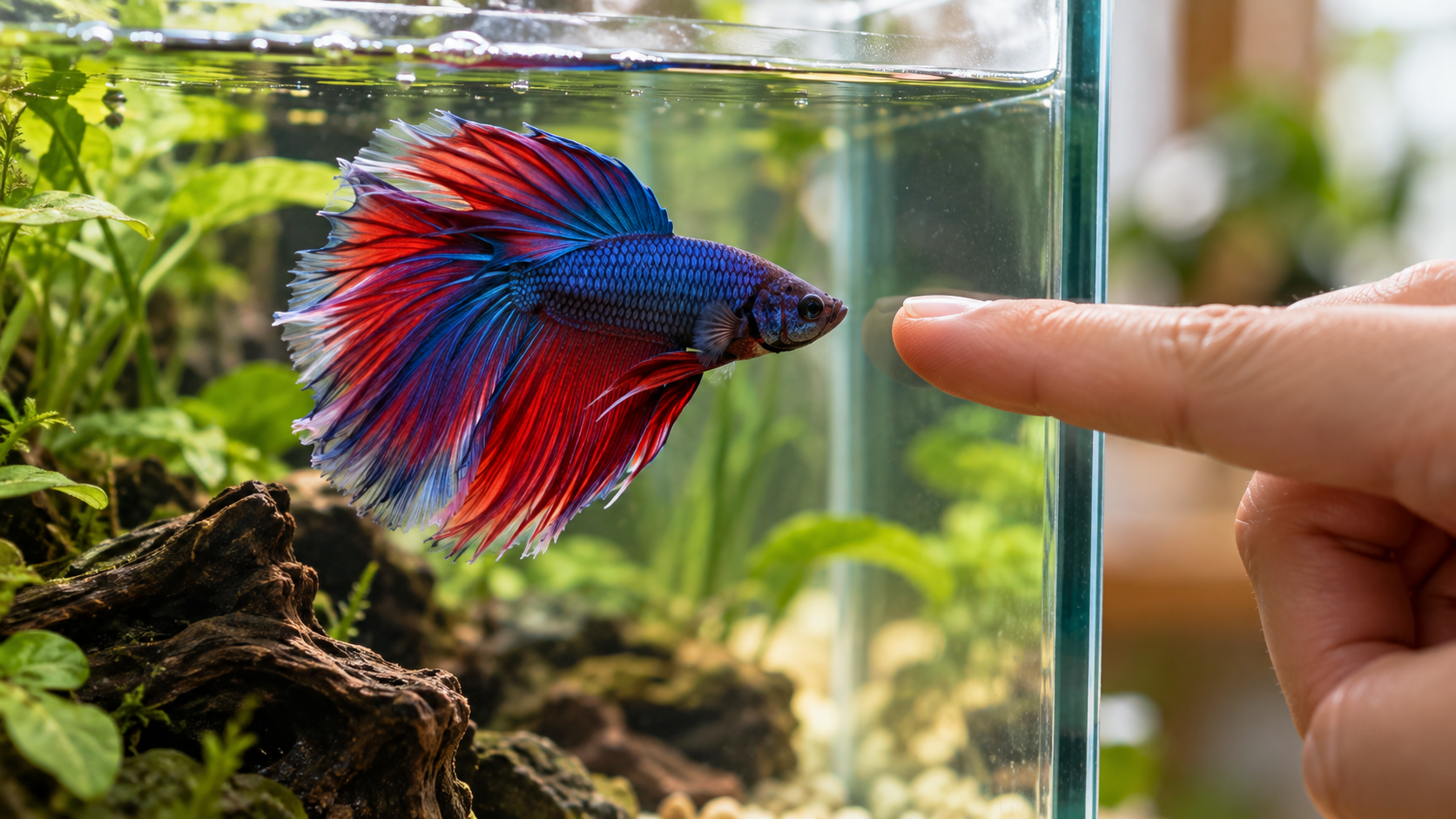
Can you pet betta fish? The sources we opened do not describe petting a betta as something that helps the fish, and the University of Florida stress publication treats handling as a stressor. Touching a betta with a hand or a net can remove protective mucus and damage scales and skin. For that reason, this guide advises against petting. Admire the fish from outside the tank, keep your hands out of the water when you can, and handle equipment only when a task requires it.
Quick answer
- The sources we opened do not describe petting or touching a betta as beneficial.
- UF/IFAS says that “Handling stress physically removes mucus from the fish.”
- The same source says that “Scales and skin are most commonly damaged by Handling Stress.”
- Any break in skin or a lost scale “creates an opening for invasion by pathogenic organisms,” so handling can raise the risk of infection.
What handling does to a fish
The UF/IFAS publication Stress: Its Role in Fish Disease defines the basic problem. It states that “Stress is a condition in which an animal is unable to maintain a normal physiologic state because of various factors adversely affecting its well-being.” Handling is listed among the procedural stressors that can push a fish beyond what it can tolerate.
The mechanism is physical as well as hormonal. The source explains that “Handling stress physically removes mucus from the fish. This results in decreased chemical protection, decreased osmoregulatory function (at a time when it is most needed), decreased lubrication thereby causing the fish to use more energy to swim.” Mucus is part of the fish’s barrier against infection and water balance, so removing it has consequences beyond the moment of touch.
The same source adds that “Any break in the skin or removed scale, creates an opening for invasion by pathogenic organisms.” A betta that has been handled may look fine on the day, but the skin and scale damage can become a route for bacteria or fungi. The source is about fish generally, not bettas only, but the mechanism applies to any scaled fish.
Why hands and nets are a problem
The sources we opened do not compare hands, nets, or other tools. The sourced point is simpler: handling removes mucus and damages skin and scales, whatever the tool.
Long fins are a further concern for bettas. The UF/IFAS betta publication describes the betta as a fish with “long fins developed by selective breeding in captivity.” Long, delicate fins are a reason to avoid catching a betta in a net or rubbing it with a hand. The source does not give a rule for fin damage, but it establishes that the fins are a bred trait and not a feature that tolerates rough treatment.
When a fish must be moved, the sources describe gradual steps rather than a quick grab. Merck Veterinary Manual warns that “Adding the fish directly, without a gradual equalization of temperature, can cause shock and stress.” The same page advises floating the bag with the new fish until the temperature equalizes. That guidance is about acclimation, but it shows that sudden changes in a fish’s environment are a stressor.
What water quality has to do with it
A stressed fish is less able to resist disease. The UF/IFAS publication says that “Stress compromises the fish’s natural defenses so that it cannot effectively protect itself from invading pathogens.” That makes handling a poor choice even when it looks gentle, because the fish may already be under other stress from water conditions. The UF/IFAS ammonia publication adds that low-level ammonia “will not tolerate routine handling as well as they otherwise would.” A fish that has been exposed to ammonia may handle even a small disturbance badly.
Before you think about handling, check the water. Merck Veterinary Manual states that “Poor water quality is the most common cause of environmental-related diseases in fish.” For heater choices, see do betta fish need a heater.
What to do instead
The practical alternative to petting is observation and a regular routine. Watch the fish’s appetite, breathing, fins, and color through the glass. Keep the tank in a place where the fish is not startled by constant traffic. Feed on a regular schedule so the fish learns the routine without any contact. The sources do not describe training or interaction, so any claim beyond observation would not be supported here.
When you must handle a betta, for example to move it in an emergency, use the least disruptive method. Work quickly and calmly, keep the fish in water as much as possible, and return it to a stable tank. For a water change, use equipment designed for the tank rather than your hands. The sources do not give a standard procedure, so this is general guidance and not a sourced protocol.
If your betta has a visible wound, a torn fin, or unusual behavior after handling, do not treat it based on this guide. Test the water, separate the fish if you have a suitable container, and contact an experienced fish keeper or an aquatic vet. Ask for advice before using any medicine.
For setup choices that reduce the need to intervene, see the best way to set up a betta tank. For tank size, see how big of a tank do betta fish need.
How we chose
This guide uses three sources opened on 2026-10-24: a UF/IFAS publication on stress and fish disease, a UF/IFAS publication on ammonia in aquatic systems, and a UF/IFAS publication on betta evolution, culture, and care. University extension publications were chosen because they explain mechanisms and can be checked. No retail page, product listing, or video was used. The guide does not recommend any product for handling.
What we could not verify
The sources we opened do not study whether bettas can recognize their owners or enjoy contact. The points below remain open.
What the sources do not say
- Whether bettas show any positive response to being touched or stroked.
- How much handling a betta can tolerate before lasting harm, because the sources do not set a threshold.
- Whether a particular net, cloth, or glove is safer than another, because the sources do not compare them.
- The exact signs that indicate handling damage in a betta specifically.
Frequently asked questions
Is it safe to touch a betta fish?
The sources do not describe touching as safe. UF/IFAS says handling removes protective mucus and can damage scales and skin, so this guide advises against it except when necessary.
Will my betta recognize me if I pet it?
The sources we opened do not address recognition or affection in bettas. This guide cannot confirm any benefit from petting.
What is the safest way to move a betta?
The sources do not give a standard method for moving a betta. Work calmly and keep the fish in water. For new fish, Merck’s acclimation advice of floating the bag to equalize temperature applies.
Can handling cause a betta to get sick?
The UF/IFAS stress publication says that damaged skin and scales create “an opening for invasion by pathogenic organisms,” and that stress weakens defenses. Handling is therefore a possible route to infection, though the sources do not measure how often it leads to illness.
What should I do if my betta is hurt?
Test the water, watch the fish closely, and contact an experienced fish keeper or an aquatic vet. Do not use medicine based on this guide.
Sources
- University of Florida IFAS Extension, “Stress: Its Role in Fish Disease” (FA005), https://edis.ifas.ufl.edu/publication/FA005, opened 2026-10-24.
- University of Florida IFAS Extension, “Ammonia in Aquatic Systems” (FA031), https://edis.ifas.ufl.edu/publication/FA031, opened 2026-10-24.
- University of Florida IFAS Extension, “Evolution, Culture, and Care for Betta splendens” (FA212), https://edis.ifas.ufl.edu/publication/FA212, opened 2026-10-24.