What to Feed Platy Fry
As an Amazon Associate we earn from qualifying purchases.
What to feed platy fry? Small meals of food they can actually swallow, given often enough to support fast growth without fouling the water. The sources checked for this guide say that pellet size matters, that young stock needs small meals fed more frequently, and that overfeeding is the most common feeding mistake. None of the sources studies platy fry by name, so the food types and feeding routine below rest on general fish-nutrition guidance.
Quick answer
- Feed fry small amounts several times a day rather than one large meal. The University of Florida says that rearing young stock “does require small meals fed more frequently.”
- Pick a food whose pieces are small enough for the fry’s mouth. The mouth gape of smaller fish may not allow them to eat a larger pellet.
- Remove uneaten food and avoid overfeeding, which the sources link to poor water quality and a dirty tank.
- Buy live foods only from a reputable source, and discard moldy feed.
Why feeding fry is different from feeding adults
Young fish grow faster than adults and need more food for their size, but their mouths and stomachs are much smaller. The University of Florida fish nutrition publication (FA096) makes the size point directly: “For larger fish, a very small pellet may be unacceptable and the mouth gape of smaller fish may not allow consumption of a larger pellet.” It also notes that manufactured feeds can be advantageous “when feeding juveniles and larvae that accept manufactured feeds.”
The same publication says that “rearing of young stock does require small meals fed more frequently.” This is the most direct guidance in the sources. For a home tank, it means splitting the day’s food into several small portions and watching how quickly the fry eat each one. The same publication says that “one feeding per day is plenty for most pet animals,” which is a guide for adults, not for fry.
Feeding rates are also a matter of species, age and water temperature. The Merck providing-a-home section says that “feeding methods and rates vary with species, age, system, and water temperature.” The sources do not give a feeding rate for platy fry, so use the portion-size and watching steps below rather than a fixed number.
Choosing the food
The sources describe commercial dried foods as a sensible base. The Merck providing-a-home section says that “commercial dried foods, such as pellets, flakes, or granules, are a good choice because they are usually formulated to contain the proper mix of nutrients for your fish when fed properly.” The phrase “when fed properly” is important. A good food cannot make up for careless feeding.
The UF/IFAS fish nutrition publication explains why pellet quality matters. It says that “pellets are typically the most complete diets” and that a complete ration should be uniform down to very small sizes. It also warns about sinking: pellets can sink rapidly unless they are extruded. For fry, a powdered or very small-pellet food that stays in the water column long enough to be eaten is the practical goal, but the sources do not name a specific product.
Flake foods also need a check. The Merck providing-a-home section warns that “fish that prefer to feed at the bottom should not be fed flakes that float on the surface.” Platy fry feed in the water column and at the surface, so a floating food can work, but watch where the fry are eating. If the food sits on the surface and the fry cannot reach it, the uneaten portion will foul the water.
Live foods and their risks
Live food can be useful for young fish, but the sources raise two warnings. The Merck disorders chapter says that “wild-harvested live foods may harbor parasites or other harmful organisms that can cause disease in fish,” and that “you should purchase any live foods from a reputable source.” This is a reason to buy live foods from a supplier that can say where the animals came from, rather than collecting them from ponds or ditches.
Mold is the second risk. The same chapter says that “moldy feeds should always be discarded.” It describes aflatoxin from a mold that grows on feed as a cause of tumors and death in fish. Store food in a dry, sealed container and check it before feeding. The providing-a-home section also advises that “food should not be stored for excessive periods of time,” so buy smaller quantities more often.
A daily routine for fry
The steps below are general guidance built on the sources above. They are not a tested feeding schedule.
- Split the day’s food into several small portions. The University of Florida supports small, frequent meals for young stock.
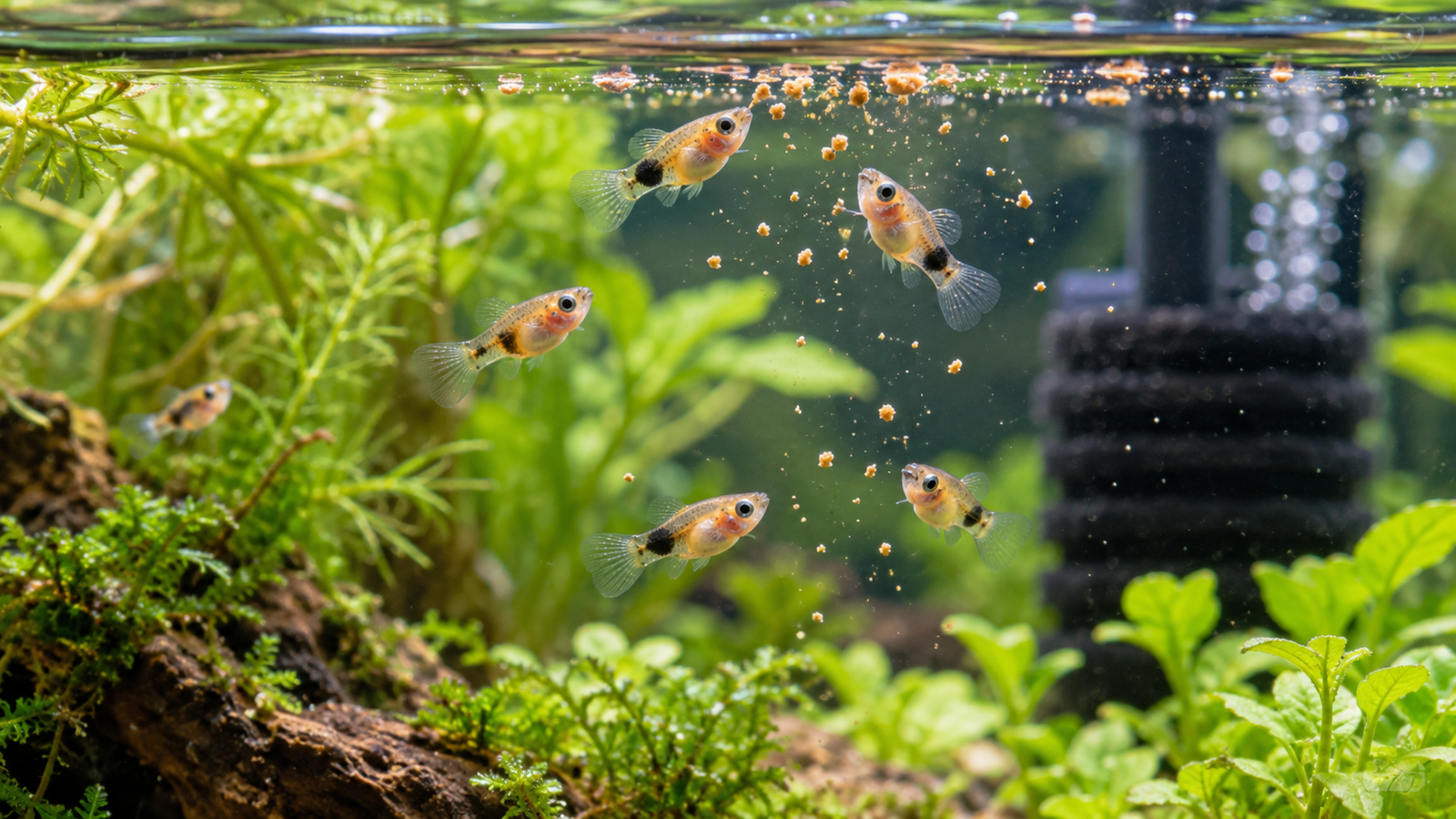
- Offer a small amount and watch until the fry have finished. If food is left floating or sinking to the bottom, the portion was too large.
- Remove any food the fry did not eat, using a net or siphon, so it does not break down in the tank.
- Use one main food and add variety. The Merck text says “a variety of foods should be fed, with one primary dietary source supplemented with other foods that provide necessary nutrients.”
- Test the water if feeding changes or the fry look unwell. The EDIS ammonia publication (FA031) says water quality should be tested “immediately any time fish appearance or behavior changes (including reduced feeding).”
For adult fish, the UF/IFAS publication gives a general maintenance guide of “0.5–1.0% body weight per day” and says fish “should probably be fed at least 5 days per week.” These are figures for adult fish in a production context. They are included here only to show that feeding is measured by body weight, not by appearance. The sources do not apply them to platy fry.
What to watch for
Food problems show up in the water and in the fish. The Merck providing-a-home section says that “overfeeding can lead to health problems as well as a dirty tank.” If the fry are not eating, if the water is cloudy, or if the fry look thin, check the food and the tank before changing anything else. Reduced feeding can be a sign of illness, so do not assume it is only a food problem.
The Merck routine health care page lists “changes in swimming behavior” and “weight loss” among signs of illness. If fry are losing condition despite regular feeding, speak with an experienced fish keeper or an aquatic veterinarian. This guide does not give medication doses or treatment steps.
For a broader look at small, colorful fish that suit a community setup, see small colorful freshwater aquarium fish. For water testing, see freshwater fish tank water test kits.
How we chose
The sources were selected for the question. The guide uses a university extension publication and a veterinary reference, all opened on 2026-10-24. Retail product pages and listings were not used. A feeding claim appears only when a source states it, or it is labeled as general guidance. Where a source covers fish in general, the guide says so and does not stretch it to platy fry.
What we could not verify
The sources are written for fish in general or for aquaculture. They do not give a complete feeding plan for a home platy fry.
What the sources do not say
- No source gives a feeding amount or schedule for platy fry.
- No source names a food, brand or pellet size written for platy fry.
- No source says how fast platy fry grow on any given diet.
- No source compares live foods, frozen foods and flakes for platy fry.
- The sources do not say how much protein a home platy fry needs.
Frequently asked questions
How often should platy fry eat?
The University of Florida says young stock needs small meals fed more frequently than adults. The sources do not give a number of feedings per day for platy fry, so watch how quickly the fry eat and adjust the number of small portions.
Can platy fry eat adult fish flakes?
The sources do not address this directly. They do say that pellet size matters, and that a fish’s mouth size can limit what it can eat. A flake that is too large or sits on the surface may not suit the fry, so check whether the fry can take it.
Are live foods safe for platy fry?
The Merck disorders chapter says wild-harvested live foods can carry parasites and that live foods should come from a reputable source. A safe choice needs a supplier that can say where the food comes from.
What happens if I overfeed fry?
Uneaten food breaks down and can degrade water quality, which the sources connect to disease. Overfeeding is named as the most common feeding mistake. Remove leftover food promptly and feed smaller portions.
When should I see a vet about feeding problems?
Contact an aquatic veterinarian or an experienced fish keeper if the fry stop eating for more than a short period, lose condition, or show unusual swimming. Reduced feeding can be a sign of illness, not only a food problem.
Sources
- UF/IFAS Extension, “Fish Nutrition” (FA096), https://edis.ifas.ufl.edu/publication/FA096 (opened 2026-10-24).
- UF/IFAS Extension, “Ammonia in Aquatic Systems” (FA031), https://edis.ifas.ufl.edu/publication/FA031 (opened 2026-10-24).
- Merck Veterinary Manual, “Providing a Home for Fish,” https://www.merckvetmanual.com/all-other-pets/fish/providing-a-home-for-fish (opened 2026-10-24).
- Merck Veterinary Manual, “Disorders and Diseases of Fish,” https://www.merckvetmanual.com/all-other-pets/fish/disorders-and-diseases-of-fish (opened 2026-10-24).
- Merck Veterinary Manual, “Routine Health Care of Fish,” https://www.merckvetmanual.com/all-other-pets/fish/routine-health-care-of-fish (opened 2026-10-24).