Best Catfish Tankmates for Your Betta Fish Tank
As an Amazon Associate we earn from qualifying purchases.
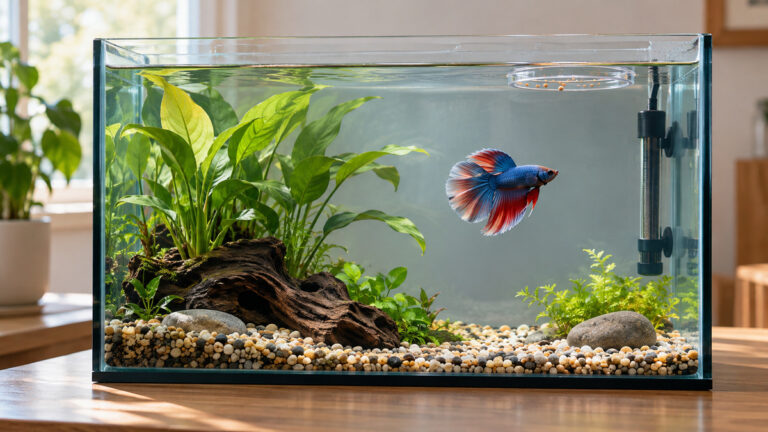
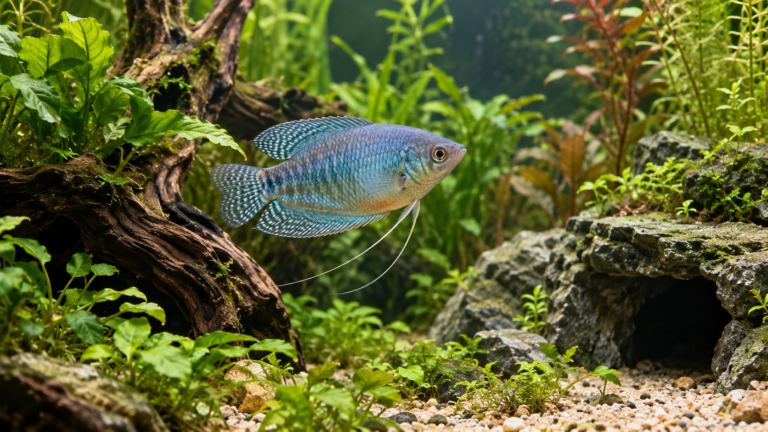
The best catfish for betta tank use are corydoras, and they are the group most guides point to. They are calm bottom feeders that eat sinking pellets and leftover food, and they spend their time near the substrate while a betta patrols the middle and top of the tank. The catch is that corydoras should be kept in a group of five or more, so the real question is less “which catfish” and more “is my tank big enough for a school and a betta.” This guide covers that question, then goes through the tank, hide and light listings that suit a shared setup.
Quick answer
- The usual choice: corydoras catfish, kept in a group of five or more.
- Space rule: allow about one gallon per inch of adult fish, so a group plus a betta needs a much larger tank than a betta alone.
- Set up: give the catfish a sinking-food routine, a smooth substrate area and a hide or two; give the betta its own cover higher up.
- Small tanks: the 1 to 1.2 gallon kits in this list are described for a single betta, not for a catfish group.
Why corydoras and bettas often work
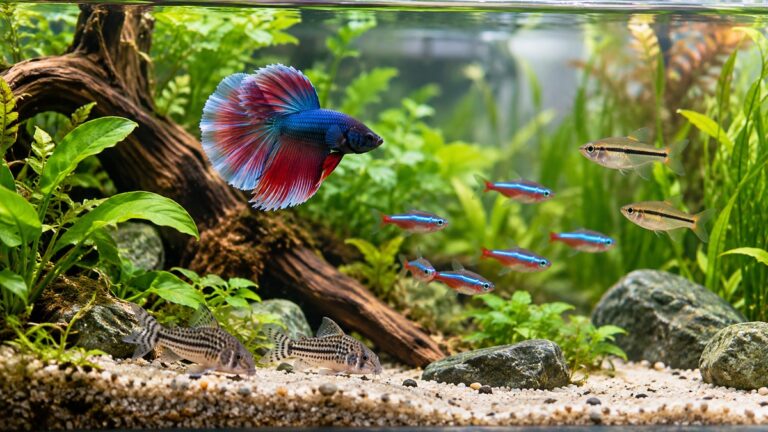
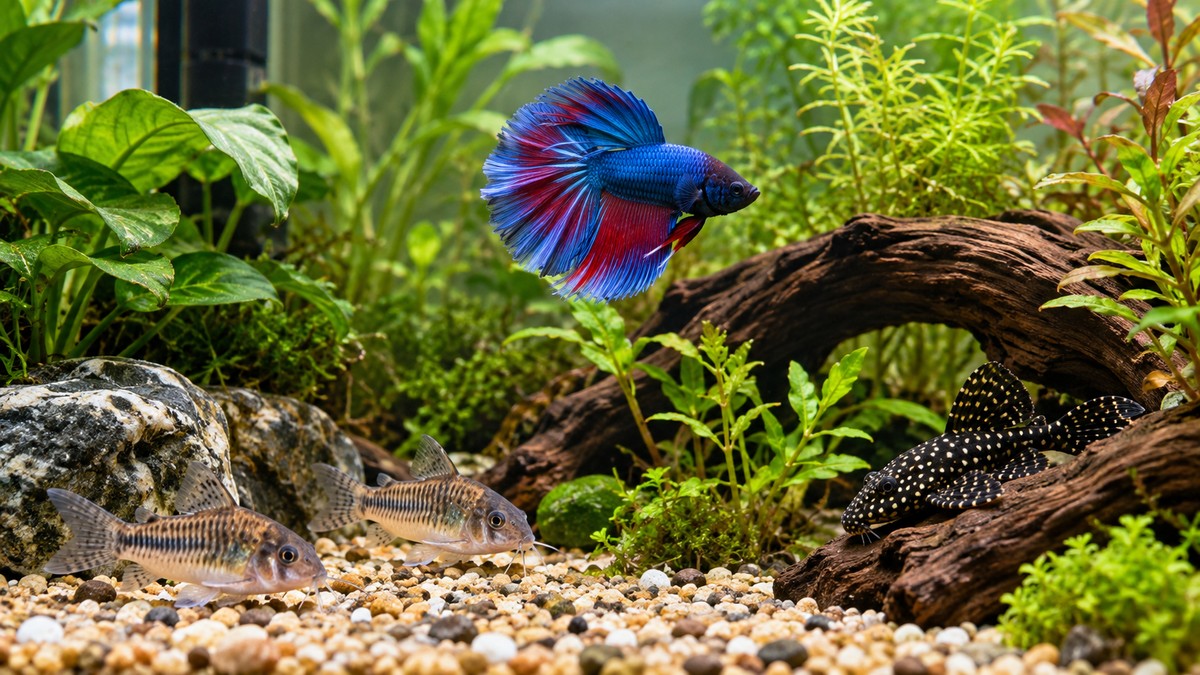
The pairing works for a simple reason: they occupy different parts of the tank. Corydoras feed on the bottom, eating sinking pellets, algae wafers and food the betta misses. A betta spends most of its time higher up, near plants and the surface where it breathes air. The two rarely compete for the same space, which lowers the chance of a territorial fight.
Two cautions apply. First, temperament varies between individual bettas, so a good match on paper is still something you watch in practice. Second, corydoras are social, which is why the guidance is a group of five or more. A single catfish alone is not the plan, and a group means more water volume.
For wider choices, including tetras, rasboras and snails, see our look at goldfish and bettas for a pairing to avoid, and the care article on what bettas like in their tank.
How much space do you need?
The benchmark from a major aquarium brand is one gallon per inch of adult fish. A single male betta can live in 1 to 5 gallons, and 10 gallons lets you add decor. Once you add a school, you add the total length of every fish. The same source works through a betta plus eight rasboras and arrives at 27 gallons or larger. Use that approach for corydoras: count the adult length of each fish, add the betta, and size the tank to the total. If you cannot reach the group size the guidance suggests, do not buy fewer catfish to squeeze them in; choose a tank that fits or skip the catfish.
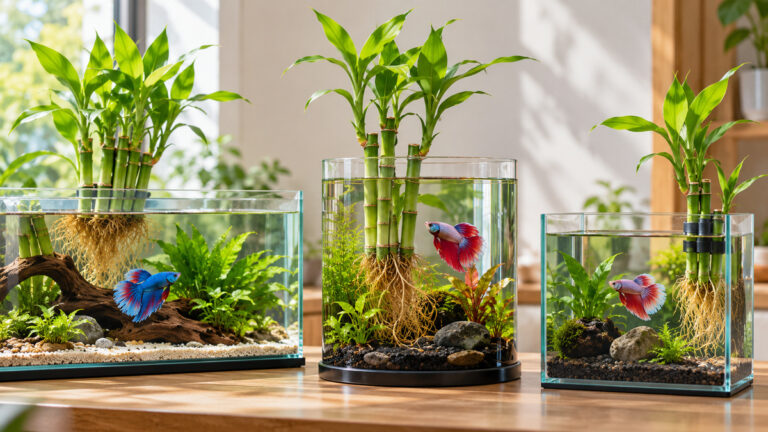
Tank kits are tempting because they come with equipment. Be realistic about which ones suit this plan. The 3.5 gallon kit in this list is described for a betta, small schooling fish or shrimp, not for catfish. The 1.2 and 1.1 gallon kits are described for a single betta or similar tiny residents. None of these listings mention catfish, so treat them as options for a betta-only tank, or as a first step before moving to a larger aquarium.
Setup that helps a betta and catfish share a tank
- Substrate area for the catfish. Corydoras live at the bottom, so leave open substrate in front of the decor rather than burying it.
- Hides for everyone. A cave at the bottom gives catfish and a stressed betta somewhere to retreat.
- Plants for cover. Live or plastic plants break sight lines. Live plants are recommended by guides, and a light that suits them helps.
- Feed on the bottom too. Sinking pellets reach the catfish before the betta can eat everything.
- Watch the first days. If the betta pursues the catfish constantly, separate them.
Before adding any fish, see how to introduce a betta to a new tank and the walkthrough on betta fish tank setup.
A planning example, step by step
Suppose you already own a betta and are curious about adding catfish. Work through it in order rather than starting at the store.
- Measure what you have. Write down the tank volume in gallons. If it is 5 gallons or less, the guidance describes that as a home for a single male betta, and the plan ends here.
- Add up the inches. Estimate the adult length of your betta (the guidance uses about 3 inches for a male betta) and add the adult length of every catfish you plan to buy, using the group size of five or more.
- Compare to the one-gallon-per-inch rule. If the total inches exceed your gallons, the tank is too small. Either upgrade or skip the catfish.
- Plan the layout. Reserve open substrate for the bottom feeders, place a cave in a corner, and put plants where the betta can rest near the surface.
- Choose the light and equipment. Match any light to the tank size its listing names, and confirm whether the adapter or timer is included.
- Add the fish gradually and observe. Feed sinking foods so the catfish get their share, and watch for chasing or nipped fins.
This sequence also tells you when not to buy. Many popular betta kits are sized from one to five gallons because bettas are often kept alone. Those tanks look attractive and cost little in space, but they leave no margin for a school of catfish, and there is nothing wrong with deciding that your tank is a betta-only home. The listings below follow the same split: some are for a betta-first tank, and one hide is explicitly marketed for corydoras and bettas alike.
It also helps to know what a listing can and cannot tell you. A product page states dimensions, materials, wattage and what is in the box. It does not tell you whether your particular betta will accept a neighbor. For that you rely on care guidance, patience and a spare plan, and for any health question you rely on a vet who treats fish.
The products
Only one listing in this pack mentions catfish, and it is a hide. The others are lights and tanks selected because they fit a betta-first setup that you may later expand. Their titles do not mention catfish, so none of them is described as a catfish product.
FISHNOSH Aquarium Cave, 5.1 x 2.7 x 2 inches
This is the listing that names corydoras directly in its title, alongside guppies, neon tetras and bettas. It is described as a handcrafted, driftwood-look cave for corners, made from BPA-free, non-toxic material (the specs say clay, dark brown, 1.2 pounds). The listing says units can be stacked or connected into a custom maze, that it needs no tools or glue, and that it fits into the corner of a rectangular tank. It also says it gives a secure zone to retreat from the occasional tank bully. For a mixed tank it is the most relevant item here, because bottom-dwellers and a betta each want a hiding place.
eWonLife 3.5 Gallon Betta Tank, all-in-one kit
An acrylic tank, 15 by 7.9 by 8.3 inches, that bundles a multi-stage filter, a heater held at 78 degrees Fahrenheit, a digital thermometer, an LED with timer, a water changer and a net, according to the listing. It describes a hidden design that keeps the gear out of sight, and states the 3.5 gallons suit a betta, small schooling fish like cardinal tetras or zebra danios, and ornamental shrimp. It does not name catfish, so treat it as a betta-plus-small-neighbors tank. A one-year warranty is listed.
AQUANEAT 1.2 Gallon Tank with LED and filter
The listing describes the tank for a single betta, a couple of shrimp, snails or a small goldfish, at 8 by 5.25 by 7 inches. It includes a sponge, a filter pump, a USB cord and two artificial plants, but not the USB power adapter. Keep it for a betta alone; at this size, a catfish group is not realistic under the one-gallon-per-inch rule.
Hiro Aquatics Full Spectrum LED with Bamboo Board, 5W
A 6000K full-spectrum lamp with a 360-degree swivel on a waterproof bamboo board measuring 8.5 by 9 inches, with a maximum light height of 18 inches. Its listing names nano aquariums and betta tanks and adds a one-year warranty. The title does not mention catfish; it is simply a light for a small planted betta tank, useful if you want live plants in cover areas.
AREPK Aquarium Light, under 7 gallons (9W)
Full-spectrum LED at 6000K with a timer for auto on and off, a 360-degree gooseneck, a 50-inch USB cord and a bamboo board. It is listed for tanks under 7 gallons and names betta tanks, moss and miniature landscapes. A 1-year warranty is listed. Choose this as the mid-size option if your betta tank is on the larger end of small.
AREPK Aquarium Light, under 3 gallons (5W)
The same design scaled for tanks under 3 gallons, at 5 watts, 9 by 8.6 by 15.7 inches, 0.89 kg. For a one- or two-gallon betta tank with a few plants.
Small Aquarium Clip-On Light, USB (two listings)
Two listings describe the same clip-on lamp for 1 to 5 gallon betta tanks: 48 beads, three modes, ten brightness levels, a swivel gooseneck and a 4.4 foot cord at 8 watts and 5V. The listings say neither a timer nor an adapter is included. One lists the waterproof field as True and the other as False. Clip-on lights suit rimmed tanks and let you adjust the brightness for plants and fish.
View on Amazon View second listing
Comparison
| Item | Role in a shared tank | Size cue |
|---|---|---|
| FISHNOSH cave | Hide for bottom dwellers and betta | 5.1 x 2.7 x 2 in |
| eWonLife kit | Complete betta tank | 3.5 gallons |
| AQUANEAT kit | Betta-only tank | 1.2 gallons |
| Hiro Aquatics light | Plant light for small tanks | Nano tanks |
| AREPK lights | Plant light with timer | Under 3 or under 7 gallons |
| Clip-on lights | Adjustable accent or plant light | 1 to 5 gallons |
Common mistakes with catfish and bettas
- Buying fewer than the recommended group. Corydoras are social; a lone fish is not what the guidance describes.
- Undersizing the tank. A group plus a betta needs far more than 5 gallons by the one-gallon-per-inch rule.
- Choosing fin-nippers by mistake. The same guidance warns against nippers, especially long-finned fish, so confirm what you are buying is a corydoras.
- Skipping hides. A cave or two lowers stress for both species.
- Forgetting water care. More fish means more waste; see why a betta tank turns cloudy.
FAQ
Can I keep one catfish with a betta?
The guidance recommends keeping corydoras in groups of five or more, so a single fish is not the setup it describes.
Is a 5 gallon tank enough?
A 5 gallon is listed as suitable for one male betta. A group of catfish adds a lot of inches, so a larger tank is the safer plan under the one-gallon-per-inch rule.
Do corydoras need special food?
They are described as eating sinking pellets, algae wafers and leftover betta food. Make sure food reaches the bottom.
Will my betta attack the catfish?
Individual bettas vary. Watch the first days, and separate the fish if the chasing does not stop.
Can the 3.5 gallon kit hold catfish?
Its listing names a betta, small schooling fish and shrimp, not catfish. Treat it as a betta tank first.
Where do I get advice on a sick fish?
Ask a vet who treats fish; do not guess based on an article.
Bottom line
If you want catfish with a betta, plan for a group of five or more corydoras, size the tank by the inches of fish, and add a hide for both. If your tank is 3.5 gallons or smaller, keep the betta alone and enjoy it.