What Do Betta Fish Like in Their Tank?
As an Amazon Associate we earn from qualifying purchases. Details
What do betta fish like in their tank? Betta fish like calm water, a warm and steady temperature, clean water that is changed on a schedule, and a regular day and night light cycle. The University of Florida IFAS betta publication and the Merck Veterinary Manual both describe these conditions. The sources say less about decorations and hiding places, so this guide keeps that part short and says where the evidence stops.
Quick answer
- Betta fish prefer calm water. The UF/IFAS publication says heavy filtration may be harmful to a betta’s welfare.
- Bettas do best in warm water. The same publication says they do not do well in cold water.
- Water management matters more than container size, according to the UF/IFAS source.
- Regular water checks, a heater for tropical fish, and a day and night light cycle are recommended by Merck.
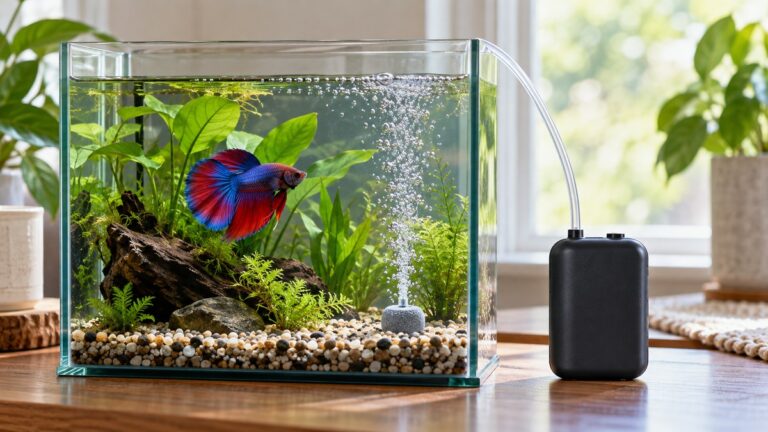
Calm water, not strong current
The clearest statement on flow comes from the UF/IFAS betta publication. It says, “Bettas prefer calm water as shown by research using flow as a stressor, so heavy filtration may actually be harmful to a betta’s health and welfare.” That sentence is the basis for the advice in this guide to choose a gentle filter and to avoid anything that pushes a strong current across the tank.
The same source describes the natural setting. “In the wild, the betta is typically found in standing waters, including shallow ponds, rice paddy fields, and even puddles.” A field study from Thailand, quoted in the same publication, describes those habitats as having heavy emergent vegetation, shallow water, low dissolved oxygen, high temperature, and an acidic pH. A tank is not a pond, and the field data do not set a target for a home aquarium. The natural setting does suggest that a betta is adapted to slow or still water.
In practice, this means checking the filter’s outflow before buying. The sources do not give flow rates for specific products. If the listing does not say whether the flow is adjustable, treat that as an open question and look for a model with a gentle or adjustable outlet. The guide on heaters for betta tanks covers the other equipment decision: do betta fish need a heater.
Warm, steady temperature
The UF/IFAS publication says, “As mentioned, bettas thrive in warmer water and do not do well in cold water.” It also gives a room-temperature guideline for a case where the tank is unfiltered and unheated: “the air temperature of the room should be maintained at no less than 22°C (71.6°F).” That is a minimum for the room, not a target for the water, and the source does not give a single water temperature for home tanks.
The Merck Veterinary Manual is more direct about heating. It states, “A heater is necessary for both freshwater and saltwater tropical fish.” Merck also says a heater typically has a programmable thermostat that can be set to control the water temperature. Betta fish are tropical fish, so the Merck statement is the most direct source support for using a heater in a betta tank.
Field readings from the Thailand study are included in the UF/IFAS publication. It publication reports an average water temperature of 29.9°C (about 86°F) at the sampled sites, with a range from about 27.0 to about 31.5°C. Those are measurements from wild populations, not a recommendation for a tank. They show that bettas tolerate warm water in the wild, which is consistent with the source’s description of warmer conditions, but they do not settle what temperature a particular heater should hold. Check the heater’s own instructions and a reliable thermometer for that. The related guide on how big of a tank do betta fish need covers the tank side of the same setup.
Clean water and regular changes
Water quality is the part of the setup the sources treat most strongly. The UF/IFAS publication says that “water quality is not dependent on the size of the container, but rather on management and husbandry.” A small tank can be healthy if it is managed well, and a large tank can go wrong if it is neglected.
The UF/IFAS ammonia publication explains why changes matter. It says, “Nitrite is toxic to fish at levels as low as 0.10 mg/L.” It also says that “A new biofilter requires six to eight weeks to build up sufficient bacteria” to reduce waste in a tank. A new tank therefore needs time before it can handle fish waste on its own, and a brand new betta tank should be tested before the fish goes in.
Merck gives a practical schedule for small tanks. It says more frequent water changes are needed in small aquariums, “perhaps as much as 50% per week.” That is a figure from a general source for small aquariums, not a rule for every betta tank, so it should be read as general guidance. Merck also warns that “Overfeeding can lead to health problems as well as a dirty tank.” Feeding a measured amount and removing uneaten food protects the water between changes.
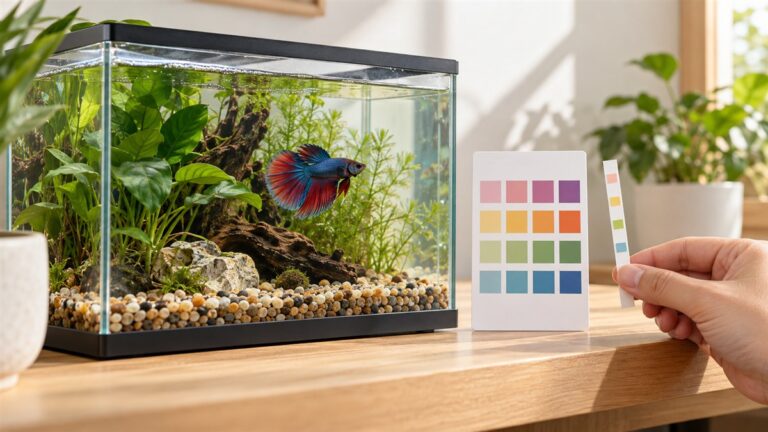
Merck’s routine care list includes checking the water with a test kit for “ammonia levels, nitrate and nitrite levels,” along with pH and temperature. A test kit is the only way to confirm these numbers. Ammonia has no smell at harmful levels, so a clean-looking tank can still be unsafe. The guide on the right tank size is a useful companion when deciding how much water a tank holds and how often to test it.
Light, plants and cover
Merck is clear on light. It says, “Fish need a day/night cycle for optimal health.” It adds that “Leaving the lights on 24 hours a day, 7 days a week stresses fish, leaving them more susceptible to disease.” A timer for a tank light is a simple way to keep that cycle steady. The tank should also be placed out of direct sunlight, because Merck notes that sunlight encourages algae growth.
Plants are described in the Merck source mainly as helpers for water quality. It states that “Aquatic plants also help prevent the growth of algae by absorbing nutrients that would otherwise feed the algae.” The same passage says plants can help oxygenate the water and can shade the water. Those are general benefits, and they apply to pond-style setups as well as tanks. The sources do not say that bettas need plants to be happy, and they do not name any plant as safe or unsafe for betta fins. Decorations that have sharp edges should be avoided, but that point is a matter of general care and is not stated in the sources opened for this guide.
How we chose
This guide uses only sources opened on 2026-10-24. The main reference is a UF/IFAS publication on betta evolution, culture and care. The water chemistry points come from the UF/IFAS ammonia publication. The housing and routine care points come from the Merck Veterinary Manual section on providing a home for fish. Those were chosen because they are university or veterinary references, not product pages. Retail listings were not used as evidence for any statement in this guide. Each quote was checked against the text of the opened page before it was included.
What we could not verify
Several parts of the question are not answered by the sources opened for this guide. The gap is stated here so that a reader does not mistake a general tip for a sourced rule.
What the sources do not say
- The sources do not give a single ideal water temperature for a home betta tank. They give a wild field average and a room-temperature minimum for unheated, unfiltered containers.
- The sources do not give flow rates for specific filters or say which filter models are gentle enough.
- The sources do not say how much decoration a betta prefers, or whether particular caves, leaves or floating objects are better than others.
- The sources do not give a tank volume for a betta, and they do not say that bettas need a particular amount of space to be comfortable.
- The sources do not say how fast a betta responds to a change in light or temperature.
Those gaps mean this guide cannot give a complete ideal list for a betta tank. It can give the conditions the opened sources support, and it can point to the tests and checks a keeper can run in their own tank.
Frequently asked questions
Do betta fish like strong current in their tank?
The UF/IFAS publication says bettas prefer calm water and that heavy filtration may be harmful to their welfare. A gentle outflow or an adjustable filter fits that guidance better than a strong one. The sources do not give a flow number, so check the product listing and the manufacturer’s instructions for the outflow details.
Do betta fish like warm water?
Yes, according to the UF/IFAS publication, which says bettas thrive in warmer water and do not do well in cold water. Merck says a heater is necessary for tropical fish. The sources do not specify one exact temperature, so use a thermometer and follow the heater’s own settings.
Do betta fish like bright light all day?
No. Merck says fish need a day and night cycle, and that leaving the lights on 24 hours a day stresses fish. A timer keeps the cycle consistent, and a tank should not sit in direct sunlight for long periods because that encourages algae.
Do betta fish need live plants in their tank?
The sources do not say bettas need plants. Merck describes what plants can do for the water, including absorbing nutrients that would feed algae and helping to oxygenate the water. Plants are a reasonable choice for water quality, but they are not stated as a requirement for the fish.
How often should the water in a betta tank be changed?
Merck gives a general figure for small aquariums of changing as much as 50 percent of the water per week, with more frequent changes needed in small tanks. The UF/IFAS ammonia publication explains why changes matter, because waste builds up and nitrite is toxic at low levels. A test kit is the best guide to whether the water needs a change sooner.
Sources
- UF/IFAS, “Evolution, Culture, and Care for Betta splendens,” FA212, https://edis.ifas.ufl.edu/publication/FA212 (opened 2026-10-24)
- UF/IFAS, “Ammonia in Aquatic Systems,” FA031, https://edis.ifas.ufl.edu/publication/FA031 (opened 2026-10-24)
- Merck Veterinary Manual, “Providing a Home for Fish,” https://www.merckvetmanual.com/all-other-pets/fish/providing-a-home-for-fish (opened 2026-10-24)