How an Aquarium Sponge Filter Works for Bettas
As an Amazon Associate we earn from qualifying purchases.
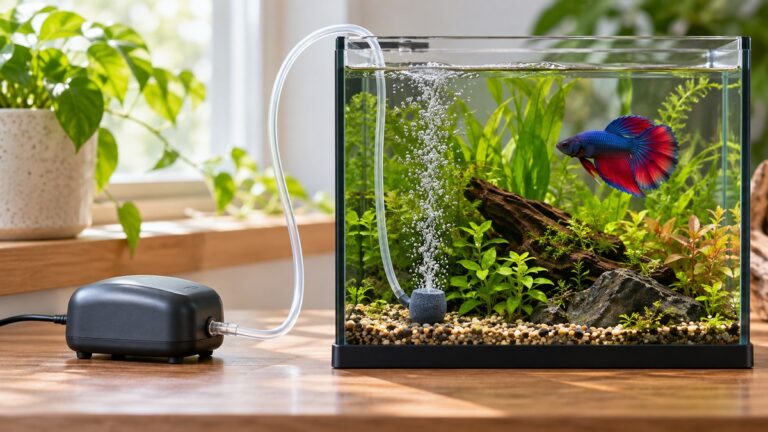
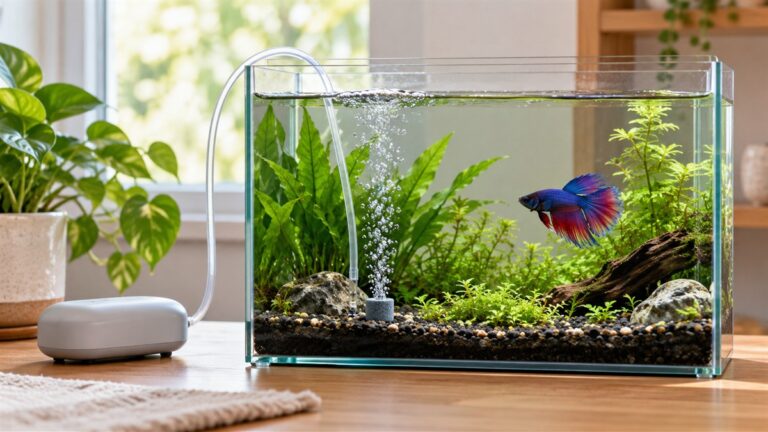
How does an aquarium sponge filter work? An air pump pushes bubbles up a tube inside or beside a block of foam; the rising bubbles pull water through the sponge, which traps particles and gives bacteria a surface to live on. The result is mechanical and biological filtration with a soft current, which is why this design is a popular match for bettas, fry and other small fish that dislike strong flow. This guide explains each part, what to expect, and how one listed model describes itself.
Quick answer
- The filter is driven by air, not by an electric impeller: an air pump, airline tubing and the sponge are all you need.
- The sponge works as a sieve (mechanical filtration) and as a home for bacteria (biological filtration).
- Flow is gentle, which suits bettas, and the sponge keeps small fish from entering the filter.
- Rinse the sponge in old tank water, never under the tap.
The parts
A sponge filter has few components, and that simplicity is part of its appeal:
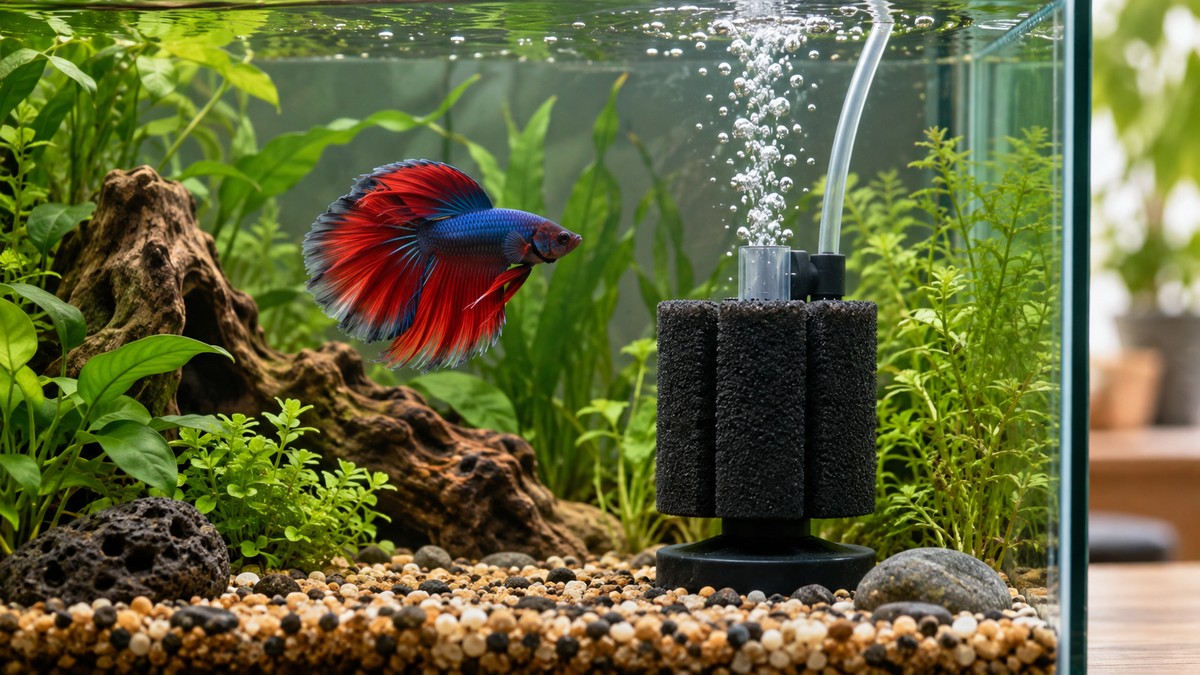
- The foam body. An open-cell block of foam with a hollow center. Water can pass through the pores, which are large enough to move water but fine enough to catch debris.
- The lift tube. A tube or opening in the middle of the sponge where air rises. On the model discussed below, the air pump connects to the top center of the filter.
- The air pump and airline tubing. These sit outside the tank. The pump pushes air through the tubing to the filter. They are not part of the sponge itself, and with many listings they are sold separately.
- Weight or base. Because the foam and the air inside it are buoyant, the filter has to sit on the bottom, sometimes with a weighted base, sometimes with extra weight you add.
The airlift step by step
General aquarium references class the sponge filter as an internal filter that works by airlift. The sequence looks like this:
- The air pump sends air down the tubing into the lift tube.
- Bubbles rise inside the tube. As they climb, they carry water upward with them.
- That rising water leaves a low-pressure area behind, so more water is drawn in through the sponge’s surface to replace it.
- Particles are caught in the foam as water squeezes through the pores, and the cleaned water leaves at the top with the bubbles.
The bubble stream also moves the surface a bit, which helps with oxygen exchange. The listing for the SunGrow filter says the small bubbles create “numerous minute bubbles for increased oxygen flow” and a slow current. The flow depends on the pump you attach, so a bigger or smaller pump changes the flow.
Two kinds of filtration in one block
Mechanical filtration
The foam acts as a sieve for uneaten food, fish waste and bits of plant or algae. The catch is that trapped waste is still in the tank. Mechanical filtration is ineffective if the solid waste is left to decay inside the sponge, because it adds back to the load. That is the reason you rinse the sponge rather than leaving it for months.
Biological filtration
The porous foam gives bacteria a large surface to colonize. In the nitrogen cycle, ammonia from fish waste and decaying matter is toxic. One group of bacteria turns ammonia into nitrite and another turns nitrite into nitrate, which is less harmful and removed by water changes (and absorbed by live plants). In a tank, most of those bacteria live in the filter media, so the sponge is both a filter and a bacteria home. The colonies take several weeks to establish, so a new tank stocked too quickly is at risk of “new tank syndrome”. For a betta, the sensible approach is to set up and run the sponge filter before the fish arrives. More on this is in our small sponge filter with air pump post.
Why bettas and sponge filters pair well
Bettas have long, delicate fins and are known as fish that do not like strong currents. The SunGrow listing makes this point itself: it says bettas generally prefer calm, steady water and that its filter is designed with a slow current. A sponge filter’s gentle, air-driven flow, and the fact that the intake is a wide foam surface rather than a narrow slot, make it a gentle option. General references also note that sponge filters suit small or lightly stocked tanks and are useful for rearing fry, because the sponge keeps small fish from being pulled in.
Compare designs in betta aquarium filters compared by flow, or look at size-specific advice in best 5 gallon sponge filter. If you want a model-specific look, there is a post on the Pawfly sponge filter.
What a sponge filter does not do
- It does not remove dissolved waste by itself. Nitrate still builds up; partial water changes remain necessary.
- It does not replace cleaning. The sponge can clog, and the tank still needs debris removal.
- It does not heat, light or aerate on its own, beyond the bubbles that come with the air pump.
- It is not a chemical filter. It does not carry carbon or other media unless you add them in another way. If you need media bags for a different filter, see filter media bags compared.
A listed example: SunGrow 10-gallon betta sponge filter
To make the explanation concrete, here is how one listing describes its product. These points come from the listing text and specifications, nothing else.
- Air pump required. The listing says the filter must be connected to an air pump, which is not included, and that it needs airline tubing, also not included.
- Tank size. It is listed as suitable for a tank up to about 10.5 gallons when used singly. The specs list a 10 gallon volume.
- Quantity. The listing is for 2 pieces (a count of 2).
- Fish. It is described as designed for betta, fry and other small aquatic pets, with a slow current.
- Fry support. The listing says the small bubbles and the sponge can provide a place for supplemental food for fry, since the sponge hosts food that supplements a daily diet.
- Base. The listing notes that the base is not weighted, so you may need to weigh it down.
- Cleaning. It says to wash it with water from the tank during a water change, rinsing and squeezing a few times until the water runs clear, and that it can be reused.
- Package. Listed weight is about 0.21 kg and the package size is 4.72 x 3.03 x 2.44 inches; the model number given is MNO-052.
The listing also claims betta and fry “will never get stuck” in the filter. Treat absolute statements like that as the seller’s claim, not a guarantee, and watch your fish and the intake the first days. View on Amazon
Setting one up
- Rinse the sponge in dechlorinated or tank water. Avoid soap.
- Attach the airline tubing to the filter’s connector and to the air pump.
- Place the pump above the waterline, or use a check valve so water cannot flow back down the tube if the pump stops. Protecting the pump from back-siphoning is a common hobby practice; read your pump’s own instructions.
- Weigh down the sponge if it floats, as the listing above suggests for its model.
- Run the filter for several weeks before adding fish, or add the fish only when the cycle is established.
- Check that the bubble stream is steady and the water current is calm enough for your betta.
Cleaning and maintenance
General guidance on cleaning filters without upsetting the biological balance is to rinse mechanical filter media in a bucket of aquarium water, not tap water. Tap water can contain chlorine or chloramine, which can harm bacteria. Squeeze the sponge gently; you want to release waste, not scrub the surface bare. Do this about the time of a water change, using the water you just took out. If you have two filters, clean one at a time; if you only have one, clean it lightly. A harsh clean can cause an ammonia spike. The SunGrow listing gives the same simple method: use tank water, rinse and squeeze until the water runs clear.
Common problems
The sponge floats
Air trapped in foam makes it buoyant. A weighted base or extra weight holds it down. Fully soak a new sponge so trapped air escapes.
Bubbles are too strong for the betta
Pick a smaller air pump or one with an adjustable output. Strong bubbling can push a long-finned fish around.
The flow slows down
A clogged sponge moves less water. Rinse it as described above.
It is noisy
Noise usually comes from the pump or from bubbles breaking at the surface, not from the sponge. Placing the pump on a soft surface may help. Specs for your pump will say more.
FAQ
Do I need an air pump for a sponge filter?
Yes. The air pump drives the airlift. The SunGrow listing says plainly that the pump and tubing are not included.
Is a sponge filter good for bettas?
Its gentle current suits fish that dislike strong flow, and the sponge cannot trap fins the way a narrow intake can. A betta still needs a suitable tank size, conditioned water and regular water changes.
Does a sponge filter provide biological filtration?
Yes. Bacteria colonize the foam and convert ammonia to nitrite and then to nitrate, once the colonies are established.
How often should I clean it?
There is no universal schedule in the sources checked. Rinse when flow drops or the foam looks packed with debris, and use tank water.
Can fry use a sponge filter?
General references describe sponge filters as useful for rearing fry because the sponge keeps small fish from entering the filter.
Bottom line
A sponge filter is an air-driven foam block that catches debris and hosts the bacteria that process ammonia, with a soft current that suits bettas. Pair it with a suitable air pump, weigh it down if needed, rinse it in tank water and keep up the water changes.