What Betta Pellet Size Is Right for Your Fish?
As an Amazon Associate we earn from qualifying purchases.
The right betta pellet size is small: no bigger than the fish’s eye. According to a feeding guide from Gensou, a betta’s stomach is roughly the size of its eyeball, and 1.0 to 1.5 mm pellets suit an adult, while 2 mm pellets are described as sized for community fish. Pellet size matters because an oversized pellet is hard for a small mouth to handle and uneaten food fouls the water. This article explains how to judge size, how many pellets to offer, how to tell if you are overfeeding, and which feeding accessories turned up in the listings.
Quick answer
- Choose pellets no larger than your betta’s eye; 1.0 to 1.5 mm is the range given for adults in the source.
- The source suggests two to four pellets per day in total, either one evening feed or two feeds of two pellets.
- Skip food one day a week, as the source describes a 24-hour fast.
- Cloudy water, an ammonia spike or a fish that floats sideways can signal overfeeding.
How to judge pellet size
The simplest check needs no ruler. Hold a pellet beside your fish, or lay one on the glass next to its head, and compare it to the eye. If the pellet is clearly bigger than the eye, it is too big. That matches the guide’s reasoning that the stomach is about the size of the eyeball, so a pellet that large fills the whole stomach at once.
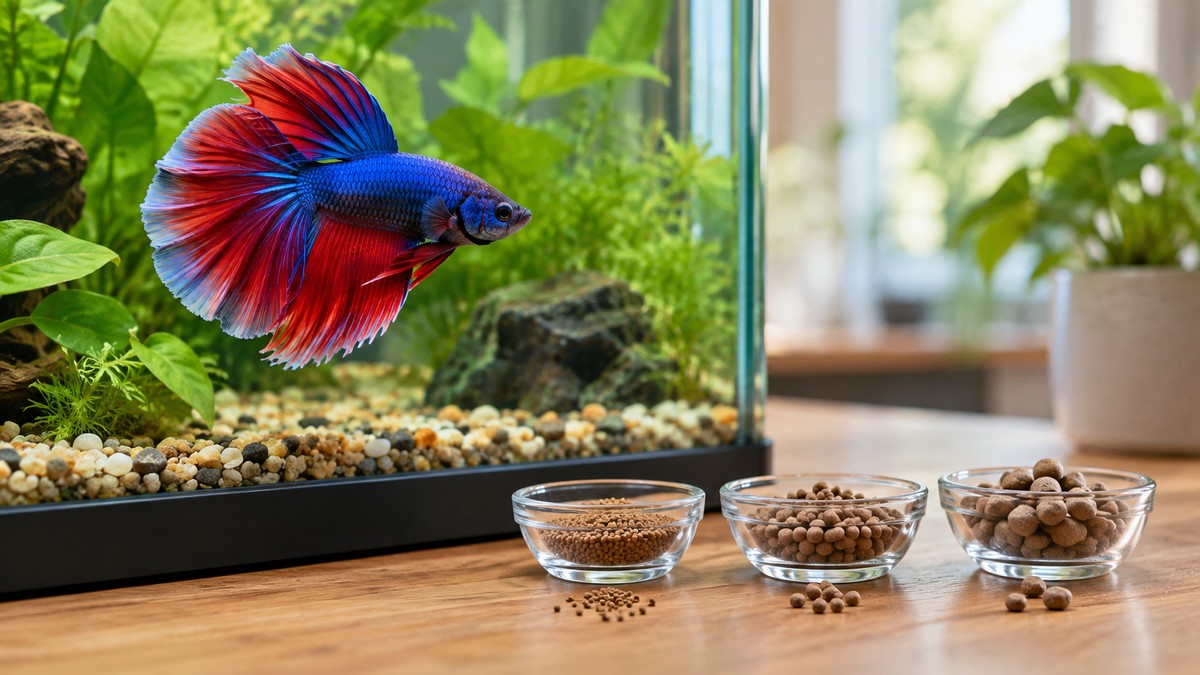
Packaging often lists pellet diameter in millimeters. The source gives 1.0 to 1.5 mm as suiting an adult betta and 2 mm as a size for community fish. A 2 mm pellet is therefore a step up for a betta, and the pellets sold for larger tank mates are not automatically right for yours. If a pellet is slightly large, you can offer it, but only watch whether the fish handles it easily. If it keeps spitting it out, move down a size.
Young or small bettas simply have smaller mouths than adults, so the same eye test applies: judge each fish by its own eye, not by an average.
How many pellets to feed
The Gensou guide says to feed two to four pellets per day in total. It describes two workable patterns: one feed of three to four pellets in the evening, or two feeds of two pellets each. Small portions are the point. A betta has a small stomach, and the guide ties overfeeding to the water problems listed below.
Timing matters too. The guide advises avoiding mid-afternoon feeding when tank temperatures reach 30 degrees Celsius or more, because heat slows digestion and uneaten food fouls faster. In a warm room, that makes an evening feed the safer pattern.
The weekly fast
The guide recommends skipping food one day a week. It describes a 24-hour fast that clears partially digested food from the gut, and suggests picking a fixed day such as Sunday so you never forget which day is the off day. It does not cover soaking pellets, so this article does not either.
Signs you are overfeeding
The same source lists the following signs:
- Cloudy water within 48 hours of a feed.
- Ammonia spikes.
- A layer of brown mulm on the substrate.
- A betta that floats sideways or refuses food.
The suggested response is a two-day fast, then half portions when feeding resumes, with symptoms usually clearing within a week. If a fish stays unwell, do not guess; ask a vet who treats fish.
A quick belly check helps too. A correctly fed fish has a subtle rounded belly that fades within four hours. A belly still distended after 24 hours suggests overfeeding, while visible ribs suggest underfeeding.
Feeding gear from the listings
None of the products below is a food, so none of them has a pellet size to compare. They are feeding and tank accessories from the listings that relate to how food reaches the fish. Read each listing’s own details before deciding.
SunGrow floating fish feeding ring
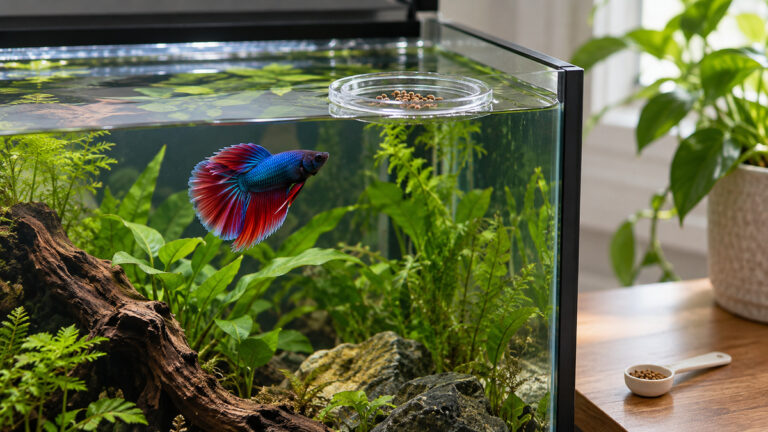
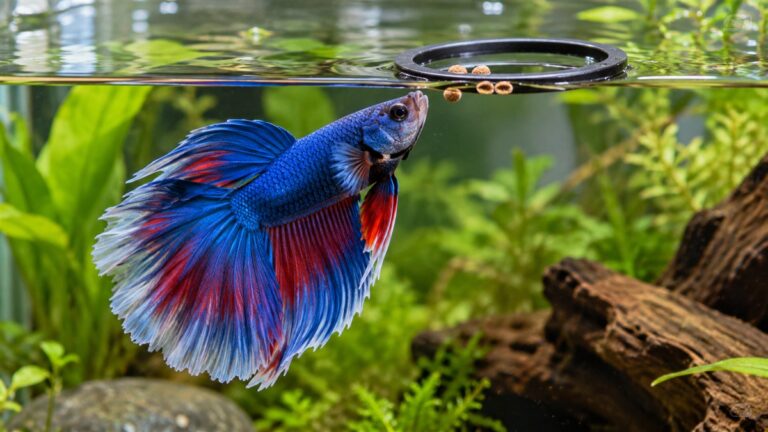
The listing describes a floating ring that stops water turbulence from washing food and floating plants into the filter. It says the ring lets you feed specialty foods to a pickier fish while sprinkling standard floating food for the general population, and that it encourages picky eaters. For a betta, the practical use is keeping a few floating pellets in one spot so they are easier to count and to see whether they were eaten. The listing does not state a size for the ring in the text available, so check dimensions before buying.
Aoyar automatic fish feeder, 200 ml
This is an automatic dispenser with a 200 ml capacity. The listing describes three fixed interval modes that rotate feeding every 8, 12 or 24 hours, plus a manual mode for feeding at any time. Because the guide above wants two to four small pellets a day, with a fast one day a week, a timed dispenser is only helpful if its portion can be matched to a betta, and the listing text available here does not state a portion size. It is better read as a close alternative for trips than as a fit for daily betta feeding.
Buddha head resin aquarium decoration
This is a decoration, not a feeding tool. The listing says it suits 20 to 30 gallon aquariums and even 55 gallon aquariums, and gives its size as 7.7 x 5.5 x 11.2 inches with a height of about 11.2 inches. It is marketed as a hideout for large tanks. It is here only because it was the closest large-tank betta cave in the pack; it will not suit a small betta tank, and it has nothing to do with pellet size.
4-piece faux silk aquarium plant set
This is a set of soft artificial plants. The listing gives plant heights of 4 inches and 2 inches, says they swing with the water, and says they are easy to clean and stable in water. It asks you to soak the plants in warm water before use. Plants like these give cover and, in a small tank, a place for uneaten pellets to catch, so a regular check of the tank floor after feeding is worthwhile.
Common mistakes with pellets
- Buying by brand instead of by size. Check the diameter on the package and compare it to the eye.
- Feeding community-fish pellets. The source lists 2 mm as a community size, one step above the adult betta range.
- Feeding in the hottest part of the day. Heat slows digestion and uneaten food fouls faster.
- Treating every begging look as hunger. A small rounded belly that fades within hours is the target, not a full one.
- Skipping the fast day. The guide wants one 24-hour fast every week.
If you are also wondering about your fish’s growth and size, our short piece on whether betta fish grow covers that angle.
FAQ
What size pellets do adult bettas eat?
The Gensou guide says 1.0 to 1.5 mm suits an adult, with pellets no bigger than the eye.
How many pellets should I give a betta each day?
The guide suggests two to four in total: one feed of three to four in the evening, or two feeds of two pellets.
Can a betta eat 2 mm pellets?
The guide describes 2 mm as sized for community fish. If the pellet is bigger than your betta’s eye, choose a smaller size.
Should I fast my betta?
The source recommends one fasting day a week, a 24-hour break that clears partially digested food from the gut.
How do I know if I fed too much?
Look for cloudy water within 48 hours, ammonia spikes, brown mulm on the substrate, or a betta that floats sideways or refuses food. The guide suggests a two-day fast then half portions.
Bottom line
Hold the pellet next to the eye: if it is bigger than the eye, it is too big. Feed two to four small pellets a day, fast one day a week, and treat cloudy water as a sign to cut back. For anything that looks like illness, ask a vet who treats fish rather than adjusting food alone.