How to Set Up an Aquarium Filter for Betta Tanks
As an Amazon Associate we earn from qualifying purchases.
Learning how to set up a aquarium filter comes down to a short sequence: read the manual, rinse the media, load it in the right order, fill or prime the unit with water, position it, and only then plug it in. The details differ between the small internal power filters that come in betta starter kits and canister filters built for big tanks. This guide covers both, explains where beginners go wrong, and shows what four listed products say about their own setup and upkeep.
Quick answer
- Never run a filter dry. Fill or prime it with water before power goes on.
- Rinse new media to clear dust, then load it from coarse (mechanical) to fine, with biological media next and chemical media last.
- Keep the flow gentle for a betta. Fixed-flow kit filters are already small; canister filters need the outlet aimed or baffled.
- Follow the manual for your exact model, since the listings below give different upkeep intervals.
Before you start
Lay the box contents out and compare them to the parts list. A guide from Fish Tank Advisor notes that some canister models have more than 40 parts, so it is worth checking before you are halfway through assembly. Decide where the filter will sit and make sure the power cord reaches an outlet. Keep a drip loop in the cord so water cannot run down it to the socket, which is a general safety habit; for anything electrical you are unsure about, ask an electrician.
Step 1: rinse the media
New filter media carries dust. The Fish Tank Advisor guide says to rinse all media before loading it, which also clears trapped air bubbles. Hobby sources found in a search agree that plain tap water is acceptable only for brand-new, unseeded media. Once media has bacteria growing on it, rinse it in old tank water or dechlorinated water instead, because chlorine can kill the bacteria you want to keep. Pre-seeded biological media should not be rinsed at all, according to one source. If you are unsure which applies, read the packaging.
Step 2: load the media in order
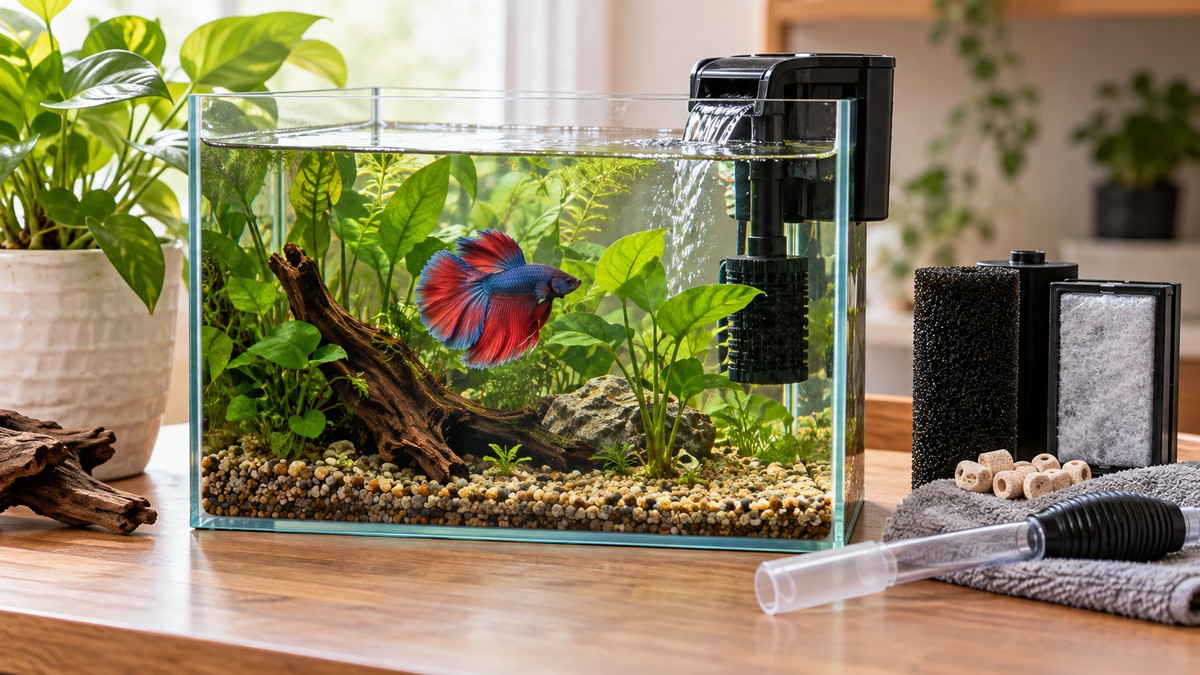
The order used in the canister guide runs from bottom to top: mechanical sponge first to catch debris, then activated carbon if you use it, then biological media such as ceramic rings, then a fine pad on top. Other sources describe the same logic as mechanical, then biological, then chemical. Do not overpack the baskets, because stuffed media restricts water flow. Small kit filters usually take a single cartridge, so this step is just seating the cartridge as the manual shows.
Step 3: place the filter
Internal filters sit inside the tank, usually in a corner, fully submerged as directed. Hang-on-back units clip to the rear rim. A canister filter goes below the aquarium, because gravity feeds the pump; the Fish Tank Advisor guide warns that placing one beside a tall tank can weaken siphon flow and starve the pump. Leave room to slide the canister out for maintenance, and check that it will be reachable once the stand is closed up.
Step 4: connect hoses (canister filters)
Connect an intake and a return hose and leave enough slack to pull the canister out. Kinks restrict flow, and the guide points out that silicone tubing resists kinking better than stiff vinyl. Cut hose ends squarely so they grip barbs evenly, and hand-tighten plastic clamps because tools can crack them. Keep the intake screen on at all times so fish and snails cannot get into the impeller.
Step 5: prime, then power on
A canister must be full of water before you plug it in, since running the pump dry can damage the impeller. Use the primer button, if there is one, or follow the manual to start the siphon. Some air is normal on the first run. If the impeller grinds, an air pocket is probably trapped: unplug it, wait about 30 seconds, and start again. Hang-on-back filters often need their housing filled with tank water first, and small internal filters have to be submerged before they run. Check each connection for leaks in the first minutes, and make sure the O-ring sits flat and untwisted.
Step 6: aim the flow for a betta
Bettas have long fins and prefer a calm surface, so flow matters more than raw capacity. Aim the outlet along the glass or at a decoration to break the stream, and watch whether the fish struggles to swim. Our page on filter current that is too strong goes deeper, and betta aquarium filters compared by flow lists gentle options. A filter also needs time to build up bacteria, so a new tank still needs patience; our general walk-through is how to set up a tropical fish tank.
Four filters and kits, and what their listings say about setup
SW Products 3-Gallon Aquarium Starter Kit
This round, globe-style kit lists an included Easy-Flow power filter, a filter cartridge, a full hood, an LED light and an illustrated user guide. The filter is described as a fixed-flow internal unit at 25 GPH operating at 30 dB; the listing says the adjustable settings apply to the LED light only and that flow rate is fixed. Care directions in the listing say to rinse the tank with cold water only before first use, never soap or warm water, and to replace the cartridge monthly; another line recommends replacing every 3 to 4 weeks, with XS cartridges sold separately. The tank is 3 gallons and lists betta fish as the target species. Setup is mostly following the included guide.
Koller Products 6-Gallon AquaView 360 Aquarium Kit
A 6 gallon cylindrical kit with LED lighting and an internal power filter. The listing gives the filter flow as 45 gallons per hour and says it uses Koller Products S replacement cartridges, model AQ10FC-60. The light has a timer with 4 hour, 8 hour and continuous settings. Dimensions are listed as 11.5 inch diameter by 19.5 inches high, and betta fish are among the listed species. Because the flow figure is higher than the 3 gallon kit, aim the outlet with care in a betta tank.
Fluval 207 Performance Canister Filter
For tanks up to 45 gallons according to the listing. It lists eTEC technology, a quiet motor, a vertical pre-filter cartridge with independent access, and EZ-Lift media baskets with a center handle for removing the media stack without emptying the canister. The specs give a maximum flow of 780 liters per hour and a 10 watt rating. This is far more filter than a betta tank needs, so it makes sense when you have a large community tank.
Fluval 307 Performance Canister Filter
The larger sibling, listed for tanks up to 70 gallons. It shares the eTEC technology, the vertical pre-filter cartridge and the EZ-Lift baskets. The specs list a maximum flow of 1150 liters per hour, 16 watts and a weight of 6 pounds. The listing does not state a betta use, so it is a match for large tanks, not a single small betta tank.
Keeping the filter working
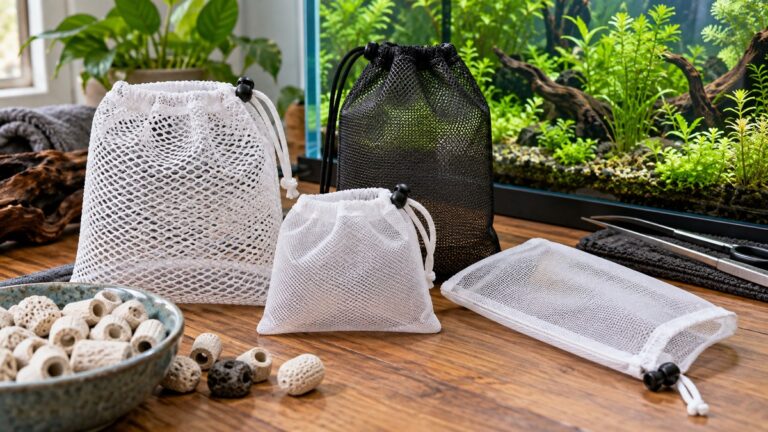
Hobby sources suggest rinsing mechanical media every two to four weeks in old tank water, and cleaning biological media only when it is dirty or flow drops. The kit listings above give their own cartridge intervals, so follow the maker for your model. Do not replace everything at once if you can avoid it, because the bacteria on the media are doing much of the work. For media storage and swaps, our page on filter media bags and the one on fine filter pads help with custom setups.
FAQ
Can I plug the filter in before adding water?
No. Running a filter dry can burn out the motor or damage the impeller. Fill or prime it first, as the manual says.
Do I rinse filter media with tap water?
Brand-new, unseeded media can be rinsed in tap water according to several sources. Established media should be rinsed in old tank water or dechlorinated water.
Where should a canister filter go?
Below the tank, so gravity feeds the pump.
How often do I change the cartridge?
It depends on the model. The SW Products listing recommends monthly, and also mentions every 3 to 4 weeks. Check the manual for yours.
Is a big filter better for a betta?
Not necessarily. A betta wants gentle flow, so bigger filters need baffling. Match the filter to the tank size on the listing.
What if the filter makes a grinding or humming noise?
For grinding, unplug it, wait about 30 seconds and restart in case air is trapped. A hum in a wooden cabinet can be dampened by placing corrugated cardboard under the canister, per the Fish Tank Advisor guide.
Bottom line
Rinse, load coarse to fine, fill the unit with water, place it correctly and then plug in. For one betta, a small kit filter at a gentle flow is enough; save canisters for big tanks.