How Do I Set Up a Tropical Fish Tank? Step by Step
As an Amazon Associate we earn from qualifying purchases.
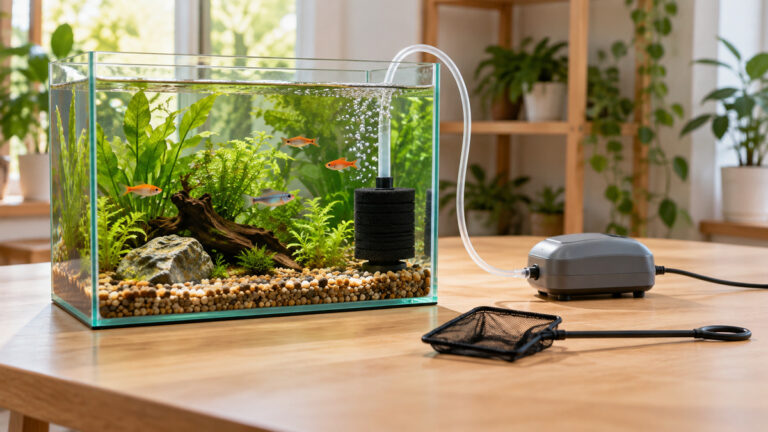
If you are asking how do i set up a tropical fish tank, the sources give a clear order of steps. To set up a tropical fish tank, place it on a strong, level stand away from direct sun, fill it before turning on electrical equipment, install a heater and filter, test the water, and allow the biofilter to establish before adding fish. The Merck Veterinary Manual is the main source for this order of steps. It states that “Filters, pumps, heaters, and lights should not be turned on until after the tank is filled with water.” Bettas are tropical fish too, so the same logic applies to a betta tank.
Quick answer
- Choose a strong, level stand. Merck says “The floor and the tank stand or cabinet must be strong, level, and stable.”
- Fill the tank before plugging in the heater, filter, or lights, and do not plug in the heater until the tank is full.
- Test the water before adding fish, and add fish gradually so the biofilter can keep up.
- Expect the biofilter to take several weeks. Merck says bacteria develop “in 4 to 6 weeks,” and UF/IFAS says “six to eight weeks.”
Step 1: Choose the location
Place the tank where you can reach it easily for feeding, cleaning, and maintenance. Merck says the aquarium “should be placed in a location that you can get to easily for feeding, cleaning, and general maintenance.” The floor and stand must be able to carry the load. Merck notes that “1 gallon (3.8 L) of water weighs 8.3 lb (3.8 kg), even a small aquarium can be extremely heavy relative to its size.”
Keep the tank out of direct sunlight. The source says “The tank should be located out of direct sunlight,” because sun encourages algae and can change water temperature. Also plan for power. Merck recommends checking whether outlets are grounded and considering a surge protector for equipment that runs for long periods.
If you already own a stand, check that it is level before you add water. A tank that sits unevenly can put stress on the glass seams. The sources do not give a weight rating for specific stands, so use the manufacturer’s rating for your tank and stand.
Step 2: Set the substrate and decor
Rinse gravel before adding it. Merck says gravel should be “rinsed thoroughly to remove any accumulated dust,” because dust “can prematurely clog filters and damage water pumps.” The source describes gravel at about one pound per gallon, but this guide does not repeat that figure as a rule, because the same passage does not set it for bettas.
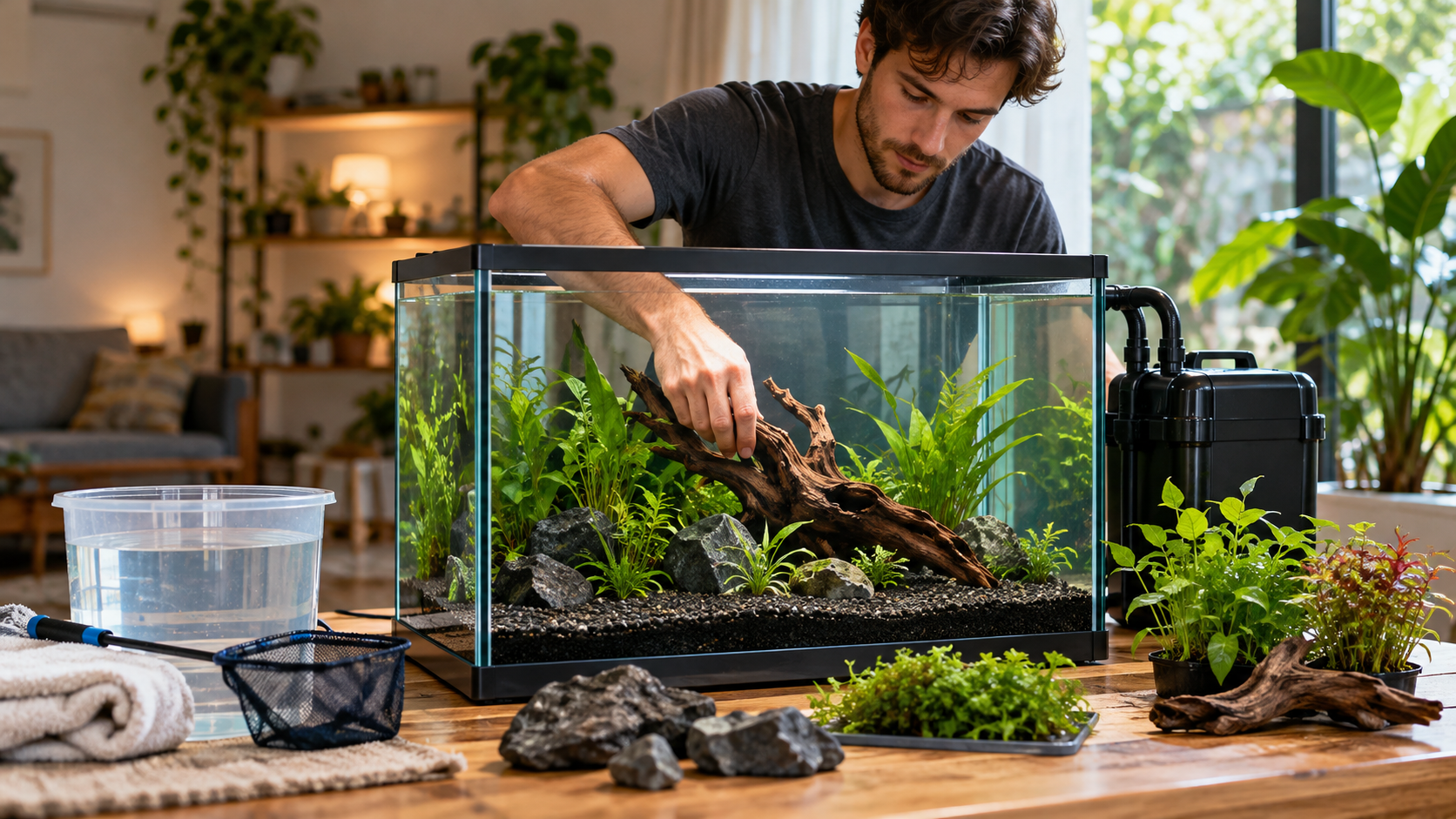
Place large decor such as rocks or driftwood before filling. Merck explains that such objects are “easier to place before the tank is filled with water because they can be moved much more easily.” Decor also divides the tank, which can matter for territorial fish. The sources we opened do not give a decor material for bettas.
Step 3: Fill and power on in the right order
Fill the tank first. Merck says the heater should not be plugged in “until the tank is full of water,” because the glass tube “may shatter if not surrounded by water.” Filters, pumps, and lights should also wait until the tank is full. Merck notes that many submersible pumps “need the water to keep them cool and running safely.”
Tap water usually needs treatment. Merck says that most city water is treated with chlorine or chloramine, and that water “will probably require treatment in one or several ways.” Follow the label of the treatment product you use. The sources we opened do not compare specific conditioners.
Once powered on, set the heater and check the temperature. The UF/IFAS betta publication says that “bettas thrive in warmer water and do not do well in cold water.” For a heater choice, see do betta fish need a heater.
Step 4: Choose a filter with care
Merck explains that “Filtration is important to remove waste and particulate matter.” Merck describes hanging filters, which draw water through a replaceable cartridge, and under-gravel systems, in which the gravel itself acts as the filter medium. For bettas, the UF/IFAS betta publication says that “Bettas prefer calm water as shown by research using flow as a stressor, so heavy filtration may actually be harmful to a betta’s health and welfare.” Choose a gentle filter and check whether the flow can be adjusted.
The filter is also where the biofilter lives. Merck notes that many hanging filters hold a medium for nitrifying bacteria, which is the biofilter discussed in the cycle step below.
For a tank size that gives a filter room to work and a betta room to move, see how big of a tank do betta fish need.
Step 5: Set the light cycle
Lights should follow a schedule. Merck says that “Fish need a day/night cycle for optimal health,” and that leaving lights on all the time “stresses fish, leaving them more susceptible to disease.” A timer is a simple way to keep the schedule consistent. The sources do not specify hours of light for a betta tank.
Step 6: Cycle the tank before adding fish
The biofilter needs time. Merck explains that “These bacteria are common in the environment and will develop on their own in 4 to 6 weeks. Commercial products may speed up the process slightly, but these are not necessary for most home aquariums.” UF/IFAS gives a longer window: “A new biofilter requires six to eight weeks to build up sufficient bacteria to effectively reduce ammonia and nitrite levels.”
Test for ammonia and nitrite during this time. The UF/IFAS ammonia source explains that “a good ammonia test kit will include a TAN test, a pH test, and a thermometer.” Wait until test readings show the tank is handling waste before adding the first fish. The sources also explain why the wait cannot be skipped.
Step 7: Add fish gradually
Merck says that “Adding too many fish at once will overwhelm the available bacteria, and toxins will build up quickly.” It advises that “it is best to add fish gradually, 1 or possibly 2 at a time.” When you add a fish, float the bag in the tank for about 20 to 30 minutes so the temperature can equalize. The source warns that “Adding the fish directly, without a gradual equalization of temperature, can cause shock and stress.”
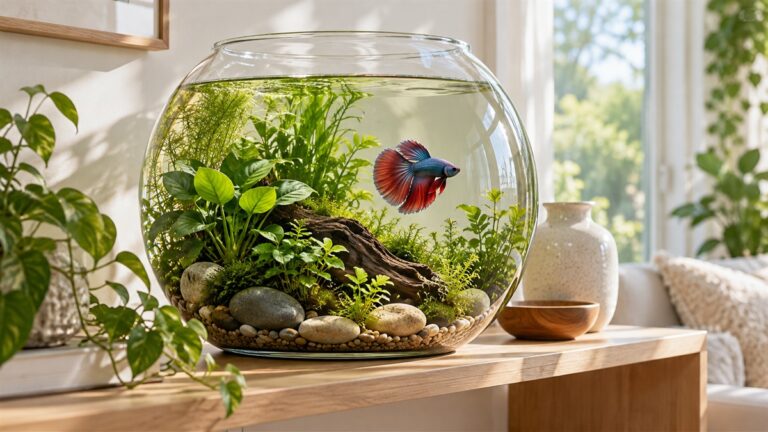
For a betta-specific setup, the same general steps apply. For a checklist that covers the betta tank, see the best way to set up a betta tank. For the question of whether bettas need larger tanks, see do bettas like big tanks.
How we chose
This guide uses three sources opened on 2026-10-24: a Merck Veterinary Manual page on providing a home for fish, a UF/IFAS publication on ammonia in aquatic systems, and a UF/IFAS publication on betta evolution, culture, and care. The Merck page was chosen as the main source because it covers the order of setup steps. The UF/IFAS sources were chosen for the cycle and betta-specific points. Retail setup guides, kit listings, and product pages were not used.
What we could not verify
Setup advice varies by tank size, equipment, and location, and the sources we opened do not cover every case. The points below are not settled by this guide.
What the sources do not say
- A specific heater wattage, filter flow rate, or light hour count for a betta tank.
- Whether the steps above are complete for a particular kit, because kits differ in what they include.
- How to set up a planted tank, because the sources we opened focus on general setup.
- Which filter, heater, or conditioner brand to buy, because the sources do not compare products.
Frequently asked questions
Should I fill the tank before turning on the heater?
Yes. Merck says the heater should not be plugged in “until the tank is full of water,” and that filters, pumps, and lights should also wait until the tank is filled.
How long should I wait before adding fish?
The sources give four to six weeks (Merck) and six to eight weeks (UF/IFAS) for a new biofilter to develop. Test the water rather than relying only on the calendar.
How many fish can I add at once?
Merck advises adding fish gradually, “1 or possibly 2 at a time,” so the bacteria can keep pace with waste.
Does tap water need treatment before filling?
Merck says tap water “will probably require treatment in one or several ways,” depending on whether the city uses chlorine or chloramine. Follow the treatment product’s label.
Can a tropical tank run without a heater?
Merck states that “A heater is necessary for both freshwater and saltwater tropical fish.” For bettas, the UF/IFAS publication says they “do not do well in cold water,” so a heater or a stable warm room is needed.
Sources
- Merck Veterinary Manual, “Providing a Home for Fish,” https://www.merckvetmanual.com/all-other-pets/fish/providing-a-home-for-fish, opened 2026-10-24.
- University of Florida IFAS Extension, “Ammonia in Aquatic Systems” (FA031), https://edis.ifas.ufl.edu/publication/FA031, opened 2026-10-24.
- University of Florida IFAS Extension, “Evolution, Culture, and Care for Betta splendens” (FA212), https://edis.ifas.ufl.edu/publication/FA212, opened 2026-10-24.