How to Use Seachem Prime
As an Amazon Associate we earn from qualifying purchases. Details
Quick answer: Add Prime to the new tap water before that water goes into the betta tank. Seachem’s dosing page gives 1 capful (5 mL) per 200 liters (about 50 gallons) of new water. For smaller changes, it gives 0.1 mL per gallon, which a capful cannot measure. Use a measuring tool that reads fractions of a milliliter.
Sources: Seachem’s knowledge-base article “Info: Seachem Prime dosing instructions”, read on 2026-10-17, which gives the dosing tables quoted below. The Amazon page for the 250 ml bottle, read on 2026-10-17, confirmed the title and size only. Its bullet points were cut off in our read, so no product claim from that page is used. Prime does not replace a filter, a heater or a clean tank, and for a sick fish or any treatment dose, ask an experienced fish keeper or an aquatic vet.
What the person typing this wants
The person typing “how to use Seachem Prime” wants a dose and an order of steps for a water change. They do not need the chemistry of water treatment. This guide gives the dose, the steps, the small-volume arithmetic, and the mistakes that cause problems.
Quick steps for a betta water change
- Remove part of the old water. Take out the amount you plan to change, not all of it. The filter bacteria live in the tank, and removing everything removes them too.
- Fill a bucket with new water. Use a bucket kept only for fish. Bring the new water near the tank temperature, and check it with a thermometer.
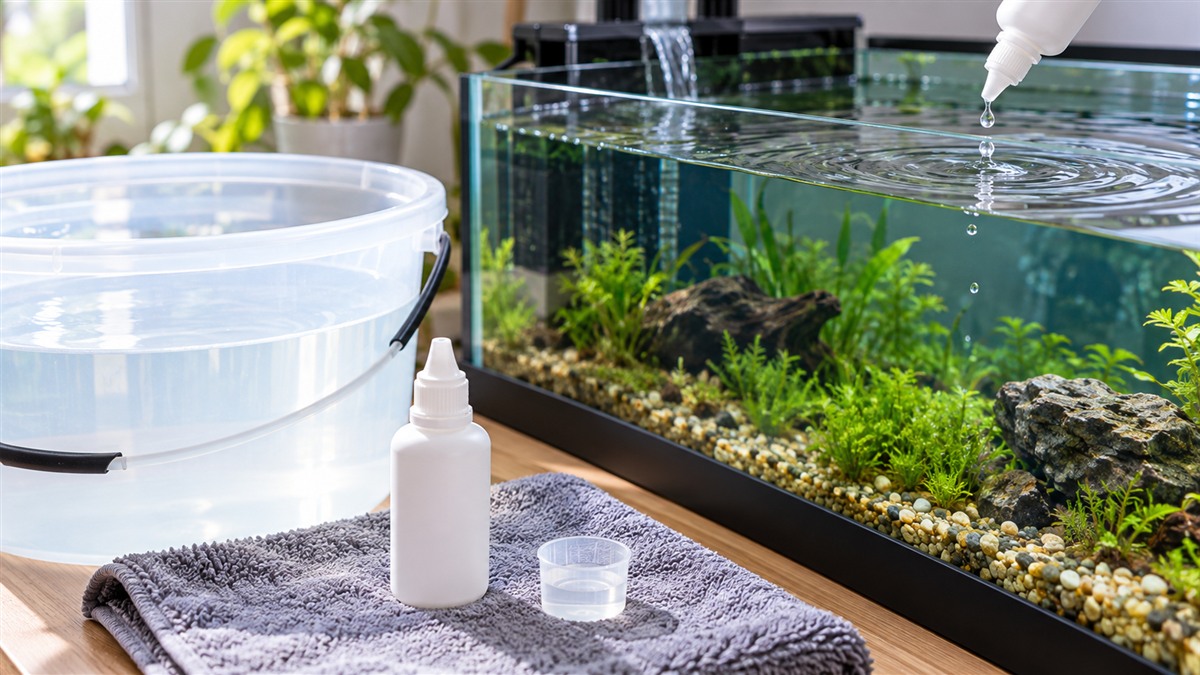
- Add Prime to the new water first. Seachem says it is better added to new water before the water goes into the tank.
- Measure for the volume of new water. Use the standard rule for the amount you are adding, not the total volume of the tank. The rule is in the table below.
- Stir, then pour gently. Pour slowly so the betta is not pushed around by the flow.
- Check the temperature again. Make sure the treated water is close to the tank temperature before it goes in.
Dose rules, in one place
| Situation | What Seachem’s dosing page says |
|---|---|
| Standard water change | 1 capful (5 mL) per 200 L (about 50 US gallons) of new water |
| Smaller volumes | The table gives 0.1 mL per gallon (0.1 mL per 4 L); a capful is about 1 mL, so it cannot measure small doses |
| Very high chloramine | A double dose may be used safely; the table lists 10 mL for 50 US gallons |
| Very warm water | Use a half dose if the water is above 30 °C (86 °F) and chlorine or ammonia levels are low |
| Emergency or treatment dose | Higher doses are given for ammonia and nitrite. This guide does not repeat them; ask an experienced keeper or an aquatic vet for a sick fish |
Worked example for a small tank
For example, take a tank of 5 gallons and change one quarter of it, which is about 1.25 gallons of new water. The table gives 0.1 mL per gallon, so 1.25 gallons needs about 0.125 mL. A capful is about 1 mL, so a capful is roughly eight times too much. This is why small changes need a measuring tool that reads fractions of a milliliter, not a cap.
A second example: a tank of 10 gallons with a change of 2 gallons needs 0.2 mL of Prime for the new water. The same arithmetic works for any volume: multiply the gallons of new water by 0.1 mL. A tank of 20 gallons with a change of 4 gallons needs 0.4 mL. For a full 50-gallon change, the rule returns to one capful (5 mL), which matches the standard dose.
Measuring this small a volume is easy to get wrong. Check your measuring tool against a known volume before you rely on it, and write the dose on the bucket so you do not repeat it.
Mistakes that cause problems
- Adding it to the tank before the new water. Seachem says to add it to new water first, although direct addition is allowed.
- Guessing the dose. The dose is a measured rule per volume of new water. A splash is not a measurement, and a capful is too large for a small change.
- Dosing for the wrong volume. If Prime goes directly into the aquarium, the dose is based on the aquarium’s volume, not the water you added. Mixing the two methods in one change leads to the wrong amount.
- Skipping the temperature check. Cold water added quickly can stress a betta. Check the thermometer before you pour.
- Changing too much water at once. A partial change is the usual approach. Removing most of the water at once can upset the tank.
Seachem Prime – 250 ml (B0002568S6)
Specs (from the listing, checked 2026-10-17): Seachem Prime, 250 ml (1.7 fl. oz.) bottle, per the listing title. The listing’s other specs and bullet claims were not visible in our read, so none are stated here.
Pros: A clear dosing rule from the maker, with tables for each volume. Cons: The 250 ml size gives fewer changes per bottle than a larger size; the dose for a small tank is a fraction of a milliliter, which needs a measuring tool.
Best for: A single betta tank that gets regular partial water changes. Skip if: You do not change water, or you have no tap water to treat.
View on Amazon (affiliate link)
Does Prime replace a filter or a heater?
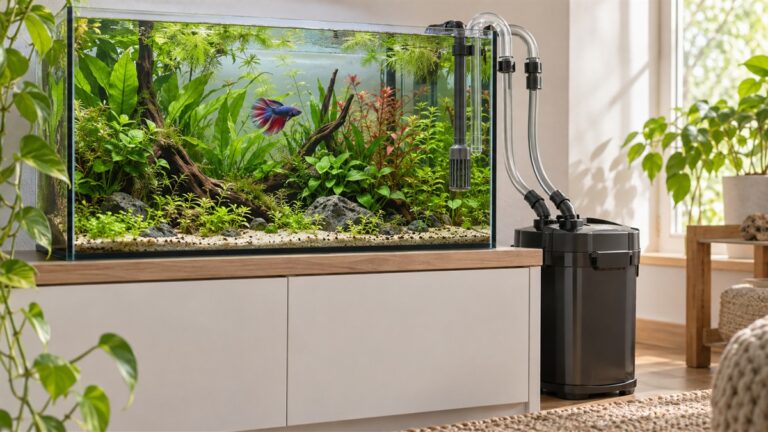
No. Prime treats the water you add. It does not heat the tank or move water through a filter. If your tank is too cool, read whether a betta fish needs a heater. If the current is too strong for a betta, read our filter guide.
Prime and Stability together
Keepers often ask whether Prime can be used with another Seachem product. The answer depends on the product and the timing, and it is covered in can you use Seachem Prime and Stability together.
Who should skip this product
Skip it if your tap water is already treated another way and you have a conditioner you trust, or if you cannot measure fractions of a milliliter. A conditioner is only useful if the dose is right.
Related guides
- When to add water conditioner to fish tank
- API Stress Coat aquarium water conditioner
- Stress coat vs tap water conditioner
- Can I add Stress Coat with fish in tank
Frequently asked questions
How much Seachem Prime do I add for a water change?
Seachem’s dosing page gives 1 capful (5 mL) per 200 liters (about 50 US gallons) of new water. For smaller volumes, the table gives 0.1 mL per gallon of new water.
Should I add Prime to the tank or to the water first?
Seachem says it is better added to new water first. It can also go directly into the aquarium, and then the dose is based on the aquarium’s volume.
Does Prime remove ammonia?
Seachem’s dosing page gives higher doses for ammonia and nitrite emergencies, mapped to measured levels. It is a detoxifier for the water you treat, not a substitute for a cycled filter. This guide does not repeat those emergency doses.
What about emergency or treatment doses?
Seachem’s page gives higher doses for emergencies. This guide does not repeat them. For a sick fish, ask an experienced fish keeper or an aquatic vet.