Good Plants for Betta Tank: A Silk Cave Set and What to Check
As an Amazon Associate we earn from qualifying purchases. Details
Good plants for a betta tank are soft at the edges, stay where you put them, and leave open water for swimming. This guide covers the plant and cave listings in the data that match those needs. Only one silk plant set in this group fits the criteria below, so it is the pick. The rest of the guide explains how to judge any plant before you buy it, whether it comes from this group or somewhere else. A plant is part of a betta setup, not the setup itself, so the tank size, heater and filter come first.
Quick answer
Choose a plant that is soft at the edges, has a stable base, and fits the open floor of your tank. Silk plants and silk-and-cave sets suit most betta tanks, because the listings describe soft leaves and smooth edges. Check the cave’s opening before you buy, since a betta needs an entrance it can use. Keep the site’s tank rule in view: a heated, filtered tank of 5 gallons or more, with plants added once the basics are right.
What makes a plant good for a betta
Five things decide whether a plant suits a betta. Judge each one before you rely on a listing’s marketing.
- Fin safety. Bettas have long, thin fins that tear on sharp or rough edges. Look for rounded tips and smooth stems. Some listings say their leaves are soft or that they will not scratch fins, but few name a test for that claim, so check the edges yourself.
- Anchoring. A plant that floats or tips will move with the filter current and may end up on the glass or against the heater. Look for a weighted or hard base, and choose a cave or plant that stays where you put it.
- Size against the tank. A plant should leave open water for your betta to swim through. Measure the floor, then choose plants whose base and height leave a clear lane. The site’s tank rule is 5 gallons or more for a single betta.
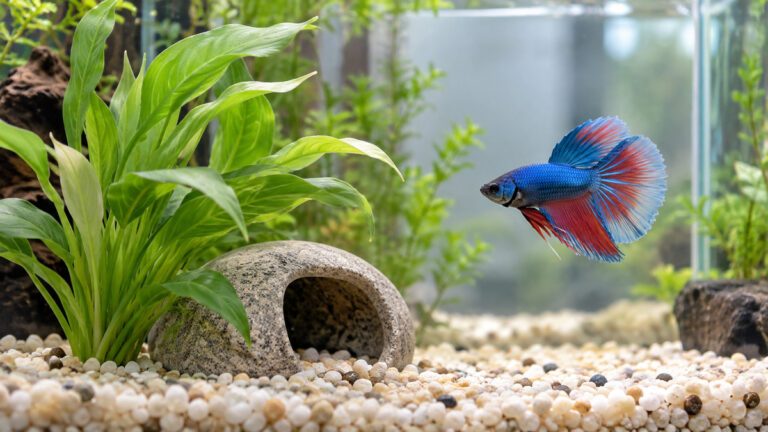
- Cover and hiding. A betta uses cover when it wants to rest or hide, and bettas enjoy a decorated tank even when they live alone. A cave with a usable opening gives that cover, but only if the opening is wide enough for your fish to enter and leave.
- Care. Some plants come out for cleaning, and some need hand washing only. Read the care line before you buy, and plan to rinse the plant before it goes in the tank.
These criteria apply to every plant on the market, not only the listings here. They are general guidance for choosing a betta decoration. The listings give the material, size and claims, and this guide shows you where to check them.
Quick comparison
The comparison below covers the one silk plant and cave set that fits these criteria. The table shows what its listing states and what it leaves out.
| Item | Stated in the listing | Not stated |
|---|---|---|
| Size | 6 by 4 by 3 inches | Weight |
| Material | Silk plants on a resin cave | Test for fin safety |
| Base | Weighted base | Base dimensions |
| Opening | Rounded 2 inch swim-through opening | Opening height |
| Tank range | 2.5 to 30 gallons | Usable water volume |
| Care | No installation or special care | Cleaning method |
The table shows what the listing gives you. The silk leaves and rounded opening are the strongest points for a betta. The gaps are the weight, the test behind the fin-safety claim and the cleaning method, so ask the seller or check the item when it arrives.
The pick
The card below shows the listing’s specs, pros and cons. It is the only card in this guide.
1. Aquarium Decorations Cave Silk Aquarium Plants Betta Fish Tank Decor (Best silk plant and cave set)
Specs from the listing (checked 2026-10-11):
- Material: Silk
- Product Dimensions: 6"D x 4"W x 3"H
- Recommended Uses For Product: Aquarium Decor, Betta Fish Tank Decor, Goldfish Bowl Decor
- Additional Features: Fish-Friendly, Nature & Lifelike, No Sharp Edges, Realistic Driftwood, Soft Silk Leaves
Pros
- The bullets describe a rounded 2 inch swim-through opening, and the listing says each cave is inspected for a clean, rounded opening before shipping.
- The listing describes a weighted base that keeps the piece anchored, and it says the silk is fade-resistant.
Cons
- The listing gives a range of 2.5 to 30 gallons, which is too broad to show that the piece suits a 5-gallon tank in particular.
- The recommended uses include goldfish bowl decor, which this site does not recommend as a home for a betta.
Best for: Owners who want a silk plant with a hiding cave and a stated opening in one set.
Skip if: You need a set with more than one cave or a stated weight.
View on Amazon (affiliate link)
How to choose
Use these rules, and check each listing before you order.
- Choose a silk plant and cave set if you want a soft, natural look with a hiding spot. The listing describes soft silk leaves, a resin cave and a weighted base.
- Choose a set with a stated opening if your betta spends time inside the cave. The listing gives a rounded 2 inch opening, which is a figure you can check against your fish.
- Choose a plant with a stable base if your tank has filter current. The listing says the piece does not float and stays anchored at the bottom.
- Skip a plant whose tank range is too broad to use. The listing’s 2.5 to 30 gallon range covers both a bowl and a large aquarium, so it does not tell you whether the piece suits a 5-gallon tank in particular.
- Skip any plant that you cannot inspect. Check the edges, the base and the opening when the item arrives, and remove any piece with a sharp or broken part.
The listing mentions goldfish bowl decor. This site does not recommend bowls or tanks under 2.5 gallons as a home for a betta, so use the set in a heated, filtered tank of 5 gallons or more.
Setting up plants in a betta tank
The steps below are general guidance for any plant or cave, not a claim from a listing. Follow the manufacturer’s instructions for each part you buy.
- Rinse the plant and the cave with clean water and check them for loose pieces, sharp edges or broken leaves.
- Set the cave or the tallest plant toward the back of the tank, and keep the front open for swimming.
- Place the plant on the gravel so its base sits flat. A weighted base should lie level without help.
- Check the filter flow after you place the decor. If the decor moves, reduce the flow or reposition the piece.
- Watch your betta for the first few days. A fish that uses the cave will rest there, and a fish that avoids it may want the opening repositioned.
Worked example: how much floor a cave takes
The cave is 6 inches long, and the second piece is 4 inches long. Add the two lengths together: 6 plus 4 equals 10 inches of decor. Subtract that from the floor length: 20 minus 10 equals 10 inches of open floor.
Ten inches of open floor leaves room for a betta to swim across the front of the tank. The arithmetic is only a planning step. It does not tell you the fish’s comfort, and it does not replace watching how your betta uses the space. If you add a third piece, subtract its length too, and check that a clear lane remains.
Signs a plant is working for your betta
Watch how your betta uses the decor during the first week. A fish that rests near the cave, moves through the opening or hovers near a leaf is getting the cover you wanted. A fish that stays pressed against the glass, or that avoids the decor entirely, may need a different layout or a different piece.
Check the fins at the same time. Look for new tears, ragged edges or fins held clamped against the body, since any of those can point to a rough spot on the decor or to stress from the tank. If you see any of them, remove the piece, inspect it, and wait before you put it back.
Look at the water as well. A decor piece that sheds fibers or shows residue in the water should come out. Rinse it again, and test the water to see whether the change in appearance matches a change in readings.
A weekly routine for decor
Lift each piece during the water change, shake off loose debris, and rinse it in clean water. Keep your hands clean and avoid soap or cleaners that the listing does not recommend.
Run a quick check on the base, the leaves and the cave opening. A base that has loosened, a leaf that has torn, or a cave edge that has become rough should come out until it is fixed. Replace any piece that cannot be made safe.
Reposition the decor only when you have a reason. Frequent moves stress a fish and can disturb the substrate. If you change the layout, note the change and watch your betta for a few days before you change anything else.
Mistakes to avoid
- Trusting “fin safe” as a promise. The listing describes soft leaves, but it names no test for fin safety. Check the edges by hand before you place the piece.
- Choosing a cave with an unknown opening. A betta needs an entrance it can use. If the listing does not give the opening, measure it or choose a different piece.
- Filling the floor. Plants and caves take up space that the fish needs. Leave a clear lane and keep the front open.
- Ignoring the filter current. A light piece can drift or tip in a strong current. Set the flow low enough that the decor stays where you put it.
- Skipping the water test. A plant does not remove the need to test the water. A new tank needs time for its biofilter to build up, which UF/IFAS puts at six to eight weeks.
FAQ
Do silk plants hurt betta fins?
Silk is generally softer than hard plastic, and the listing describes soft silk leaves. It does not prove that the plant is fin safe. Check the edges and watch your betta after the first day. If fins look ragged, remove the piece and inspect it.
Do bettas need plants?
No. A betta needs a heated, filtered tank of 5 gallons or more. Plants and caves give cover and a more natural look, and many bettas use them. A tank without plants can still be a good home if the water and the heat are right.
What is the best plant for a betta tank?
The best plant is the one that is soft, stable and sized for your tank. The silk plant and cave set in this guide fits those criteria based on its listing. Check the listed size, base and opening before you buy.
Can a betta live in a bowl with a plant?
This site does not recommend a bowl as a home for a betta, and it does not recommend tanks under 2.5 gallons. Use the plant in a tank of 5 gallons or more, with a heater and a filter.
How do I clean a silk plant?
Rinse it in clean water and let it dry before returning it to the tank. The listing for this set describes no special care, so check the item and follow a gentle routine. Avoid soap, which can leave residue.
Should the cave go on the gravel or at the surface?
Place the cave on the gravel so its base sits flat. Surface pieces are a different choice and need their own anchoring. The listing describes a weighted base, which is meant for the tank floor.
How often should I check the decor?
Check it during each water change. Look for loose pieces, sharp edges and any wear on the leaves, and remove anything damaged before your betta uses it again.
Bottom line
Good plants for a betta tank are soft at the edges, stable on the floor and sized to leave open water. The silk plant and cave set in this guide fits those criteria based on its listing, and it adds a hiding spot with a stated opening. Check the set’s edges and opening when it arrives, keep the tank at 5 gallons or more with a heater and filter, and test the water through the first six to eight weeks.
For more on setting up a betta tank, see best live plants for betta fish tank, best aquarium heater for betta fish and what size aquarium for betta fish.
Source notes: the labyrinth organ, the territorial behavior and the decorated-tank note come from the Wikipedia article on the Siamese fighting fish. The biofilter timing comes from UF/IFAS.
Sources
- Wikipedia: Siamese fighting fish: bettas set up territories even when housed alone and enjoy a decorated tank, and they have a labyrinth organ for taking in surface air.
- UF/IFAS: Ammonia in Aquatic Systems: a new biofilter takes six to eight weeks to build up enough bacteria to reduce ammonia and nitrite.