Betta Fish Light at Night: Should It Stay On?
As an Amazon Associate we earn from qualifying purchases.
Should the betta fish light at night stay on? Usually not, so the light should normally be off at night. The Merck Veterinary Manual says “Fish need a day/night cycle for optimal health,” and it warns that “Leaving the lights on 24 hours a day, 7 days a week stresses fish, leaving them more susceptible to disease.” The sources opened for this guide do not discuss dim night lights or the exact hours a betta needs in the dark, so those points are left open below.
Quick answer
- Turn the tank light off for a dark period at night, because Merck says fish need a day and night cycle.
- Do not leave the light on 24 hours a day, which Merck says stresses fish.
- Merck says most fish go into a “rest” mode within a few minutes of the lights going off.
- The sources do not address dim night lights, so this guide does not recommend one.
Why the light should go off at night
The Merck page on providing a home for fish sets the principle plainly. Fish need a regular cycle of light and dark, and constant light is a stress that makes disease more likely. The page does not describe a night in terms of hours, but its meaning is clear: the tank should have a period when the light is off, and that period should happen every day.
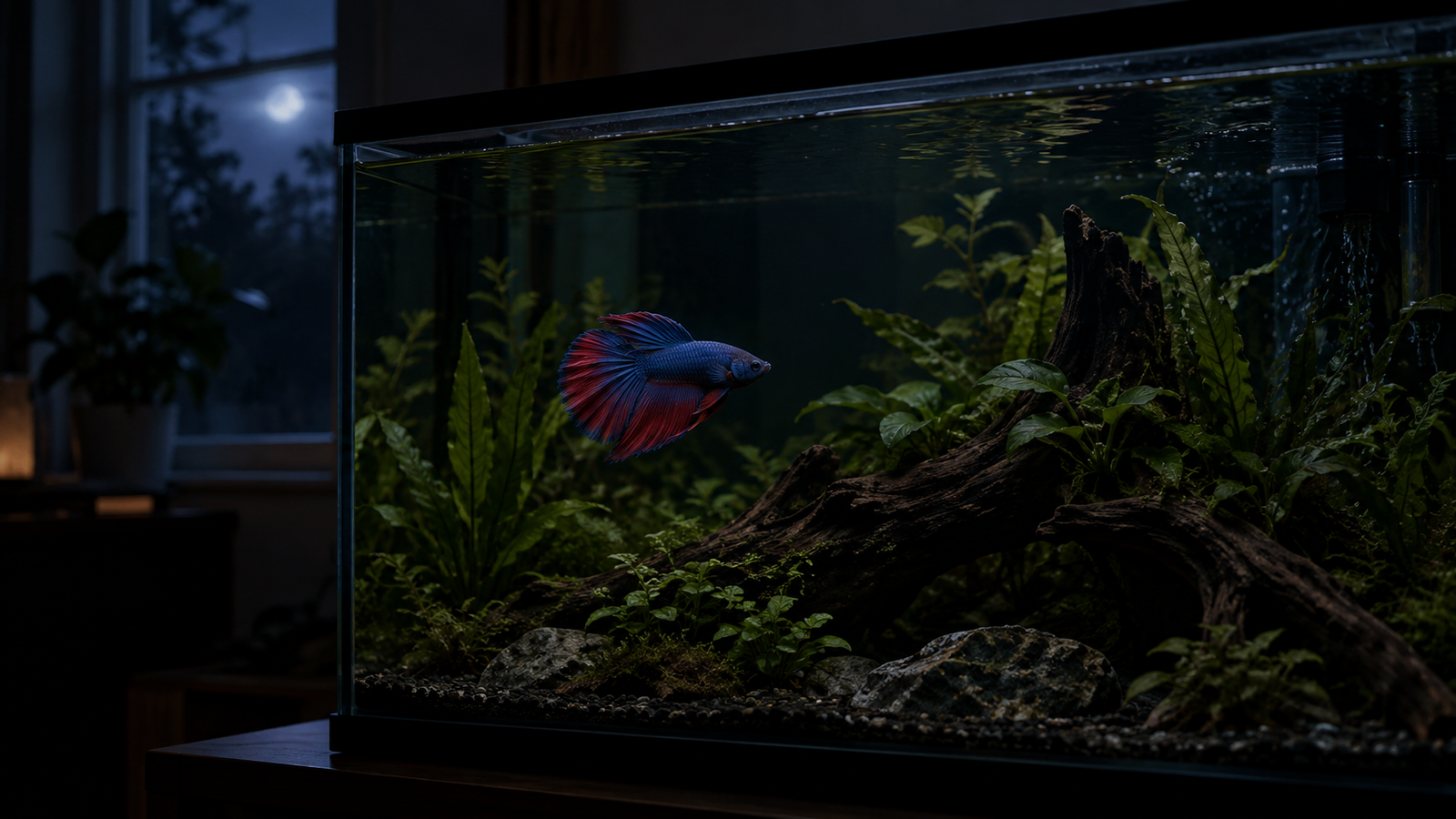
The same page gives the practical reason for turning the light off. In its advice on releasing new fish, it notes that “When the tank light and the room lights are turned off, most fish will go into a “rest” mode within a few minutes.” Darkness is therefore described as a normal resting state for most fish, and it is the condition the night should provide.
What happens when the light stays on
The sources describe the cost of constant light without giving a betta-specific reaction. The risk they name is susceptibility to disease. Merck writes that constant light “stresses fish, leaving them more susceptible to disease,” and that is the reason the cycle matters. A betta kept under a light that never goes off has no dark period to rest in, and the sources frame that as a health risk.
A light that is left on overnight by habit is easy to miss. A timer keeps the dark period in place without relying on memory. The guide to light bulbs for a fish tank hood covers the light itself, and the timer and placement points above apply to whichever light is used.
Keep the room dark enough to rest
Room lights matter as well as the tank light. The Merck example turns off both the tank light and the room lights before the fish rest, so a bright room is a practical problem for a tank that is otherwise on a timer. The sources do not say how much room light is too much. The tank size itself, which affects how quickly water changes, is covered in the guide on how many gallons a betta fish needs.
Sunlight is a separate problem. Merck advises that “The tank should be located out of direct sunlight. This helps limit the growth of algae in the tank.” Direct sun also warms the water, and “The warmer the water becomes, the less oxygen it will hold.” A tank in a window that is bright at night, from street lights or room lamps, is harder to manage than one in a dark corner, although the sources do not give a light level that counts as too bright.
New fish and the dark release
The night is also useful for adding a new betta to a tank that already has fish. Merck describes releasing new fish in the dark to reduce aggression from the current residents. Its method is to float the bag until the temperature has acclimated, then release the fish with the lights off. The page says: “After several minutes, turn the lights back on to feed or rearrange the decorative objects again if necessary.”
The same page also suggests feeding the fish in the tank when the new fish are released, which can distract aggressive residents. The page’s examples concern tanks with resident fish, so they do not settle the question for a single betta in its own tank.
Signs to check at night
A fish that rests in the dark is behaving normally. The concern is a fish that cannot settle and shows signs of illness. Merck’s list of common signs of illness in fish includes “Lethargy,” “Not eating,” and “Swelling or bloating.” The routine care page also says that “Some general signs of illness include changes in swimming behavior and noticeable changes in the color or condition of the body and fins.”
The sources do not describe how resting in the dark differs from illness, so the signs above are the best guide. A betta that is quiet in the dark but eats, swims and looks normal by day is not showing the listed signs. A betta that stops eating, looks swollen or stays still during the day should be checked, and a vet should see a fish that stays unwell.
How we chose
This guide uses only pages opened with curl on 2026-10-24. It relies on the Merck Veterinary Manual because it is one of the few general fish-care sources that covers the day and night cycle, room light and new fish in a form that can be quoted directly. Retail pages and product listings were not used for facts, and no product is recommended. Quotations were checked against the downloaded text before use.
What we could not verify
The sources opened say that fish need a day and night cycle and that constant light stresses them. They do not give the length of a betta’s dark period, whether a dim night light is acceptable, or how a betta differs from the general pattern.
What the sources do not say
- How many hours of darkness a betta should get each night.
- Whether a dim night light, moonlight effect or LED nightlight is acceptable for a betta.
- Whether bettas rest in the same way as the fish described in the Merck page.
- What light level counts as too bright for a betta tank in a room.
Frequently asked questions
Should I turn the betta tank light off at night?
Yes, according to the principle in the Merck Veterinary Manual. Fish need a day and night cycle, and leaving the lights on around the clock stresses them and makes disease more likely. A timer is the simplest way to keep the dark period regular.
Can I leave a night light on for my betta?
The sources opened do not address dim night lights. Because they warn against constant light, a steady bright light at night is not the right choice. This guide does not recommend a night light.
Is my betta sick if it is still at night?
Merck says most fish go into a rest mode when the lights are off, so stillness in the dark is expected. Check for the signs Merck lists, including “Lethargy,” “Not eating,” and “Swelling or bloating,” particularly if the fish is also still during the day.
Does sunlight count as light at night?
Sunlight does not occur at night, but a tank near a window can receive street light or room light after dark. Merck advises placing the tank out of direct sunlight to limit algae, and it notes that sunlight can raise the water temperature. Keep the tank away from a bright window if you can.
Should I turn the light off before adding a new betta?
Merck describes releasing new fish with the lights off to reduce aggression from current residents, then turning the lights back on. That method is written for tanks with other fish. For a single betta in its own tank, the sources do not say the dark release is needed.
Sources
- Merck Veterinary Manual, “Providing a Home for Fish,” https://www.merckvetmanual.com/all-other-pets/fish/providing-a-home-for-fish, opened 2026-10-24.
- Merck Veterinary Manual, “Routine Health Care of Fish,” https://www.merckvetmanual.com/all-other-pets/fish/routine-health-care-of-fish, opened 2026-10-24.