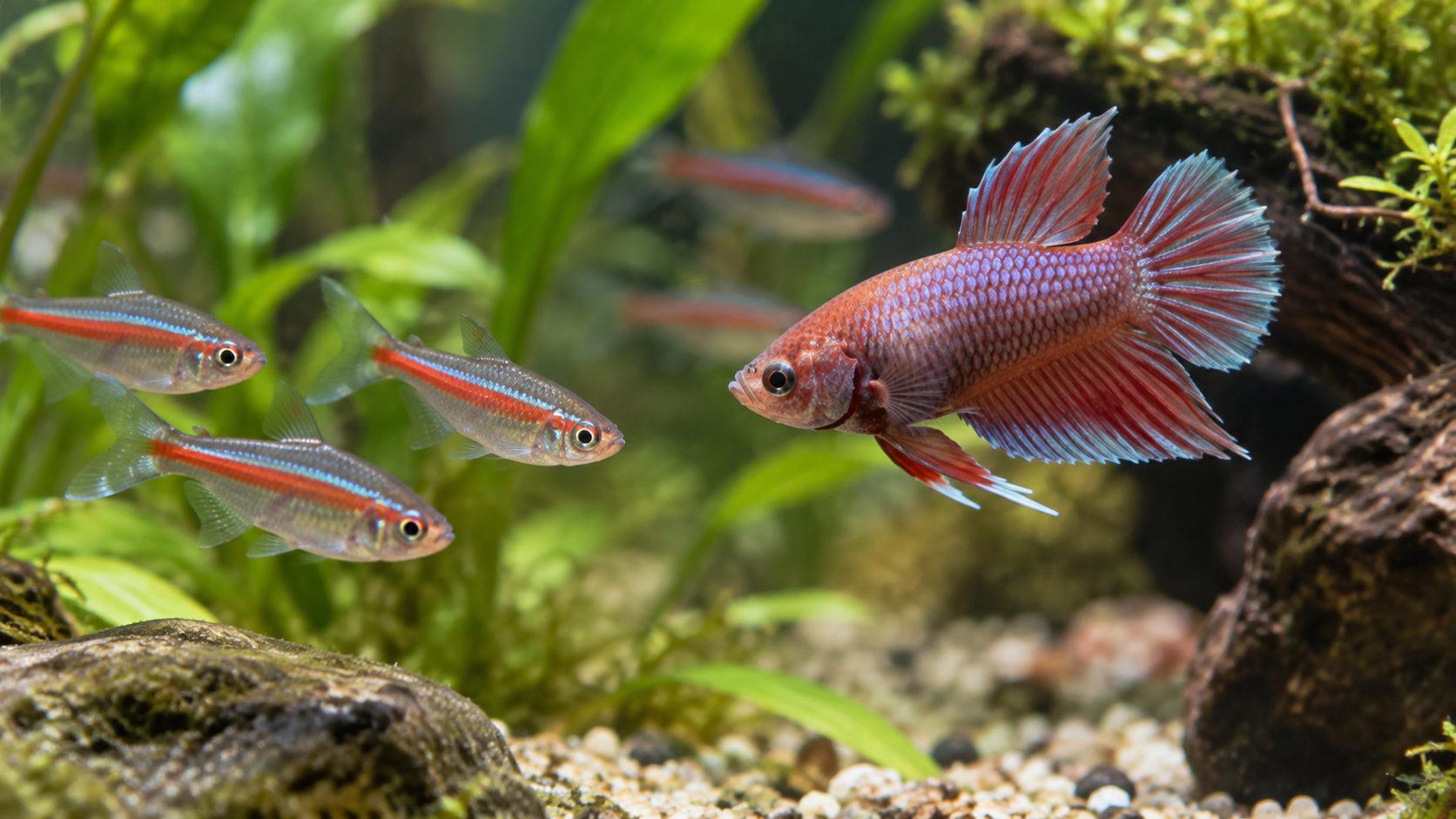
Are Female Bettas Aggressive to Other Fish?
As an Amazon Associate we earn from qualifying purchases.
Are female bettas aggressive to other fish? The sources we opened do not answer that for females. The UF/IFAS betta care publication describes aggression mainly in male bettas, and it does not describe female bettas living with other fish. The Merck Veterinary Manual describes aggression between resident fish and newcomers in general terms. This guide explains what those sources cover, what they leave out, and what to check before you add any fish to a tank that already has a betta.
Quick answer
- The sources we opened describe strong aggression in male bettas. They do not give a rule for female bettas kept with other fish.
- When new fish join a tank, resident fish can chase or attack them. The Merck Veterinary Manual says this about fish in general.
- Stress from conflict and poor conditions affects every fish in the tank, so plan the setup before buying tank mates.
- If a fish has torn fins or new injuries after a conflict, see an experienced fish keeper or an aquatic vet.
What the UF/IFAS betta publication says about aggression
The University of Florida IFAS publication on betta care (FA212) explains where betta temperament comes from. It says that “Males will almost immediately display aggressive behaviors—spreading their fins and flaring out their gill covers—when they encounter another male.” It goes on to describe how a male fight usually ends: “As aggression proceeds, the fish will then bite each other, particularly on the fins and flanks.”
The publication also gives the history. Early breeding selected males for aggression because “fights between two males were popular in Thailand for gambling.” Modern commercial bettas were bred mainly for color and fin shape, and the publication notes that “male aggression remains.” That sentence is about males. The publication does not describe female bettas in a shared tank, and it does not say whether females are more or less likely to chase other species.
This matters for the question you are asking. A source that describes male-to-male fights is not evidence about female behavior toward other fish. If you have seen a female chase a tank mate, the sources we opened cannot tell you whether that is typical. They can only tell you what to check next.
What happens when new fish join a tank
The Merck Veterinary Manual section on providing a home for fish is general and covers fish of many species. It says: “When new fish are added to the aquarium, the current residents sometimes respond aggressively, chasing or attacking the new fish.” The same section adds that “Aggressive behavior is stressful for all fish in the tank, so it is helpful to reduce aggression toward new fish by using the following techniques.”
One technique in that section is to rearrange decorations. The manual explains that doing so “helps break up established territorial markers, which may reduce territorial aggression.” Moving a few decorations is a low-effort step, and it does not cost much. The manual also gives a second option. The manual describes releasing the new fish in the dark as a third technique, and it notes that when the lights are off, “most fish will go into a ‘rest’ mode within a few minutes.”
If the conflict continues, the manual lists further options. It says that “the fish can be separated with a clear plastic tank divider.” If that is not practical, “it may be necessary to remove either the aggressive fish or the new additions.” Separation is a real option in the source. Choose whichever option keeps every fish in the tank safer.
Chasing alone is not the only concern. The UF/IFAS stress publication (FA005) notes that trauma from fighting can cause harm to the body: “Trauma caused by fighting (Reproductive Stress or Behavioral Stress) could result in breaks in the skin or scale loss.” If you see torn fins, missing scales, or red patches after a fight, the sources treat that as a reason to act. They do not give a number of chases that makes a fight dangerous.
Why stress and water conditions matter
The UF/IFAS stress publication names stressors that affect fish health. Among them is “Correction of stressors (i.e., poor water quality, excessive crowding, etc.).” That publication is written for fish farm management, so its advice is not a home-tank rule. The principle still applies to a betta tank with several fish in it: crowding and poor water make every fish more likely to fight, and fights add more stress.
The betta publication also addresses flow. It says that “Bettas prefer calm water as shown by research using flow as a stressor, so heavy filtration may actually be harmful to a betta’s health and welfare.” A tank with strong current and competing fish gives a betta fewer quiet places to rest. Check the flow of any filter before you add a second fish.
Practical steps before adding any fish
Biosecurity is the first step the UF/IFAS publication names. It defines the term as “practices that minimize the risk of introducing an infectious disease to your fish and spreading it to other fish in the same or other tanks and systems.” A new fish should never go straight into a display tank without thought about where it came from and what it could carry.
The following steps are general guidance. The sources above do not state them as rules. Plan the tank around the fish already living in it, keep the water tested and stable before you add anyone, and provide decorations that break up sight lines so that no fish is always in view of a rival. Make changes one at a time so you can tell which change caused a problem.
When a fish shows injuries, a swollen body, or a change in swimming, get help from an experienced fish keeper or an aquatic vet. The UF/IFAS publication says that “Proper diagnostics will be facilitated by working with a fish veterinarian.” It also warns that “Many drugs and chemicals can do more harm than good if they are used inappropriately.” This guide does not give medication doses, and you should not start a treatment based on this article.
If you are thinking about keeping more than one female, the tank-size question is separate from the aggression question. For a separate guide on that, see Female Betta Sorority Tank Size. For general tank volume, see How Many Gallons Do a Betta Fish Need.
How we chose
The sources in this guide were chosen by subject. They are university extension material and a veterinary reference, not retail listings. Retail pages were not used to support any statement here, and no product is recommended in this article. Each quotation was checked against the text of the page on the date the page was opened. Where a source talks about male bettas or about fish in general, this guide says so and does not stretch the statement to cover females.
What we could not verify
The question in the title is not answered directly by the sources we opened. The list below states the gaps so that no reader has to guess what the sources intended.
What the sources do not say
- Whether female bettas are more or less aggressive toward other fish than males are.
- Which species, if any, are safe to keep with a betta.
- How many females, or any other fish, can share a tank of a given size.
- How aggression changes after the fish have lived together for several weeks.
Frequently asked questions
Can female bettas live together?
The sources we opened do not say. They describe male aggression in detail and do not cover female bettas kept together. Do not assume that a group of females is safe. Watch the fish closely during the first days, and have a plan for separating them if conflict starts.
Will my betta attack a new fish I add?
The Merck section on new fish says that resident fish “sometimes respond aggressively, chasing or attacking the new fish.” Whether a particular betta does this depends on the fish, the tank, and the individual animal. The sources do not give a percentage or a rule that predicts it.
What is the first sign that aggression is hurting a fish?
The sources do not name one first sign. The UF/IFAS stress publication describes fighting trauma as “breaks in the skin or scale loss.” Check the fins and body for tears, missing scales, or new marks after a conflict, and consult an aquatic vet if the injuries do not look better.
Should I separate fish that chase each other?
The Merck section says that if aggression persists, “the fish can be separated with a clear plastic tank divider.” If that is not practical, it says “it may be necessary to remove either the aggressive fish or the new additions.” Separation is one of the options the source gives. Choose the option that keeps every fish safe.
Does a bigger tank stop aggression?
The sources we opened do not say that. The betta publication states that “water quality is not dependent on the size of the container, but rather on management and husbandry.” Space and decoration may help with conflict, but the sources do not give a tank volume that prevents aggression.
Sources
- University of Florida IFAS Extension, “FA212: Evolution, Culture, and Care for Betta splendens”, https://edis.ifas.ufl.edu/publication/FA212 (opened 2026-10-24)
- Merck Veterinary Manual, “Providing a Home for Fish”, https://www.merckvetmanual.com/all-other-pets/fish/providing-a-home-for-fish (opened 2026-10-24)
- University of Florida IFAS Extension, “Circular 919/FA005: Stress—Its Role in Fish Disease”, https://edis.ifas.ufl.edu/publication/FA005 (opened 2026-10-24)