Do Rasboras Need a Heater? What the Sources Say
As an Amazon Associate we earn from qualifying purchases.
Do rasboras need a heater? For the one rasbora species the sources checked cover, the answer is yes. The brilliant rasbora, the brilliant rasbora (Rasbora einthovenii), is listed as tropical with a temperature range of 22 to 26 degrees C. The Merck Veterinary Manual says “A heater is necessary for both freshwater and saltwater tropical fish.” A heater with a thermometer is the safe default, because room temperature may fall below the range the species needs.
Quick answer
- FishBase lists the brilliant rasbora as tropical, with a temperature range of 22 to 26 degrees C.
- Merck says a heater is necessary for tropical freshwater fish.
- Merck also recommends a separate thermometer, so the water temperature can be read apart from the heater.
- The sources cover one rasbora species only, so other rasboras need their own source before a final answer.
What the sources say about the brilliant rasbora
The FishBase species page for the brilliant rasbora (Rasbora einthovenii) lists the ecology as freshwater and benthopelagic, with a pH range of 6.0 to 6.5 and a dH range listed as up to 5. It gives the temperature as tropical, from 22 to 26 degrees C. The same page describes the species as living in forest streams in the Malay Peninsula and Indonesia. Those are wild conditions, not a home tank setting, but they show the fish comes from warm, soft water.
The page gives a maximum length of 10.6 cm, measured as standard length. That is larger than many small community fish, so tank size should be checked alongside the heater. The page also describes the species as feeding on worms, crustaceans and insects, which is useful background for the feeding section of any setup.
The temperature range is the main answer to the heater question. If the water in the home falls below 22 degrees C for long periods, the species page places the fish outside its listed range. The sources do not say how long a fish can tolerate water below that range, so the safest reading is to keep the water inside the listed range.
What Merck says about heaters and temperature
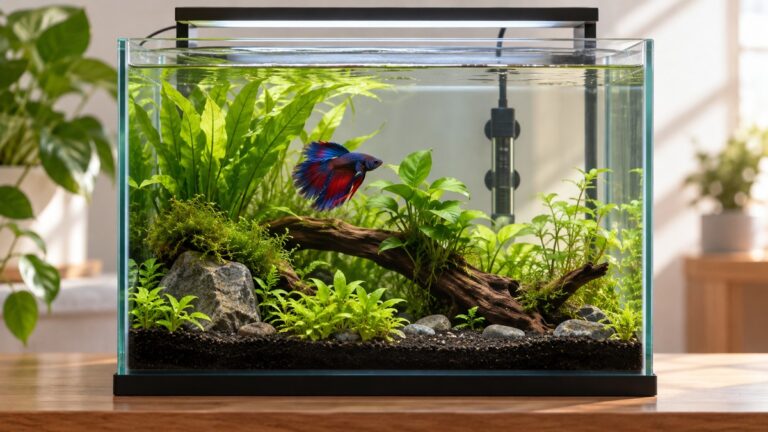
The Merck Veterinary Manual section on filtration, heaters and lights is the clearest general source for home aquariums. It says: “A heater is necessary for both freshwater and saltwater tropical fish.” It also gives practical points on the heater itself, such as not plugging it in until the tank is full of water, because the glass tube can shatter if it is not surrounded by water.
Merck recommends a separate thermometer. It says the thermometer lets you “monitor water temperature independently from the heater.” That matters because a heater can fail in either direction, and a thermometer is the only way to see the actual water temperature. Merck also says that keeping the water in “an appropriate range for the fish species you are keeping is critical to their health.”
Merck notes that a heater is not always needed in every tank. In its discussion of small aquariums, it says “neither filtration nor a heater may be required,” and it gives goldfish bowls and betta tanks as examples. That passage is about those setups, and it does not cover rasboras. For a tropical rasbora, the heater guidance in the main section applies.
When a heater may be needed and when the sources are silent
The sources do not give a room temperature at which a heater becomes necessary for every home. The question depends on the house, the season and the tank location. General guidance is to measure the water temperature with a thermometer for a week before deciding. If the readings stay inside the listed range without a heater, the heater may not be needed, but the reading should be checked again when the seasons change.
Merck also says direct sunlight can push the water temperature up, and that warm water holds less oxygen. The tank should be placed away from direct sunlight to help keep the temperature steady. Warm water with low oxygen is a risk the sources describe, so a tank in a sunny spot may need the heater turned down or moved.
The sources do not describe a heater wattage for a rasbora tank, a thermostat setting or a brand. Any heater listing should be checked for its wattage and its rated tank size, but those figures come from the product, not from the sources used here.
Other rasbora species
For a related heater question, see whether betta fish need a heater and a betta heater roundup, which cover heater choice for a different species.
The question says “rasboras,” which covers more than one species. The sources checked cover the brilliant rasbora only. Other rasbora species may have different temperature and water-chemistry needs, so a species page should be checked before a final heater decision.
The gap matters most for the species that are sold under the rasbora name in shops. Without a species page for each one, the sources do not say whether each fish needs a heater. A reader who has a particular rasbora species should look for that species’ own record before setting the temperature.
If the species cannot be identified, the safest general approach is to keep the water in a stable range with a heater and a thermometer, then check the temperature each day. That approach follows from the Merck guidance on tropical fish, but it is general guidance rather than a species-specific finding.
Water chemistry and the heater
FishBase gives a low pH range of 6.0 to 6.5 and a soft dH range for the brilliant rasbora. A heater does not change that chemistry, and the sources do not link temperature to pH for this species. Water tests are the way to check the chemistry, and the Merck section on water notes that dissolved minerals can lead to excess algae growth.
Merck also says that nitrates can be used by plants and algae or removed by filtration, and that beneficial bacteria take 4 to 6 weeks to develop on their own. A heater and a filter work together in a new tank, so the heater should not be treated as a substitute for a cycled filter.
How we chose
This guide relies on the sources listed at the end. The temperature, pH, dH, length and habitat facts come from the FishBase species page for the brilliant rasbora. The heater, thermometer, sunlight and water-quality points come from the Merck Veterinary Manual fish pages. Retail listings and heater product pages were not used. Each claim in the body either matches a source or is labelled as general guidance.
What we could not verify
The sources cover one rasbora species in detail and the general fish-care points in broad terms. They do not give a heater model, a wattage per gallon for rasbora tanks, or the room temperature that makes a heater necessary in every home.
What the sources do not say
- The sources do not give a heater wattage or a thermostat setting for a rasbora tank.
- The sources do not cover other rasbora species, so their temperature needs are not confirmed here.
- The sources do not say how long a rasbora can tolerate water below its listed range.
- The sources do not give a room temperature at which a heater becomes necessary for every home.
Frequently asked questions
Do rasboras need a heater in a home tank?
The brilliant rasbora is listed by FishBase as tropical, and Merck says a heater is necessary for tropical freshwater fish. For that species, a heater with a thermometer is the safe default. Other rasbora species should be checked on their own species pages.
What temperature do rasboras need?
FishBase lists the brilliant rasbora at 22 to 26 degrees C. Other species may differ, and the sources do not give a range for them.
Can a rasbora live without a heater?
The sources do not describe a rasbora living safely without a heater. For the brilliant rasbora, the listed tropical range means the water should stay inside 22 to 26 degrees C, and a heater is the usual way to hold that range.
Why is a thermometer needed if the heater has a dial?
Merck recommends a separate thermometer so the water temperature can be monitored apart from the heater. A dial setting shows the target, not the actual water temperature, so the thermometer is the check.
Does a heater alone keep rasboras healthy?
No. Merck says maintaining an appropriate temperature is critical, but water quality, filtration and feeding also matter. A heater supports the fish, but it does not replace water testing, filtration or a regular water-change routine.
Sources
- FishBase, species summary for Rasbora einthovenii (brilliant rasbora): https://www.fishbase.se/summary/Rasbora-einthovenii.html (opened 2026-10-24)
- Merck Veterinary Manual, “Providing a Home for Fish”: https://www.merckvetmanual.com/all-other-pets/fish/providing-a-home-for-fish (opened 2026-10-24)