What to Feed Swordtail Fry: What the Sources Say
As an Amazon Associate we earn from qualifying purchases.
What to feed swordtail fry? The Merck Veterinary Manual section on breeding and reproduction names small live or frozen foods and crushed flakes. Merck says: “Small live or frozen food and crushed flakes are good for feeding fry,” and it names swordtails among the livebearers. The same section says fry should be separated from the adults, because the adults, including the parents, tend to eat them. Feeding amounts for swordtail fry are not given in the sources.
Quick answer
- Merck names small live or frozen food and crushed flakes as good for feeding fry.
- Merck says swordtail fry should be separated from adults, because adults tend to eat them.
- Merck says overfeeding can lead to health problems and a dirty tank, so small amounts are the safer approach.
- The sources do not give a feeding schedule or amount for swordtail fry specifically.
What Merck says about swordtail fry
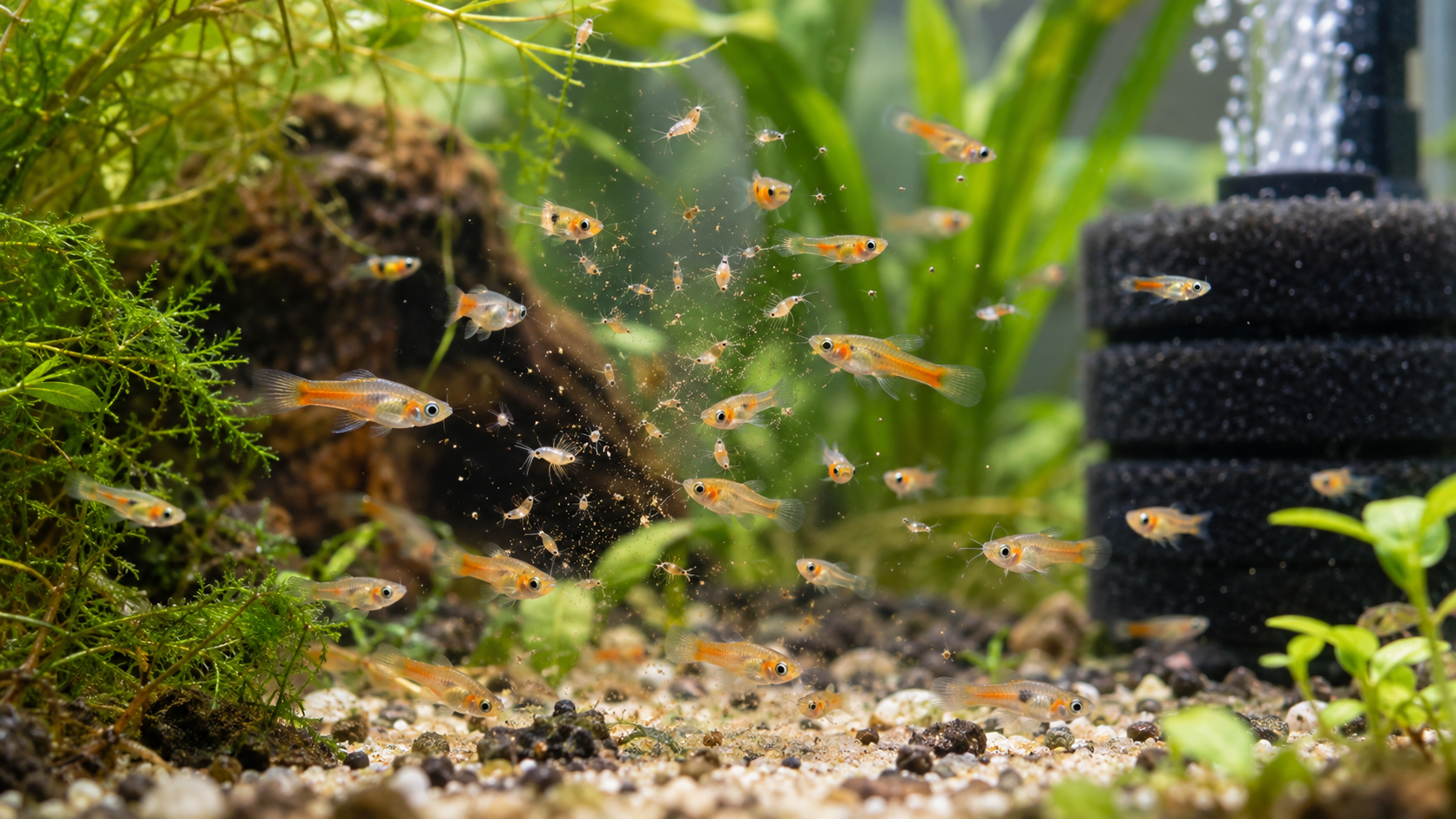
Merck explains that livebearers, which include swordtails, give birth to young that are already formed. It says: “Livebearers give birth to fully formed and functional young called fry.” The eggs are fertilized and hatch inside the female, which is why the fry are born free-swimming rather than hatching from eggs laid in the tank.
The same section names swordtails in its list of freshwater livebearers, alongside mollies, platys and guppies. It also notes that male swordtails have the “sword” on their tails. For feeding, the key point is that the fry are born small and need food suited to their size from the start.
The Merck text says the adults are a risk to the fry. It states: “Fry should be separated from adults because the adults (including the parents) tend to eat them.” A nursery setup, with a divider or a separate tank, keeps the food meant for fry from being eaten by larger fish before the fry can reach it.
Which foods the sources name
Merck names two food types for fry: small live or frozen food, and crushed flake. It says “Small live or frozen food and crushed flakes are good for feeding fry.” The section does not rank the two, and it does not name a specific live food such as brine shrimp or microworms for swordtails. Any choice among these foods is general guidance.
Merck also mentions commercial baby fish foods. Its words are: “Several commercial baby fish foods are available.” It does not name a brand or say a product is required. A baby fish food is a practical option when live food is not on hand, but the sources do not compare the options or say which one swordtail fry grow best on.
The filter is also part of feeding. Merck says “The aquarium should be filtered, but the pump should not be so powerful that it sucks in the fry.” A strong intake can pull fry into the filter, so the flow should be gentle in a fry tank. Food that is not eaten also adds waste, so the filter should be able to keep up with the feeding.
Amount and frequency: what the sources do not give
Merck gives general feeding rates for fish, but not for fry. It says: “In general, maintenance diets are fed at a rate of 1% to 2% of body weight per day, and growth diets at 3% to 5% of body weight per day.” Growth diets are the closer match for young fish, but the section does not say that the rate applies to fry, and it does not give a schedule. Treat the rate as a general reference, not a fry-specific instruction.
Merck also says that “Feeding methods and rates vary with species, age, system, and water temperature.” That sentence is the source’s own caution that the rate depends on the fish and the tank. A fry tank at a warm temperature may use food faster than a cooler one, but the sources do not give a temperature-based feeding table.
Overfeeding is the risk the sources name most clearly. Merck says overfeeding “can lead to health problems as well as a dirty tank.” In a small fry tank, uneaten food breaks down fast, so the safer approach is small portions given more often, with any uneaten food removed. The sources do not state how many feedings per day to give.
Swordtail species facts from FishBase
FishBase has a species page for the green swordtail (Xiphophorus hellerii). It says the female “produces 20 to 200 young after a gestation period of 24 to 30 days.” That range helps explain why a single brood can contain many fry, and why feeding a large number of small fish needs a plan. The page also gives a maximum length of 14.0 cm, measured as total length, for males and unsexed fish, and a tropical temperature range of 22 to 28 degrees C.
The FishBase page also includes an aquarium note that says the males can be aggressive toward each other, and it gives a minimum aquarium size of 80 cm for adults. That tank size is for the adults, not for the fry, but it shows that the fry will grow into a large fish that needs room. The sources do not describe a size at which fry are moved to the adult tank.
| Point | What the sources say | Source |
|---|---|---|
| Fry type | Born fully formed and functional | Merck, breeding and reproduction |
| Fry feeding | Small live or frozen food and crushed flakes | Merck, breeding and reproduction |
| Adults and fry | Separate fry from adults | Merck, breeding and reproduction |
| Brood size | 20 to 200 young per female | FishBase, green swordtail |
Practical points for a fry tank
For general tank basics, see whether sand is better than gravel for a fish tank and how many gallons a betta fish needs. Both are written for a different species but cover the same tank basics.
A fry tank should be warm, filtered gently and free of the adults. Merck says the fry should be kept in conditions “much as they are in the main aquarium,” and that there should be some cover so the fry are safe and not stressed. Plants or a breeding trap can provide cover. The sources do not give a size for a fry tank or a required volume.
Clean water matters more for small fish. Merck notes that water quality affects fish health, and it recommends testing for ammonia and nitrite when fish are added. A fry tank with uneaten food and no water changes can build up waste quickly. General guidance is to remove uneaten food and check the water on a set schedule.
If the fry look thin, do not grow, or stop eating, the sources point to a veterinarian or an experienced fish keeper rather than a home remedy. Merck recommends working with a knowledgeable veterinarian for fish health questions. This guide does not give medication doses or treatment instructions.
How we chose
This guide relies on the sources listed at the end. The fry care, feeding and separation points come from the Merck Veterinary Manual breeding and reproduction page. The feeding-rate and overfeeding notes come from the Merck section on providing a home for fish. The brood size, length and temperature facts come from the FishBase species page for the green swordtail. Retail listings and baby-food product pages were not used. Each claim in the body either matches a source or is labelled as general guidance.
What we could not verify
The sources describe fry care for livebearers in general terms. They do not give a feeding schedule, a fry-size chart, or a list of foods ranked for swordtail fry. They also do not say how fast swordtail fry grow on each food type.
What the sources do not say
- The sources do not give a number of feedings per day for swordtail fry.
- The sources do not name a specific live food for swordtail fry.
- The sources do not say which commercial baby food works best for swordtails.
- The sources do not give a fry-specific food amount as a percentage of body weight.
Frequently asked questions
What is the best food for newborn swordtail fry?
Merck names small live or frozen food and crushed flakes as good for feeding fry. It does not rank them, and it does not name a single best food for swordtails.
Can swordtail fry eat adult fish food?
The sources do not say adult fish food is suitable for swordtail fry. Merck’s guidance points to small live or frozen food, crushed flakes or commercial baby fish food for fry, so a food should be chosen for the size of the fry.
How often should swordtail fry be fed?
The sources do not give a schedule for swordtail fry. Merck warns that overfeeding can cause health problems and a dirty tank, so small portions with uneaten food removed is the general approach.
Should swordtail fry stay with the adults?
Merck says fry should be separated from the adults, because the adults tend to eat them. A separate nursery or a divider is the setup the source describes.
How many fry does a swordtail have?
FishBase says the female produces 20 to 200 young. The number in a particular brood can vary, and the sources do not give a typical brood for a single tank.
Sources
- Merck Veterinary Manual, “Breeding and Reproduction of Fish”: https://www.merckvetmanual.com/all-other-pets/fish/breeding-and-reproduction-of-fish (opened 2026-10-24)
- Merck Veterinary Manual, “Providing a Home for Fish”: https://www.merckvetmanual.com/all-other-pets/fish/providing-a-home-for-fish (opened 2026-10-24)
- FishBase, species summary for Xiphophorus hellerii (green swordtail): https://www.fishbase.se/summary/Xiphophorus-helleri.html (opened 2026-10-24)