How to Keep Betta Fish Happy: Water, Food and Calm
As an Amazon Associate we earn from qualifying purchases.
The person typing “how to keep betta fish happy” wants a short, usable checklist: what water to give a betta, how much to feed it, and what to avoid. A betta stays settled when its water is warm and stable, the flow is calm, feeding is measured, and no aggressive fish shares its tank. The University of Florida IFAS extension says bettas “prefer calm water” and “thrive in warmer water and do not do well in cold water.” It also ties water health to management rather than to container size alone. This guide sets out those points, the sources behind them, and the gaps that the sources leave open.
Quick answer
- Keep the water warm and stable. IFAS says bettas do not do well in cold water.
- Choose calm flow. The same IFAS publication warns that heavy filtration may be harmful to a betta’s welfare.
- Test the water and change it on a regular schedule, because poor water quality is a common stressor.
- Feed small, measured amounts, remove leftovers, and keep the tank free of aggressive tankmates.
Start with warm, stable water
Temperature comes first. IFAS states that “bettas thrive in warmer water and do not do well in cold water.” The same publication describes a wild population in Thailand with an average water temperature of 29.9°C (about 86°F). That figure is habitat data from a field setting. It is not a target for a home tank, and the sources opened for this guide do not give a home-tank temperature range.
The Merck Veterinary Manual says that “A heater is necessary for both freshwater and saltwater tropical fish.” It adds that “You should also have a separate thermometer in the tank to monitor water temperature independently.” A heater with an adjustable thermostat and a separate thermometer lets you check the reading rather than trust the heater’s dial. For the heater question in more detail, see whether a betta fish needs a heater.
IFAS also gives a room-temperature floor for one case: “If they are kept in an unfiltered, unheated container, the air temperature of the room should be maintained at no less than 22°C (71.6°F).” That line covers an unheated, unfiltered setup only. It is not a full care standard.
Keep water quality under control
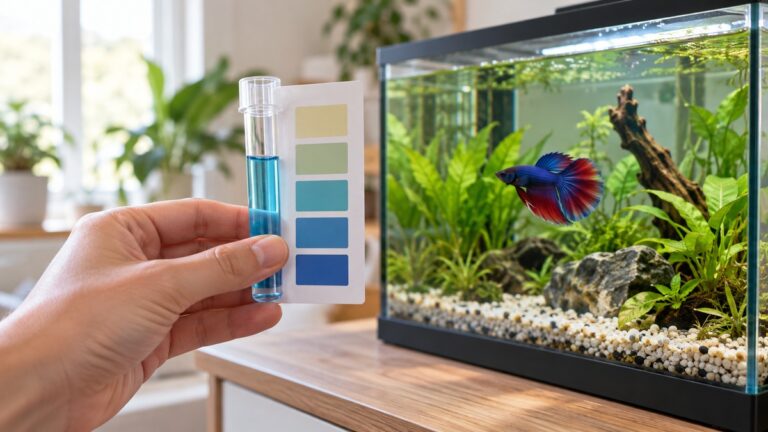
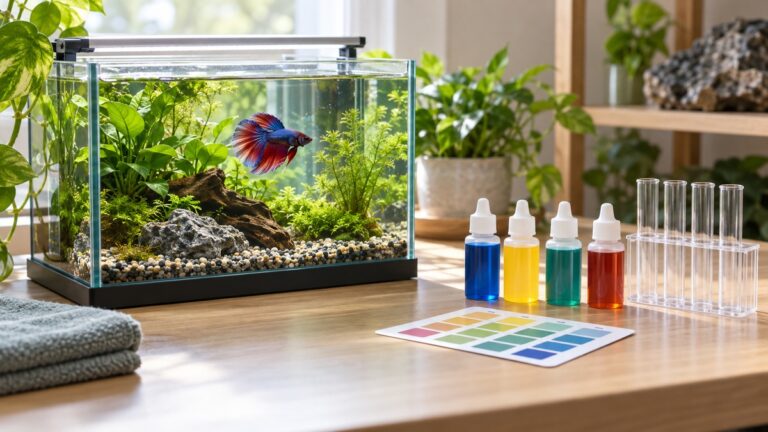
IFAS states that “water quality is not dependent on the size of the container, but rather on management and husbandry.” In practice, management means testing and changing water. The IFAS publication on ammonia explains that “The portion of un-ionized ammonia increases with increasing pH and/or temperature,” and that “a good ammonia test kit will include a TAN test, a pH test, and a thermometer.” The fish-stress publication from IFAS says “The key to prevention of stress is GOOD MANAGEMENT.” It also notes that “Poor water quality is a common and important STRESSOR of cultured fish and precedes many disease outbreaks.” That finding comes from cultured fish, so apply it to bettas as general guidance.
Tap water needs treatment before it goes into a tank. The Merck Veterinary Manual notes that “Most city water is treated with chlorine or a combination of chlorine and ammonia (known as chloramine), both of which are toxic to fish.” It adds that “Additives (dechlorinators) are available to remove both chlorine and chloramine from the water.” For a test-kit choice, see the freshwater test kit guide.
Choose calm flow, not strong current
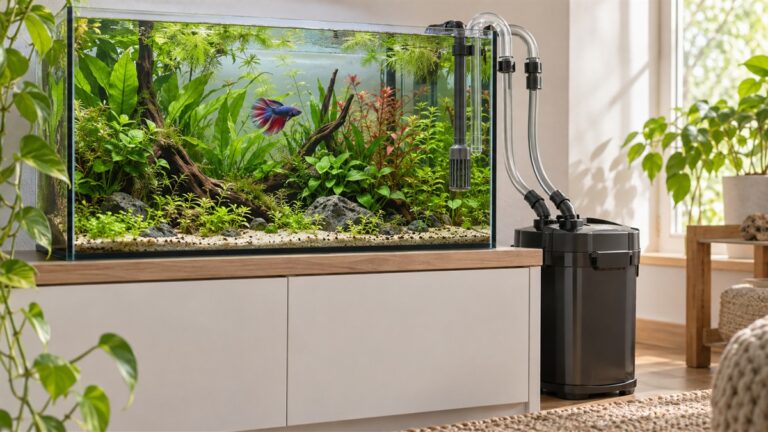
Flow is a welfare issue for bettas. IFAS writes: “Bettas prefer calm water as shown by research using flow as a stressor, so heavy filtration may actually be harmful to a betta’s health and welfare.” The same publication also says that “Aquariums of limited volume and reduced filtration should be managed to include frequent water changes so that uneaten feed as well as ammonia and other dissolved wastes are not allowed to reach harmful levels.”
That gives a clear trade-off. A gentle filter needs regular water changes to keep wastes down, and a strong current is not a substitute for changes. Whether a given filter’s flow can be adjusted is a fact for the manufacturer page or the listing, not for this guide. For filters with low flow, see the low-flow filter guide.
Feed measured amounts
Overfeeding is the most common feeding error, and the sources are direct about it. The IFAS nutrition publication, which covers fish in general, says: “The most common mistake made by pet owners is over-feeding their fish, often with resulting degradation of water quality.” It also says “One feeding per day is plenty for most pet animals.”
The same publication gives a general maintenance figure: “For maintenance, 0.5–1.0% body weight per day is adequate.” That figure is for fish in general, not bettas, and it needs a kitchen scale to apply. The sources opened do not give a betta-specific amount. A practical rule that follows from the sources is to feed a small portion, then remove any food that is left, because uneaten feed adds to the ammonia load described above. The “remove leftovers” step is general guidance, but it follows directly from the IFAS line about uneaten feed.
Avoid crowding, aggression and stress
The IFAS fish-stress publication lists biological stressors that include “Population density—crowding” and “Other species of fish—aggression, territoriality, lateral swimming space requirements.” Both apply to a tank that holds more than one fish or an aggressive tankmate. The same publication lists “Physical Stressors” such as temperature, and it names temperature as “one of the most important influences on the immune system of fish.”
For male bettas, the UF/IFAS betta publication describes how commercial farms handle the issue: males “must be separated into individual containers to avoid damage due to aggression.” At home, the general rule that follows is to keep two male bettas apart. That is general guidance and not a sourced finding about home tanks, and the sources opened do not say how tankmates behave in a home aquarium.
Signs to watch and when to ask for help
IFAS states that “Good water quality, nutrition, and biosecurity will help prevent disease and promote good health.” When a problem appears, the same publication says “proper diagnostics, including working with a fish veterinarian, will be key to successful management.” This guide does not give treatments or dosing. If a betta shows signs of illness, describe what you see to an experienced fish keeper or an aquatic vet before you treat the tank.
| Factor | What the opened source says | Source |
|---|---|---|
| Temperature | Bettas “thrive in warmer water and do not do well in cold water” | UF/IFAS FA212 |
| Flow | “Bettas prefer calm water”; heavy filtration may be harmful | UF/IFAS FA212 |
| Water changes | Limited-volume tanks need “frequent water changes” | UF/IFAS FA212 |
| Chlorine | Dechlorinators remove chlorine and chloramine | Merck Veterinary Manual |
| Feeding | 0.5–1.0% of body weight per day for maintenance (fish in general) | UF/IFAS FA096 |
How we chose
The criteria for this guide were simple. Each source is a university extension or veterinary reference that covers betta or fish husbandry directly. Retail product pages were excluded, and no product, price or rating appears here. Each claim comes from a page opened on 2026-10-24, and each quotation was checked against the text of that page. Where a figure comes from fish in general rather than from bettas, the text says so.
What we could not verify
The opened sources leave several practical questions open. They do not give a home-tank temperature range, a betta-specific feeding amount, a minimum tank volume, or a target pH for an aquarium. Treat any figure for those points as unsourced until a university or veterinary page gives one.
What the sources do not say
- A home-tank temperature range. The 29.9°C figure is a habitat average from a wild population.
- A betta-specific feeding amount or schedule. The 0.5–1.0% figure is for fish in general.
- A minimum tank volume. IFAS says water quality depends on management, but it gives no volume figure.
- Whether a particular filter’s flow is adjustable. That belongs to the manufacturer page.
Frequently asked questions
What temperature keeps a betta fish happy?
The sources say bettas “thrive in warmer water and do not do well in cold water,” but they do not give a home-tank range. Use a heater with an adjustable thermostat and a separate thermometer, and check the reading rather than trusting the dial alone.
How much should I feed a betta each day?
The sources do not give a betta-specific amount. The IFAS figure of 0.5–1.0% of body weight per day is for fish in general and needs a scale to apply. Remove any food that is not eaten, because uneaten feed adds to ammonia.
Does a betta need a filter?
The sources do not say a filter is required. IFAS warns that heavy filtration may harm bettas, and it says that tanks with reduced filtration need frequent water changes. A gentle filter with a flow the manufacturer confirms as adjustable is one option, paired with regular changes.
Can a betta live in a small container?
IFAS states that bettas “thrive in small containers as long as water quality, nutrition, and other health management considerations are properly managed.” That describes what can be managed, not what is best for the fish. This site does not recommend bowls or vases as a home for a betta.
What is the most common mistake betta owners make?
The general fish guidance from IFAS points to overfeeding as the most common mistake, and to the water-quality damage that follows from it. Feeding small amounts and testing the water address most of that risk.
Sources
- Evolution, Culture, and Care for Betta splendens (UF/IFAS FA212), opened 2026-10-24.
- Stress: Its Role in Fish Disease (UF/IFAS FA005), opened 2026-10-24.
- Ammonia in Aquatic Systems (UF/IFAS FA031), opened 2026-10-24.
- Fish Nutrition (UF/IFAS FA096), opened 2026-10-24.
- Providing a Home for Fish, Merck Veterinary Manual, opened 2026-10-24.