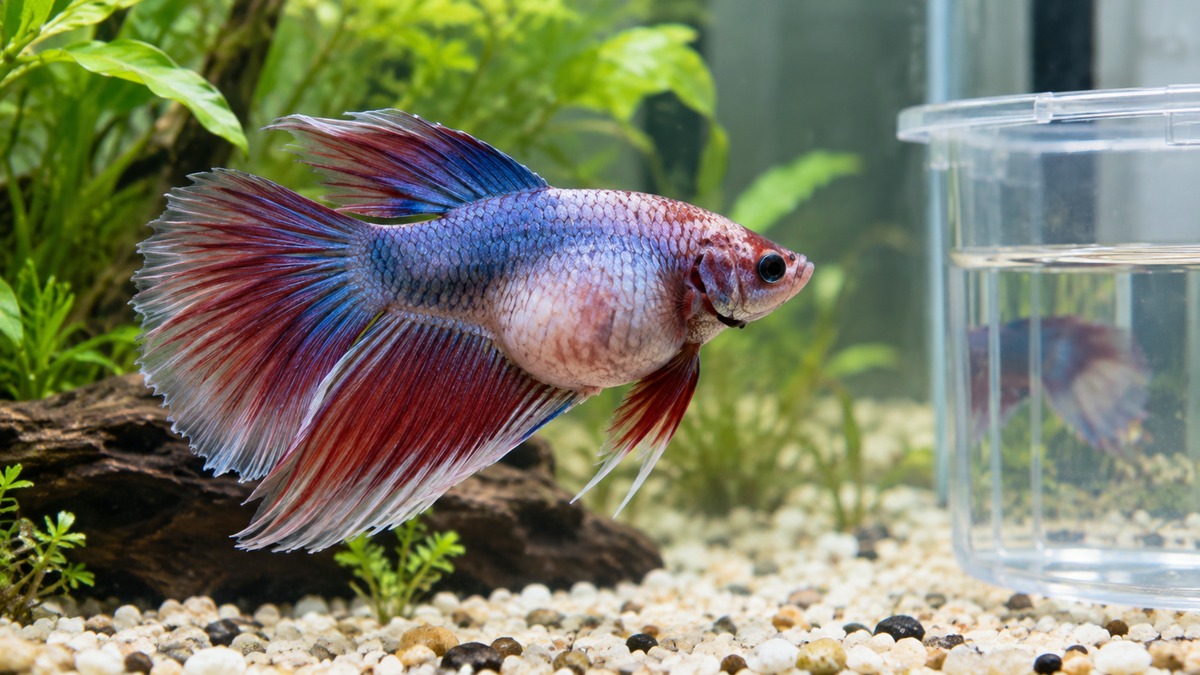
Betta Fish Bloat: Swollen Belly Signs and When to See a Vet
As an Amazon Associate we earn from qualifying purchases. Details
Betta fish bloat, meaning a swollen or enlarged belly, is listed by the Merck Veterinary Manual as a general sign of illness in fish. The sources checked for this guide do not describe a betta-specific bloat cause, and they do not give a reliable home fix. A bloated belly can come from fluid, from a bacterial infection, or from other problems, and the sources say a diagnosis needs laboratory testing. A swollen betta should be seen by an experienced fish keeper or an aquatic vet.
Quick answer
- Merck lists “Swelling or bloating” among general signs of illness in fish. It does not describe a betta-only cause.
- Merck links “fluid accumulation in the abdomen” to bacterial infections such as Aeromonas, and says diagnosis “requires laboratory testing.”
- The sources do not give a feeding or fasting rule for a bloated betta, so this guide does not give one.
- A swollen betta should go to a vet or an experienced fish keeper. Merck notes that emergency fish care is limited.
What a swollen belly can look like
Merck’s list of general signs of illness includes “Swelling or bloating,” along with “Weight loss,” “Scales sticking out or standing up,” and “Floating, drifting, or swimming erratically in unusual positions.” These are listed as signs to notice, not as a diagnosis. A betta can show one sign or several, and the list alone does not say which problem is present.
The Aeromonas description in Merck is the most specific link to abdominal swelling in the sources. It says fish infected with Aeromonas or closely related bacteria “may show signs that include bloody spots or ulcers on the body, fluid accumulation in the abdomen (‘dropsy’ and ‘pinecone disease’), ragged fins, or enlarged eyes.” The same section says Aeromonas is “the most common bacterial infection of freshwater aquarium fish.” Fluid in the abdomen is one possible sign, and it is not confirmed by appearance alone.
When you look at a bloated betta, note whether the belly is swollen all over, whether the scales look raised, whether there are sores or spots, and whether the fish is eating. Those observations help a vet narrow the list. They do not replace the vet’s exam.
Causes the sources name
Merck describes several bacterial and parasitic diseases of fish, but most of the disease descriptions are for fish groups other than bettas, such as goldfish, koi, and pond fish. The sources do not connect every swollen belly to one of these diseases. The general lesson from Merck is that “Diagnosis of a bacterial infection requires laboratory testing,” and that “Many bacterial infections can be treated with antibiotics, but laboratory testing is necessary to determine which antibiotics will work.”
Merck’s discussion of a parasite that causes renal dropsy is specific to pond-raised goldfish, and it says the parasite “attacks the kidneys” and can lead to “bloated-looking fish.” It is not presented as a betta condition, so this guide does not apply it to bettas.
Merck also describes gas bubble disease, which occurs “when water is supersaturated with dissolved gases.” The sources describe it in relation to cold-water systems and to tiny gas bubbles in the cornea, fins, or gills. The sources do not say gas bubble disease causes a swollen betta belly. It is mentioned here only so readers know it is a separate condition described by Merck.
Water and temperature
Merck says disorders often come from “stress, poor water quality, overcrowding, and failure to quarantine any new or sick fish to avoid spread of disease.” The UF/IFAS stress circular defines stress as “a condition in which an animal is unable to maintain a normal physiologic state because of various factors adversely affecting its well-being.” It also says temperature is “one of the most important influences on the immune system of fish.”
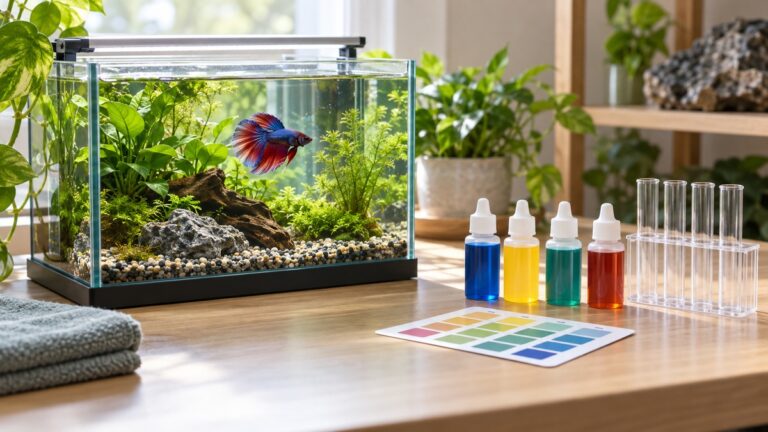
The betta publication, UF/IFAS FA212, says “water quality is not dependent on the size of the container, but rather on management and husbandry.” It states bettas “thrive in warmer water and do not do well in cold water,” and for an unheated container advises room air kept “no less than 22°C (71.6°F).” A water test is a useful next step to rule out poor water quality. A guide is here: fish tank water quality test strips.
What the sources do not say about feeding
Many people look for a feeding change when a betta looks bloated. The sources checked for this guide do not give a feeding rule, a fasting period, or a food type for a bloated betta. This guide therefore does not offer one. Feeding and any change to diet should be discussed with a vet or an experienced fish keeper, especially if the belly is swollen or the fish is losing weight.
When to see a vet
See a vet or an experienced fish keeper as soon as a betta has a swollen belly. Merck says “emergency medical treatment for pet fish is not as advanced or as readily available as it is for dogs and cats,” so the earlier the contact, the better the chance of finding a vet with fish experience. If a vet is nearby, the sources say that “proper diagnostics, including working with a fish veterinarian, will be key to successful management.” The same publication, UF/IFAS FA212, says “Many drugs and chemicals can do more harm than good if they are used inappropriately.” This guide does not give medicine names or doses.
Bring notes to the visit: the date the swelling started, water test results, recent tank changes, any new fish or plants, and photos of the belly from the side and above. A vet will use this to decide what to examine.
For a broader look at tank size and how much room a betta needs, see how big of a tank do betta fish need.
How we chose
The sources for this guide were chosen for their subject: fish disease, emergencies, stress, and betta biology. The Merck Veterinary Manual pages list the general signs of illness and describe bacterial and parasitic diseases. The UF/IFAS publications cover betta biology and stress. All five sources are non-retail and were opened on 2026-10-24. Each quoted phrase was checked against the opened text, and no retail page was used.
The guide keeps to the signs and causes the sources name, and it separates the general signs list from disease descriptions written for other fish.
What we could not verify
The sources checked for this guide do not describe a betta-specific bloat cause. They do not say how common a swollen belly is in home bettas, and they do not say whether swelling is more often a fluid problem, a gas problem, or a sign of something else in bettas.
What the sources do not say
The sources do not give a home diagnosis method for bloat, a betta-specific feeding rule, a fasting period, or a medicine dose. They do not say whether a bloated betta should be fasted, and they do not describe a home test that separates fluid from gas. Merck’s disease descriptions are for goldfish, koi, pond fish, and mixed fish groups, so they are not betta-specific statements.
Frequently asked questions
Is a bloated betta always sick?
The sources list “Swelling or bloating” as a sign of illness in fish, so it should be treated as a warning sign. The sources do not say that every swollen belly means disease, and a vet should evaluate it.
Can a betta bloat cause death?
The sources do not say bloating causes death in bettas. Merck does say that for some fish diseases the outcome can be severe; for velvet, a different condition, it states “High death rates are common.” Because the cause of a swollen belly is not known from the sources, a vet should be consulted promptly.
Should I fast a bloated betta?
The sources checked for this guide do not give a fasting rule for bettas. Ask a vet or an experienced fish keeper before changing feeding, because the sources do not confirm a home approach.
Does bloat come from water quality?
Merck links “poor water quality” to fish disorders in general. It does not say that water quality by itself produces a swollen belly. A water test can show whether the tank is a likely contributor and should be part of the vet discussion.
Can I use medicine for a bloated betta?
Not without a diagnosis. Merck says “Diagnosis of a bacterial infection requires laboratory testing,” and FA212 says “Many drugs and chemicals can do more harm than good if they are used inappropriately.” This guide does not provide medicine names or doses.
Sources
- Merck Veterinary Manual, “Disorders and Diseases of Fish,” https://www.merckvetmanual.com/all-other-pets/fish/disorders-and-diseases-of-fish (opened 2026-10-24)
- Merck Veterinary Manual, “Routine Health Care of Fish,” https://www.merckvetmanual.com/all-other-pets/fish/routine-health-care-of-fish (opened 2026-10-24)
- Merck Veterinary Manual, “Emergencies of Fish,” https://www.merckvetmanual.com/all-other-pets/fish/emergencies-of-fish (opened 2026-10-24)
- UF/IFAS Extension, FA212, “Evolution, Culture, and Care for Betta splendens,” https://edis.ifas.ufl.edu/publication/FA212 (opened 2026-10-24)
- UF/IFAS Extension, Circular 919/FA005, “Stress: Its Role in Fish Disease,” https://edis.ifas.ufl.edu/publication/FA005 (opened 2026-10-24)