How to Introduce a Betta Fish to a New Tank
As an Amazon Associate we earn from qualifying purchases.
Learning how to introduce betta fish to new tank setups comes down to four steps: prepare the tank before the fish arrives, treat the water, keep the new fish separate for a while if it came from somewhere else, and then release it slowly with the water temperature matched. The steps below follow University of Florida IFAS and Merck Veterinary Manual guidance on fish husbandry. The sources do not give a betta-specific schedule for every step, and this guide says where they stop.
Quick answer
- Run the tank with heat and filtration, and let the biological filter mature before the fish goes in. A new biofilter takes six to eight weeks.
- Dechlorinate all new water. Merck says chlorine and chloramine are both toxic to fish.
- Quarantine new fish from other sources. Merck recommends at least 30 to 60 days for valuable pet fish.
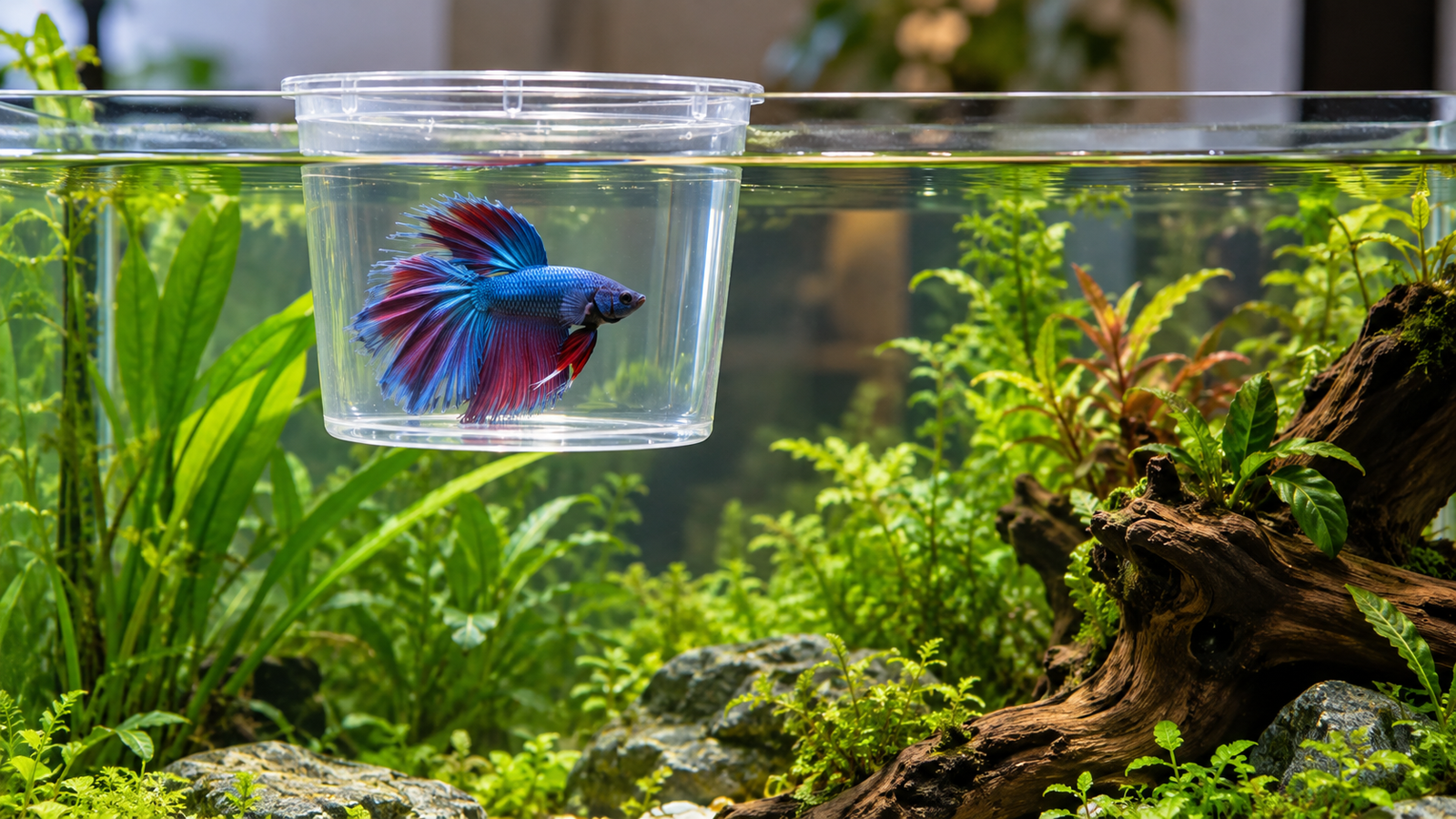
- Float the sealed bag to match temperature, keep the bag water out of the tank, and release the fish with the lights off.
Prepare the tank before the fish arrives
The tank should be ready before the betta comes home. The biggest preparation step is the biological filter. The IFAS ammonia publication (FA031) states, “A new biofilter requires six to eight weeks to build up sufficient bacteria to effectively reduce ammonia and nitrite levels.” A tank that has not finished this process can let ammonia and nitrite build up quickly, and the Merck fish housing page states, “Prolonged ammonia exposure is highly toxic to fish.”
Temperature matters as well. The IFAS betta publication (FA212) says, “bettas thrive in warmer water and do not do well in cold water.” Plan the heater and thermometer before the fish is released, not after. For tank volume, see how big of a tank do betta fish need, and for heating options see do betta fish need a heater.
Water flow is also part of setup. FA212 notes that “Bettas prefer calm water as shown by research using flow as a stressor, so heavy filtration may actually be harmful to a betta’s health and welfare.” The sources opened here do not give a flow rate or a filter size for bettas.
Treat the water
Tap water is the most common source of water for a new tank, and the Merck page on providing a home for fish says that “Most city water is treated with chlorine or a combination of chlorine and ammonia (known as chloramine), both of which are toxic to fish and to the necessary bacteria that grow in your aquarium.” The same page says, “Additives (dechlorinators) are available to remove both chlorine and chloramine from the water and should be used to treat any new water.”
The Merck routine care page makes the same point in a shorter form: “Any new water should be dechlorinated before it is added to the aquarium or pond.” This applies to the water for the first fill and to every water change after that. If the tank water source is not tap water, the sources opened here do not say what treatment is needed, so the local water report or the supplier is the place to check.
Water changes are part of the same routine. FA031 states, “A 25% to 50% water change will help remove some ammonia, assuming the incoming water source does not contain ammonia.” That approach depends on clean incoming water, which is why the dechlorination step comes first.
Quarantine and disease risk
Quarantine is the step most often skipped, and the sources treat it as important. Merck defines it this way: “Quarantine means keeping new or sick animals in a separate aquarium for a specific amount of time before joining others.” For valuable pet fish, the same page says, “Valuable pet fish should be quarantined for at least 30 to 60 days before being added to the general population.”
The Merck page on providing a home for fish warns that “there is significant risk of accidentally introducing disease if the new fish have not been carefully quarantined.” The Merck routine care page adds that “a comprehensive fish health management program should focus on water quality, nutrition, sanitation (maintenance and cleaning), and quarantine.”
FA212 gives a betta-specific point. It says, “Biosecurity against the introduction of disease agents is simplified for betta males kept in individual tanks because they and their maintenance equipment are more isolated from other sources of potential disease.” In other words, a betta kept alone with its own equipment has fewer contact points with other fish. The sources do not give a betta-specific quarantine length.
Acclimate and release the fish
Acclimation means letting the fish adjust to the new tank’s temperature and water chemistry. Merck’s fish housing page gives the basic method: “Float the bag with the new fish until the water temperature has acclimated and then release the new fish.” It also says, “When adding fish, never allow water from the transport bag to be introduced into the aquarium.” The bag water may carry material from the shop or shipping container, so it stays out of the tank.
The same page describes release in low light. It says, “A third technique is to release the new fish in the dark.” It goes on to say that when the lights are turned off, most fish settle within a few minutes. For a betta, a practical version is to dim the room and tank lights, release the fish gently, and leave it alone for a short period before turning the lights back on. The source describes this for a general group setting, so it is a reasonable approach rather than a betta-specific rule.
Limit handling where possible. The IFAS stress publication (FA005) lists “Handling” and “Shipping” among the procedural stressors that affect fish, and it states, “Stress is caused by placing a fish in a situation that is beyond its normal level of tolerance.” The source treats these as stress sources; it does not give a betta-specific handling method.
Watch the first days
Once the fish is in, water quality is the main check. The Merck page on providing a home for fish recommends that when a new aquarium is stocked, you should “monitor the water quality, especially ammonia and nitrite levels, on a daily basis.” FA031 says, “All aquaculturists and hobbyists should invest in a dependable water quality test kit.” A test kit is the only reliable way to know whether ammonia is present, because FA031 notes that ammonia is colorless and odorless even at levels toxic to fish.
Overfeeding is a common source of ammonia. FA031 states, “Overfeeding is a major cause of high ammonia concentrations.” Feed only what the fish eats, and remove uneaten food from the tank. If the fish shows signs of illness, FA212 says, “proper diagnostics, including working with a fish veterinarian, will be key to successful management.” Do not start treatment from guesswork; a veterinarian who sees fish can advise on diagnosis.
How we chose
This guide uses only sources that cover fish husbandry directly: three University of Florida IFAS publications on betta biology, water chemistry and stress, and two Merck Veterinary Manual pages on housing and routine care. Retail product pages were not used, and no product claims appear here. Each factual statement in the body is tied to text that was opened and checked on 2026-10-24. Where a source did not cover a point, the guide says so instead of filling the gap.
What we could not verify
The introduction steps above are general husbandry guidance, and the opened sources do not describe a complete betta-specific introduction protocol.
What the sources do not say
- No source opened here gives a betta-specific quarantine length. The 30 to 60 day figure applies to valuable pet fish in general.
- No source gives a specific number of minutes for floating the bag or a specific temperature difference that is safe.
- The stocking advice on adding fish slowly, one or two at a time over several weeks, is written for multiple fish in an aquarium and does not describe a single betta.
- The sources do not describe betta shipping conditions or how long a betta can stay in a shipping bag.
Frequently asked questions
Can I put a betta straight into the tank from the store bag?
The sources recommend floating the sealed bag until the water temperature has acclimated, then releasing the fish. They also say that bag water should not go into the aquarium. Putting the fish in without temperature matching is not what the sources describe.
Does the new tank need to be cycled first?
Yes. FA031 says a new biofilter needs six to eight weeks to build up enough bacteria to reduce ammonia and nitrite. A tank that is not yet established should be watched closely with a test kit before a fish is added.
Is quarantine necessary for one betta?
The Merck page recommends quarantine for new fish, and says valuable pet fish should be quarantined for at least 30 to 60 days. The sources do not give a separate betta rule, so the guide cannot say whether a shorter period is adequate for a betta from a particular source.
Should I use tap water when introducing the fish?
Tap water can be used if it is dechlorinated. Merck says chlorine and chloramine are toxic to fish and that dechlorinators should be used on new water. Water from an unknown source may need other treatment, and the sources opened here do not cover that.
What should I check in the first days after the fish goes in?
Check ammonia and nitrite daily, as the Merck page recommends for newly stocked aquariums, and keep the tank warm and calm. If the fish looks unwell, FA212 advises working with a fish veterinarian for diagnosis. The sources do not describe specific signs of early problems for bettas, so this guide does not list them.
Sources
- University of Florida IFAS, FA212: Evolution, Culture, and Care for Betta splendens, https://edis.ifas.ufl.edu/publication/FA212 (opened 2026-10-24)
- University of Florida IFAS, FA031: Ammonia in Aquatic Systems, https://edis.ifas.ufl.edu/publication/FA031 (opened 2026-10-24)
- University of Florida IFAS, Circular 919 (FA005): Stress – Its Role in Fish Disease, https://edis.ifas.ufl.edu/publication/FA005 (opened 2026-10-24)
- Merck Veterinary Manual, Providing a Home for Fish, https://www.merckvetmanual.com/all-other-pets/fish/providing-a-home-for-fish (opened 2026-10-24)
- Merck Veterinary Manual, Routine Health Care of Fish, https://www.merckvetmanual.com/all-other-pets/fish/routine-health-care-of-fish (opened 2026-10-24)