Do Neon Fish Need a Filter?
As an Amazon Associate we earn from qualifying purchases.
Do neon fish need a filter? The sources we opened do not say that neon tetras must have one. They do explain what a filter removes from the water, and they describe what changes when a tank has no filtration: more frequent water changes. A filter is the source-backed way to handle waste, but a tank without one can still be run with a disciplined water-change schedule. The right choice depends on tank size, group size and how much water you can change.
Quick answer
- No source we opened says neon tetras must have a filter.
- Merck states that “Filtration is important to remove waste and particulate matter.”
- Merck says small tanks may not need filtration, but “more frequent water changes are needed,” and the page does not name neon tetras.
- FishBase advises a group of “5 or more individuals” in a tank with a minimum length of 60 cm, which is the sizing data the sources give.
What a filter does, according to the source
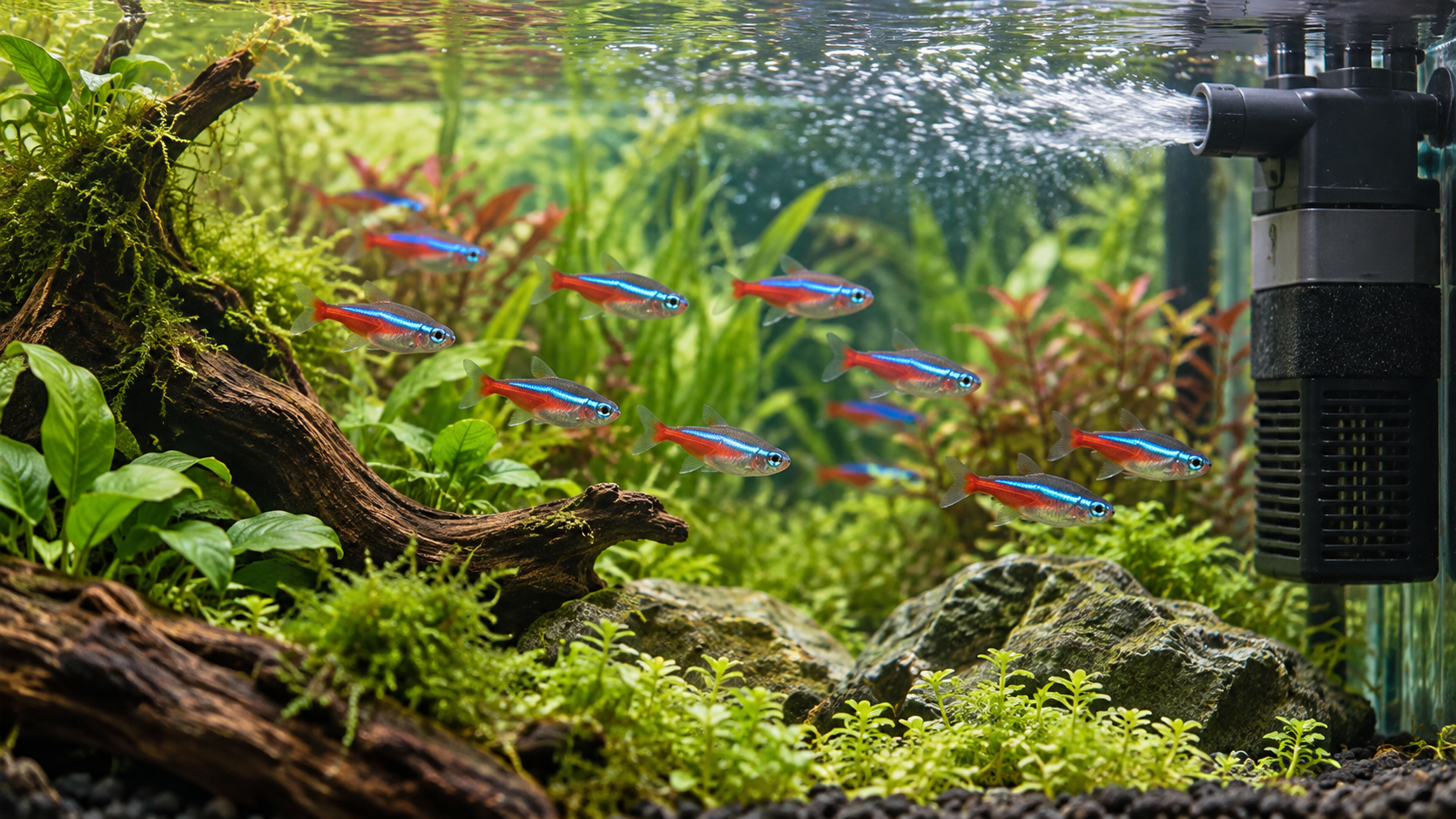
The Merck Veterinary Manual describes filtration as a way to deal with fish waste. It says that “Filtration is important to remove waste and particulate matter” and that “There are many kinds and types of filtration systems.” The page then explains the two common types in simple terms.
For an under-gravel system, the page says that “the gravel acts as the filter medium, which traps particulate matter and contains nitrifying bacteria (beneficial bacteria) that remove the primary fish waste, ammonia.” For a hanging filter, it describes “a replaceable filter cartridge that consists of filter floss, which collects particulate matter, and activated carbon, which removes certain chemicals and minerals.” Many hanging filters also hold a medium for the nitrifying bacteria. In both cases, the filter’s job is to remove waste, trap particles or hold the bacteria that break down ammonia.
The page does not say that a filter is required for every freshwater tank. It describes what filtration does, which is the information a reader needs to decide whether a filter fits their setup.
What the sources say about tanks with no filter
Merck addresses small tanks directly. It states that “In small aquariums, such as goldfish bowls and betta tanks, neither filtration nor a heater may be required.” It then adds that “However, more frequent water changes are needed,” and says the water changes may be as large as “perhaps as much as 50% per week.”
Two cautions apply. First, the passage names goldfish bowls and betta tanks, not neon tetras. Second, this site does not recommend bowls as a home for any fish, and a bowl with no filter is not a setup this post endorses. The passage is useful only as evidence that a filter is one way to manage waste, and that a tank without one needs a larger share of water changed.
Neon tetra tank size and group size
The FishBase species page for the neon tetra, Paracheirodon innesi, gives the keeping notes the sources provide. It lists the fish as “Freshwater; pelagic,” with a “pH range: 5.0 – 7.0” and a “dH range: 1 – 2.” Its temperature line reads “Tropical; 20°C – 26°C.” For keeping, the page says “in groups of 5 or more individuals; minimum aquarium size 60 cm.”
A 60 cm tank is about 24 inches long. Because the figure is a length, check the footprint of the tank before you decide how much filtration to add. The FishBase page does not say how many fish a given filter can support, and the sources we opened do not give a filter capacity for neon tetras.
The FishBase page lists a dH range of 1 to 2. The sources do not say how a tap-water change should be adjusted to meet that range, so treat the figure as a listed range and not as an instruction.
Water changes and tap water
If a tank runs with less filtration, the water changes carry more of the load. Merck says that “Most city water is treated with chlorine or a combination of chlorine and ammonia (known as chloramine), both of which are toxic to fish and to the necessary bacteria that grow in your aquarium.” It adds that “Additives (dechlorinators) are available to remove both chlorine and chloramine from the water and should be used to treat any new water that goes in the aquarium.”
Merck also states that “Filters, pumps, heaters, and lights should not be turned on until after the tank is filled with water.” That line applies to a filter as well as to a heater and a light, so the sequence matters at setup and after a water change.
Practical decision steps
- Measure the tank’s length, then confirm it meets the 60 cm minimum for a neon group of 5 or more.
- If you choose a filter, check the flow it gives against the current a small tetra can handle. The sources we opened do not give a flow limit for neon tetras.
- If you choose no filter, write down a water-change schedule before you buy fish, and keep up with it. Merck’s point is that more frequent changes are needed.
- Treat every new batch of tap water with a dechlorinator before it goes in, as Merck recommends.
- Do not turn on the filter, heater or light until the tank is full.
For a low-flow filter option for a betta-sized tank, see best low flow filter for betta. For guidance on strong current, see aquarium filter current too strong.
How we chose
We chose the two sources that cover the question directly. The FishBase species page for neon tetra gives the group, tank-size and habitat notes. The Merck Veterinary Manual page on providing a home for fish explains filtration, water changes and water treatment. We opened both with curl on 2026-10-24. Retail listings were not used. The quotes above were checked against the text of the pages we opened.
What we could not verify
The keyword asks about a species that the sources describe only in general terms. The points below are not covered by the pages we opened.
What the sources do not say
- Whether neon tetras need a filter for their health. The sources we opened do not state a requirement.
- What filter flow, capacity or type suits a group of neon tetras.
- How much water a neon tank should change per week. Merck’s figure is for small tanks in general.
- Any disease risk that depends on filtration. Ask an experienced fish keeper or an aquatic vet if a fish looks unwell.
Frequently asked questions
Can neon tetras live without a filter in a 60 cm tank?
The sources we opened do not say that they cannot. FishBase gives 60 cm as the minimum aquarium size for a group of 5 or more. Merck says small tanks may not need filtration but need more frequent water changes. The sources do not join those two statements for neon tetras, so a filter-free tank is a plan you would need to manage with a schedule.
Is a filter the same as a heater for neon tetras?
No. Merck lists filtration and heating separately, and it names a heater as necessary for tropical freshwater fish. FishBase lists neon tetra as tropical at 20°C to 26°C. A filter removes waste and particles, while a heater holds the water in the listed temperature range. The two jobs are different.
Does a filter need to be turned on before the tank is full?
No. Merck says that “Filters, pumps, heaters, and lights should not be turned on until after the tank is filled with water.” Follow that order at setup and after any water change that empties the tank.
Do neon tetras need strong current?
The sources we opened do not give a current figure for neon tetras. They describe the species’ habitat as pelagic in FishBase and do not say how strong the flow in a home tank should be.
What if I already have a small tank without a filter?
Check the length and the group size first, using the FishBase figures. Then set a water-change routine and treat new water before it goes in, as the Merck page describes. If a fish looks unwell, contact an experienced fish keeper or an aquatic vet. This post does not give treatment advice.
Sources
- FishBase, Paracheirodon innesi (neon tetra) species page, https://www.fishbase.se/summary/Paracheirodon-innesi.html (opened 2026-10-24)
- Merck Veterinary Manual, Fish: Providing a Home for Fish, https://www.merckvetmanual.com/all-other-pets/fish/providing-a-home-for-fish (opened 2026-10-24)