Are Tetras Bottom Feeders? What the Habitat Data Shows
As an Amazon Associate we earn from qualifying purchases.
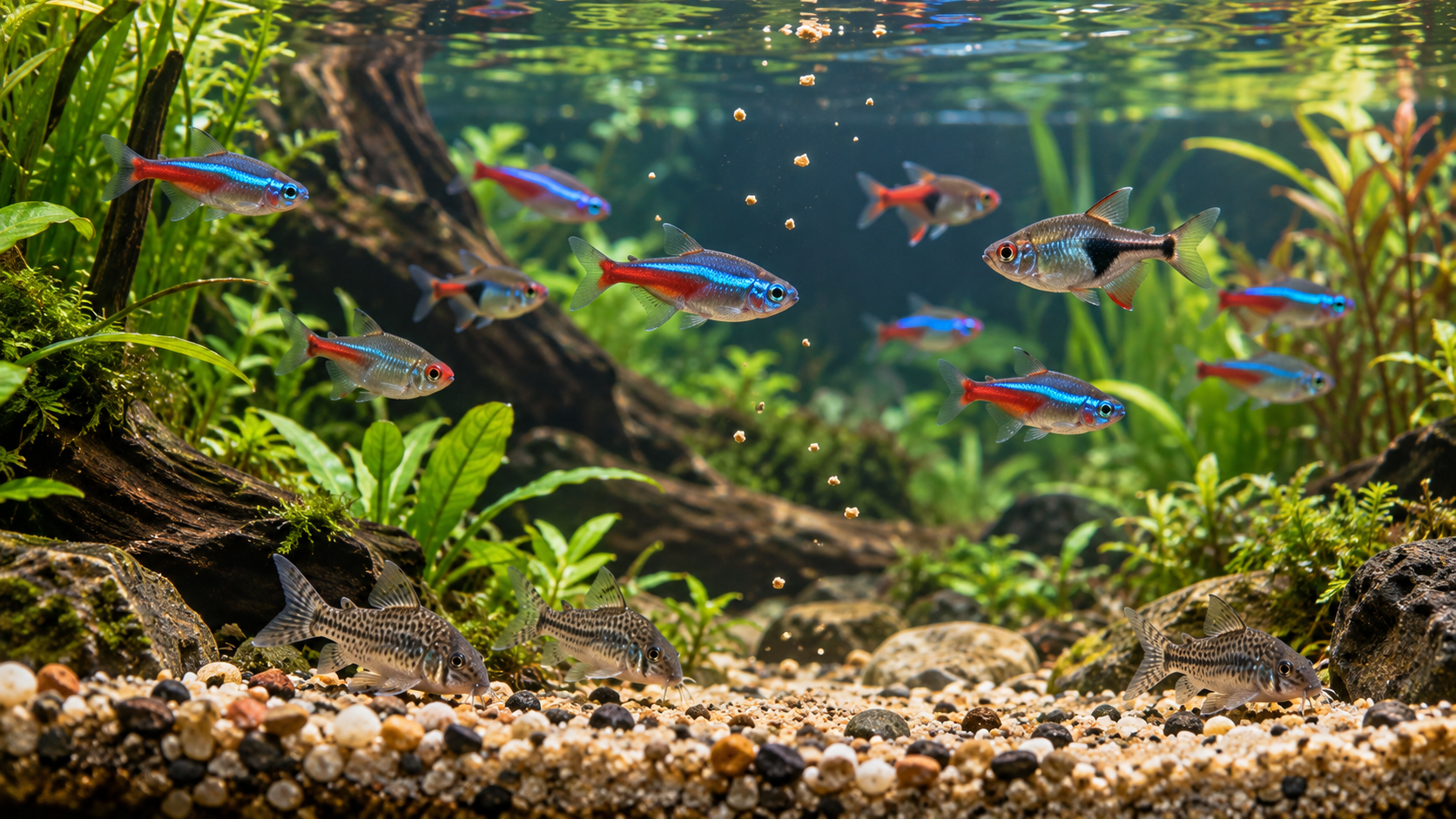
Are tetras bottom feeders? The sources we opened do not say that tetras feed on the bottom. FishBase labels neon tetra as “Freshwater; pelagic” and glowlight tetra as “Freshwater; benthopelagic.” The one bottom-associated label in the group belongs to peppered corydoras, which FishBase lists as “Freshwater; demersal.” The sources do not use the phrase bottom feeder, so the habitat and diet lines are the basis for any answer here, not a shop label.
Quick answer
- FishBase lists neon tetra as “Freshwater; pelagic,” and glowlight tetra as “Freshwater; benthopelagic.” Neither label says the fish feeds on the bottom.
- Peppered corydoras is the only species in this group with the label “Freshwater; demersal.”
- The diet lines overlap across all three fish, so diet alone does not separate tetras from corydoras.
- No source we opened describes where a tetra takes food in a tank.
What the habitat labels say
FishBase gives each species page a habitat label. We opened three species pages for this comparison, and each label is copied as printed.
- Neon tetra (Paracheirodon innesi): “Freshwater; pelagic.”
- Glowlight tetra (Hemigrammus erythrozonus): “Freshwater; benthopelagic.”
- Peppered corydoras (Corydoras paleatus): “Freshwater; demersal.”
The two tetra labels are different from each other, and the corydoras label is different from both. The sources we opened do not define these terms in the text we read, so this post does not add its own definitions. The labels are reported as FishBase prints them.
Neon tetra also has a tropical temperature line on the same page, “Tropical; 20°C – 26°C,” and a pH range of “5.0 – 7.0.” Those lines are not about feeding, but they are part of the habitat data a keeper would check before setting up a tank.
What the diet lines say
Each species page also lists a diet. These lines describe what the fish eat. They do not say where in the water the fish feeds.
- Neon tetra: “Adults feed on worms, small insects, crustaceans and plant matter.”
- Glowlight tetra: “Feeds on worms, small crustaceans and plants.”
- Peppered corydoras: “Feeds on worms, crustaceans, insects and plant matter.”
The three diets overlap a great deal. Worms, crustaceans and plant matter appear in each list, and the tetras add small insects while the corydoras adds insects. A reader cannot tell from these lines whether a fish takes food from the substrate, from the water column or from the surface. So the diet data alone does not make a tetra a bottom feeder, and it does not make a corydoras a mid-water fish.
Why the habitat label is not a feeding rule
Habitat describes where a species lives in the wild, as the FishBase label is applied. Feeding location in a home tank can differ. The sources we opened do not describe where any tetra eats in an aquarium, so this post cannot say that a tetra feeds at the bottom or in the middle of the water.
A practical check is to watch the tank at feeding time and note where each fish goes for food. That observation belongs to the keeper and is not a claim from the sources.
Feeding amounts for a mixed tank
Whatever the habitat, feeding amounts matter. The Merck Veterinary Manual gives a maintenance guideline of “1% to 2% of body weight per day” and a growth guideline of “3% to 5% of body weight per day.” Merck adds that “Feeding methods and rates vary with species, age, system, and water temperature,” so the guideline is a starting point and not a rule for every fish.
Merck warns that “Overfeeding can lead to health problems as well as a dirty tank.” It also says that “Feeding vegetables a few times a week as a supplement provides an excellent source of B and C vitamins.” That line is general guidance for fish, not a tetra-specific instruction.
In a mixed tank with tetras and corydoras, uneaten food is the main concern. The sources do not give a rule for dividing food between fish that feed in different places. Offer small portions, watch what is eaten, and avoid overfeeding, as the Merck warning describes.
Tank points that matter when feeding
Merck says that “Filters, pumps, heaters, and lights should not be turned on until after the tank is filled with water.” It also describes the gravel’s role: “the gravel acts as the filter medium, which traps particulate matter and contains nitrifying bacteria (beneficial bacteria) that remove the primary fish waste, ammonia.” Uneaten food adds to the waste a tank must process, so feeding and filtration are linked in practice.
Merck also states that “Most city water is treated with chlorine or a combination of chlorine and ammonia (known as chloramine), both of which are toxic to fish and to the necessary bacteria that grow in your aquarium.” Treat new tap water with a dechlorinator before it goes in, as the same page recommends.
A feeding checklist for tetras and corydoras
- Check the habitat and diet lines for every species in the tank, not only the tetra.
- Feed small portions and note where each fish goes for food.
- Use the Merck maintenance guideline of 1% to 2% of body weight per day as a starting point.
- Remove food the fish do not eat, to limit waste.
- If a fish stops eating or looks unwell, contact an experienced fish keeper or an aquatic vet. This post does not give treatment advice.
For a betta’s feeding basics, see best betta flakes or pellets. For a tropical flake option, see best tropical fish flakes for betta.
How we chose
We chose the FishBase species pages for the two tetras and the corydoras named in this comparison, and the Merck Veterinary Manual page on providing a home for fish for feeding and water guidance. All four pages were opened with curl on 2026-10-24. Retail listings were not used, and no product is recommended here.
What we could not verify
The keyword asks where tetras feed. The habitat and diet lines do not answer that directly, so the points below remain open.
What the sources do not say
- Where any tetra feeds in an aquarium, or whether a given tetra takes food from the substrate.
- Whether a particular tetra species will eat sinking food.
- The feeding habits of tetra species other than neon tetra and glowlight tetra.
- Any disease risk linked to feeding habits. Ask an experienced fish keeper or an aquatic vet if a fish looks unwell.
Frequently asked questions
Are neon tetras bottom feeders?
The neon tetra page lists the fish as “Freshwater; pelagic,” and its diet line lists worms, small insects, crustaceans and plant matter. Neither line says the fish feeds on the bottom. The sources do not describe where it feeds in a tank.
Is a glowlight tetra a bottom feeder?
The FishBase label is “Freshwater; benthopelagic.” The page does not say that this fish feeds on the substrate. Its diet line lists worms, small crustaceans and plants.
Are corydoras bottom feeders?
The corydoras page lists “Freshwater; demersal,” which is the only bottom-associated label among the three pages we opened. Its diet line lists worms, crustaceans, insects and plant matter. The sources do not describe the feeding location in a tank, so the label is the basis for saying the fish is bottom-associated.
Should I feed tetras from the bottom of the tank?
The sources do not give a feeding location for tetras. Watch where your fish go for food, offer small portions, and remove uneaten food. Merck links overfeeding to a dirty tank.
Can tetras and corydoras eat the same food?
The diet lines overlap, since worms, crustaceans and plant matter appear in each list. The sources do not say that one food suits every species in a mixed tank, so check the diet line for each fish and feed in small portions.
Sources
- FishBase, Paracheirodon innesi (neon tetra) species page, https://www.fishbase.se/summary/Paracheirodon-innesi.html (opened 2026-10-24)
- FishBase, Hemigrammus erythrozonus (glowlight tetra) species page, https://www.fishbase.se/summary/Hemigrammus-erythrozonus.html (opened 2026-10-24)
- FishBase, Corydoras paleatus (peppered corydoras) species page, https://www.fishbase.se/summary/Corydoras-paleatus.html (opened 2026-10-24)
- Merck Veterinary Manual, Fish: Providing a Home for Fish, https://www.merckvetmanual.com/all-other-pets/fish/providing-a-home-for-fish (opened 2026-10-24)