What to Feed a Goldfish at Home
As an Amazon Associate we earn from qualifying purchases.
What to feed a goldfish at home comes down to one main food and a few supplements. Use a commercial food made for goldfish as the main diet, with small amounts of vegetables and other foods added for variety. Merck says fish benefit from “a well-balanced diet,” and that commercial dried foods are “usually formulated to contain the proper mix of nutrients for your fish when fed properly.” Feed in small amounts, remove what is not eaten, and avoid overfeeding, which Merck links to health problems and a dirty tank.
Quick answer
- Use a dried food labeled for goldfish as the primary diet. Merck describes pellets, flakes and granules as a good choice when fed properly.
- Add variety with a few supplements, such as vegetables or plant material, rather than relying on one food.
- Feed amounts vary by species, age, system and water temperature, so there is no single portion that fits every goldfish.
- Remove uneaten food each day, because Merck lists overfeeding as a cause of health problems and a dirty tank.
What the goldfish eats in nature
FishBase gives Carassius auratus a trophic level of 2.0 with the note “based on diet studies.” That is the lower of the two trophic figures compared in this guide; the betta, by comparison, is listed at 3.3. The difference is an estimate from diet studies, not a feeding instruction, but it is a useful starting point.
The FishBase figure does not list the exact foods a goldfish eats or the proportions of each. For a home aquarium, that gap is filled by the feeding advice from Merck and by the labels on the food the owner buys.
The main food: a commercial diet
Merck describes commercial dried foods as “a good choice because they are usually formulated to contain the proper mix of nutrients for your fish when fed properly.” The phrase “when fed properly” carries most of the weight. A good food fed in too large an amount, or left to sit in a tub for months, does not give the fish the benefit the label implies.
Merck also says that “Food should not be stored for excessive periods of time. It is better to buy smaller quantities of food frequently than a large container that is used for many months.” It adds that “In general, dried foods should be kept on hand for no more than 2 months.” A sealed container bought in small sizes is the simplest way to follow that advice.
Merck notes that “fish that prefer to feed at the bottom should not be fed flakes that float on the surface.” The sources checked do not state which form suits every goldfish. Watch the fish at feeding time and choose a form, floating or sinking, that it actually takes.
Vegetables and plant material as supplements
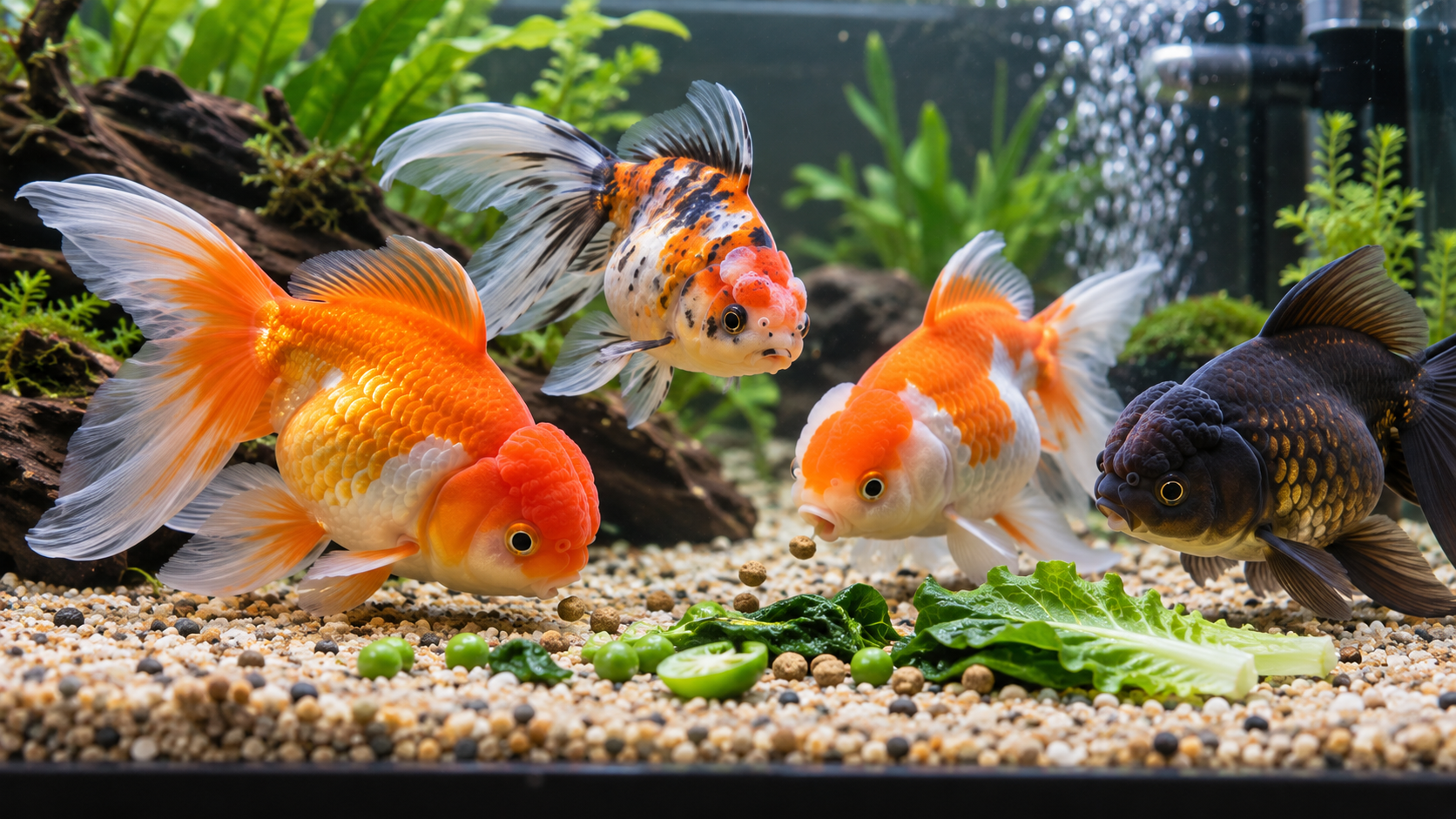
Merck states that “Fresh vegetables are also a good addition to the diet of many fish.” It gives an example: “Zucchini can be diced, lightly cooked, and stored in the freezer.” It adds that “Feeding vegetables a few times a week as a supplement provides an excellent source of B and C vitamins.” The vegetable is a supplement, not the main meal, so a few pieces a week fits the advice.
For plant-based extras, Merck names “Natural foods such as shrimp pieces and plant material” as supplements. These are useful for variety, but the sources do not give amounts for a home goldfish tank. Start with a small piece, remove any leftovers within a short time, and keep the vegetable out of the tank if it sits uneaten.
Pellets and live foods
Merck says “Several kinds of pelleted food are formulated specifically for koi and goldfish in outdoor ponds.” Those pellets are described in the context of outdoor ponds, so an indoor goldfish owner should check the label for the fish type and the feeding form. The same source also says live foods “can lack sufficient amounts of other elements and may not provide a complete diet,” and that live foods “can sometimes introduce parasites or diseases into the fish’s environment.” Live food can be a treat rather than a base diet.
How much to feed
Merck gives a general rate for fish: “In general, maintenance diets are fed at a rate of 1% to 2% of body weight per day, and growth diets at 3% to 5% of body weight per day.” That rate depends on the fish’s body weight, which an owner rarely knows. A practical rule taken from the same source is the daily check: Merck’s routine list says to “Feed fish and remove any uneaten food.” If food is left after a few minutes, the portion is too large for that fish.
Feeding schedules should also change with the season and the water. Merck notes that feeding “methods and rates vary with species, age, system, and water temperature.” Because rates depend on water temperature, a fixed portion is not the right rule across every season. The sources checked do not give a single schedule for every home tank.
Signs the diet is not working
Merck lists common signs of illness in fish, including “Not eating,” lethargy, loss of color and “Weight loss.” A goldfish that stops eating, loses weight or changes color after a diet change needs a closer look. Merck’s guidance is that more complicated diseases need veterinary treatment. For a goldfish that looks unwell, an experienced fish keeper or an aquatic vet is the right person to ask. Do not treat a sick fish with a change of food alone.
If a goldfish has been on the same food for a long time and looks thin, check the amount being fed, the freshness of the food and the water quality. The guide on whether goldfish can share betta food covers a related question about mixing foods, and the guide on best betta food covers the other side of the same feeding question.
How we chose
This guide is based on four sources opened on 2026-10-24: two Merck Veterinary Manual fish care pages on home setup and routine health care, and two FishBase species summaries. No retail listings, prices or product ratings were used. The food suggestions come from what those pages state about commercial diets, supplements, feeding rates and signs of illness.
What we could not verify
The sources do not name a single best goldfish food, and no goldfish food label was checked. They do not give a daily portion for a home goldfish, and the pellet and pond advice from Merck is written for outdoor ponds rather than a home aquarium.
What the sources do not say
The sources do not give an ingredient list for a goldfish food, a feeding schedule for a home tank, or the amount of vegetable a goldfish should eat. They do not give a water temperature range for feeding goldfish. Those points need the product label, the manufacturer’s directions or an experienced fish keeper.
Frequently asked questions
What is the best main food for a goldfish?
A commercial dried food labeled for goldfish is the most direct choice in the sources checked. Merck describes these foods as usually formulated to provide the right mix of nutrients when fed properly.
Can goldfish eat vegetables?
Merck says fresh vegetables are a good addition to the diet of many fish, and gives zucchini as an example. Use vegetables as a few-times-a-week supplement rather than the main meal.
How often should I feed a goldfish?
The sources do not give one schedule for a home tank. Merck says feeding rates vary with species, age, system and water temperature, and advises removing any uneaten food.
Is it bad to overfeed a goldfish?
Merck states that overfeeding “can lead to health problems as well as a dirty tank.” Feed small amounts and remove leftovers.
When should I call a vet about a goldfish that is not eating?
Merck lists “Not eating” as a common sign of illness in fish. A goldfish that keeps refusing food or shows other signs should be assessed by an experienced fish keeper or an aquatic vet.
Sources
- Merck Veterinary Manual, “Providing a Home for Fish,” https://www.merckvetmanual.com/all-other-pets/fish/providing-a-home-for-fish (opened 2026-10-24)
- Merck Veterinary Manual, “Routine Health Care of Fish,” https://www.merckvetmanual.com/all-other-pets/fish/routine-health-care-of-fish (opened 2026-10-24)
- FishBase, Carassius auratus species summary, https://www.fishbase.se/summary/Carassius-auratus.html (opened 2026-10-24)
- FishBase, Betta splendens species summary, https://www.fishbase.se/summary/Betta-splendens.html (opened 2026-10-24)