Can Neon Tetras Eat Tropical Flakes?
As an Amazon Associate we earn from qualifying purchases.
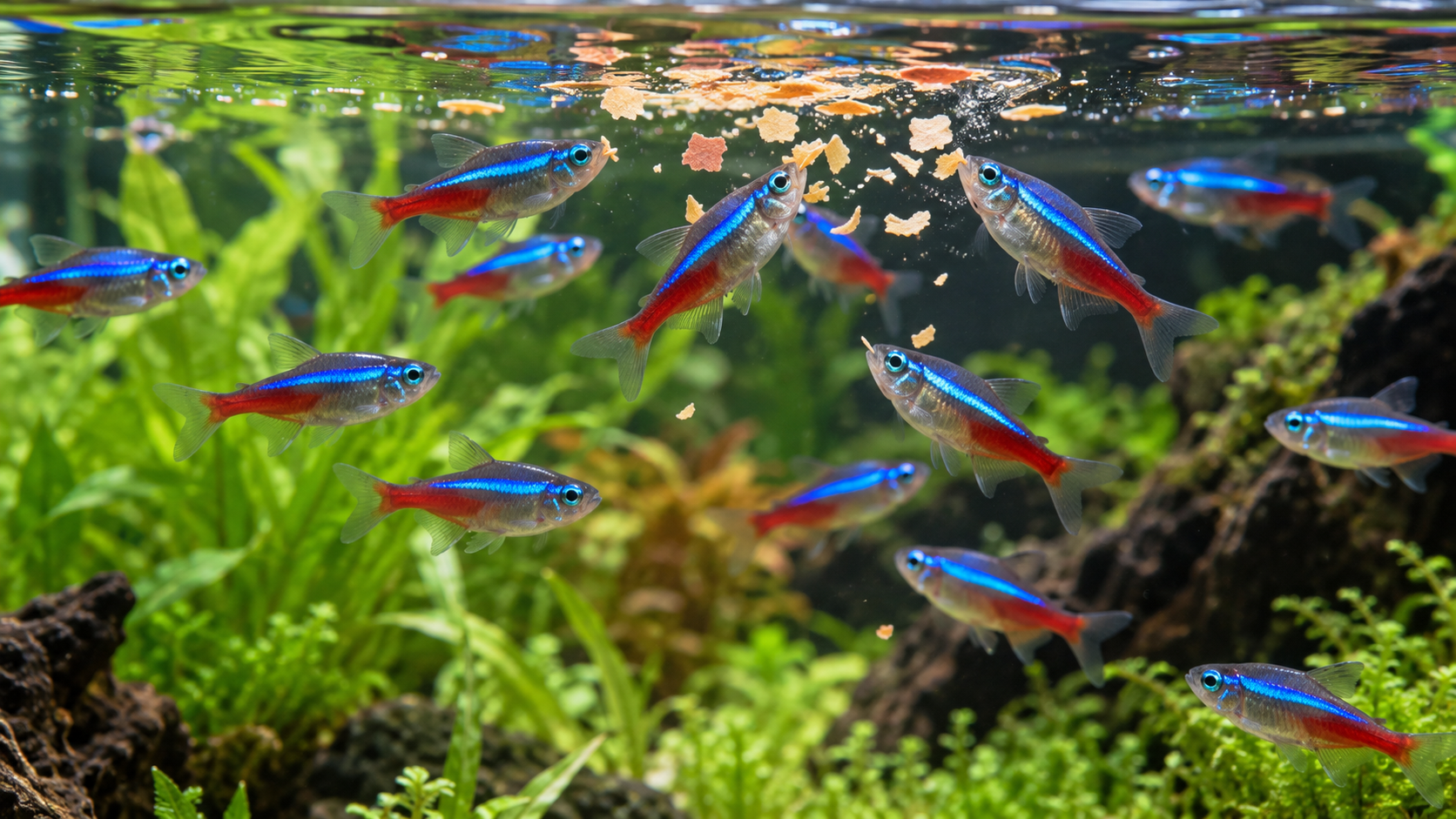
Can neon tetras eat tropical flakes? They can take small flakes if the flakes are small enough to be eaten, but none of the sources opened for this guide says that flakes are a complete diet for neon tetras. The species profile describes a wild diet of worms, insects, crustaceans and plant matter, and the Merck Veterinary Manual warns that a single commercial food is not automatically a balanced one. This guide explains what the sources support, what they leave open, and how to check the food you already have.
Quick answer
- Neon tetras can take small tropical flakes, but no source opened for this guide calls flakes a complete diet for them.
- FishBase says that “Adults feed on worms, small insects, crustaceans and plant matter.” That is the wild diet, not a feeding guide for aquariums.
- Merck says that “You will probably need to feed more than one kind of food if you have several types of fish in your environment.”
- Merck also says dry food should be kept in “a cool, dry place and used or replaced every 2 months.” Stale food is a feeding problem even when the brand is good.
What neon tetras eat, according to FishBase
FishBase is a non-retail species database maintained with fisheries and aquarium data. Its neon tetra entry, Paracheirodon innesi, describes the species as freshwater, with a tropical temperature range and a pH range of 5.0 to 7.0. For feeding, the entry says that adults feed on worms, small insects, crustaceans and plant matter. The entry also calls the species one of the most popular aquarium fish.
That description matters for flakes because it shows the range of food the species takes in nature. A flake is a processed food. It can contain animal and plant ingredients, but the sources opened for this guide do not say how any particular flake compares with the wild diet, and the FishBase entry does not mention flakes at all. The reasonable reading is that flakes can be one part of a feeding plan, not a verified full replacement for the variety in the wild diet.
The same FishBase entry gives aquarium keeping conditions. It says neon tetras are kept “in groups of 5 or more individuals” and gives a “minimum aquarium size 60 cm.” Those are housing facts, but they also affect feeding. A small group in a small tank has less room for food to disperse, and uneaten food is more likely to sit in the water. That is a general observation, not a claim taken from a source.
What the Merck Veterinary Manual says about commercial foods
The Merck Veterinary Manual is a veterinary reference maintained by a professional publisher. Its disorders page includes a section on nutrition that is directly relevant to flakes. The page says that “It is very important to learn what diet best matches the needs of your fish.” It also says that nutritional problems can happen even when good food is sold, noting that “Nutritional disorders occur despite complete, nutritious food being commercially available in a variety of forms, such as pellets, flakes, and granules.”
That sentence is the key point for this question. Flakes are a commercial form, and the presence of a complete product on the shelf does not tell a fish keeper what their own fish need. Merck also says that “Improper storage of fish foods is a common cause of nutritional imbalance.” It advises that dry food should be kept in “a cool, dry place and used or replaced every 2 months.” Those are the two storage facts the sources support directly.
So the answer to “can neon tetras eat tropical flakes” has two parts. The fish can physically take small flakes, which is a general observation. Whether flakes meet the species’ full needs is not something the sources address. Merck’s guidance points toward variety, good storage and a check on whether the fish are doing well, not toward any single product.
Practical feeding checks
The following checks are general guidance. They are not drawn from a named source, and they are offered because the sources support the idea of matching diet to the fish and keeping food in good condition.
- Choose flakes small enough that each neon tetra can take a piece whole. Large flakes can break apart in the water and drift away uneaten.
- Look at the ingredient list for animal protein and plant material. The wild diet listed by FishBase includes both, so a food with only one type is worth a second look.
- Check the date and the storage. Keep the container closed, in a cool, dry place, and replace it on a schedule. Merck’s two-month figure is the only storage interval in the sources opened here.
- Remove food that is not eaten. Merck’s home-care section lists “uneaten food” among the solid wastes that beneficial bacteria break down, so leftover food adds to the load the filter and the bacteria must handle.
- Rotate foods rather than relying on one. Merck states that more than one kind of food is probably needed when several fish types are kept.
If the fish stop eating, lose colour, swim oddly or look thin, the cause may not be the flakes at all. Water quality, stress and disease can all look similar at first. A fish keeper who sees these signs should test the water and talk to an experienced aquarist or an aquatic veterinarian rather than changing food alone.
For more on picking foods for small community tanks, see the guide to tropical fish flakes, which covers flake size and label reading in more detail. The guide to betta flakes and pellets compares two food forms that are often confused with each other.
How we chose
This guide was written from the sources listed at the end of the page. Only pages opened on 2026-10-24 were used. Retail listings, product pages and shop descriptions were not used as evidence about the fish. The choice of sources followed one test: does the page describe the species, the diet or the husbandry of freshwater aquarium fish in a way a fish keeper can check? FishBase and the Merck Veterinary Manual met that test. Both were chosen because they are non-retail and because they cover the two topics this question depends on, the species’ diet and the commercial food question.
The answer was kept narrow on purpose. The sources do not evaluate any named flake brand, so this guide does not name one as better or worse. It also does not give a feeding amount or a schedule, because the sources opened here do not give one for neon tetras.
What we could not verify
The sources opened for this guide do not establish whether a particular tropical flake is a complete diet for neon tetras. They also do not say how often to feed flakes, how much to give, or whether flakes should be mixed with live or frozen foods for this species. Those questions need a source that covers neon tetra nutrition directly, and none was reached while writing this page.
What the sources do not say
The FishBase entry does not mention flakes, pellets or any manufactured food. It describes the wild diet only. The Merck page gives general nutrition advice for pet fish and does not single out neon tetras. Neither source gives a feeding frequency or a portion size for this species. Where this guide gives advice on those points, it is labelled as general guidance and is not a sourced fact.
Frequently asked questions
Can neon tetras live on flakes alone?
The sources opened for this guide do not say that they can. Merck says more than one kind of food is probably needed when several fish types are kept, and the wild diet described by FishBase is varied. A keeper who feeds only flakes should watch the fish closely and treat the food as one part of a plan, not as a verified complete diet.
What do neon tetras eat in the wild?
FishBase says that adults feed on worms, small insects, crustaceans and plant matter. That is the only diet described in the source opened for this guide. It is a description of the species in nature and is not a feeding recipe for a home aquarium.
Is a tropical flake the same as a betta food?
The sources do not compare the two. Both are commercial foods, and Merck says commercial foods come in forms such as pellets, flakes and granules. Whether a particular betta food suits neon tetras is not something the sources address, so the label and the fish’s condition are the only checks available here.
Do neon tetras need live food?
The sources opened for this guide do not say that live food is needed. FishBase lists insects and crustaceans among the wild foods, which means live or frozen animal food is consistent with the species’ diet. Whether a home aquarium needs it is not stated by the sources, so this remains unverified.
What should I do if my neon tetras stop eating?
Check the water first, then the food. Remove uneaten food, test the water, and look for other signs of illness. Merck notes that disease signs can include changes in the body and fins. If the fish keep declining, ask an experienced fish keeper or an aquatic veterinarian for help. Do not change medicines or doses without professional advice.
Sources
- FishBase, species summary for Paracheirodon innesi (neon tetra), https://www.fishbase.se/summary/Paracheirodon-innesi.html, opened 2026-10-24. Non-retail species database.
- Merck Veterinary Manual, “Disorders and Diseases of Fish,” https://www.merckvetmanual.com/all-other-pets/fish/disorders-and-diseases-of-fish, opened 2026-10-24. Veterinary reference; nutrition section.
- Merck Veterinary Manual, “Providing a Home for Fish,” https://www.merckvetmanual.com/all-other-pets/fish/providing-a-home-for-fish, opened 2026-10-24. Veterinary reference; beneficial bacteria and waste section.