Fish Tank Lid, Heater, and Lighting Basics
As an Amazon Associate we earn from qualifying purchases.
Fish tank lid heater and lighting basics come down to three checks: a lid limits condensation and protects equipment, the heater must be fully submerged before it is switched on, and lights and sun both change water temperature. The sources we opened give reasons for a glass cover, but none says every tank needs a lid. They also give no warm-up time for heaters and no flow rate for betta filters, so those points stay open below.
Quick answer
- Lid: Merck describes a glass cover that stops “condensation from rising off warm aquarium water” and protects “lights and wires.” No source opened says all tanks require a lid.
- Heater: Merck states, “Do not plug in the heater until the tank is full of water.”
- Warm-up time: no source opened gives a time for an aquarium heater to heat water.
- Betta filter flow: the University of Florida betta guide says “heavy filtration may actually be harmful to a betta’s health and welfare.” It gives no numeric flow rate.
- Lighting: Merck lists “Check lighting” as a six-month task, and notes that “Direct sunlight can also cause the water temperature in the tank to rise.”
Lid: what the sources say
A lid is a practical item in the sources, but they describe its job rather than a rule. Merck’s routine care list includes a weekly task: “Clean glass cover or condensation tray (on top of aquarium to stop condensation from rising off warm aquarium water, to protect lights and wires).” The reasons given are condensation and protection of lights and wires.
The sources do not say that a lid is needed to keep a fish inside the tank, and they do not give a height or design rule. Treat the lid as a maintenance item with a clear purpose, not as a proven safety requirement.
Heater setup
The heater is the item where order matters most. Merck’s home-setup guidance says that “A heater is necessary for both freshwater and saltwater tropical fish.” It then gives the setup order: “Filters, pumps, heaters, and lights should not be turned on until after the tank is filled with water.” It repeats the warning for heaters: “Do not plug in the heater until the tank is full of water.”
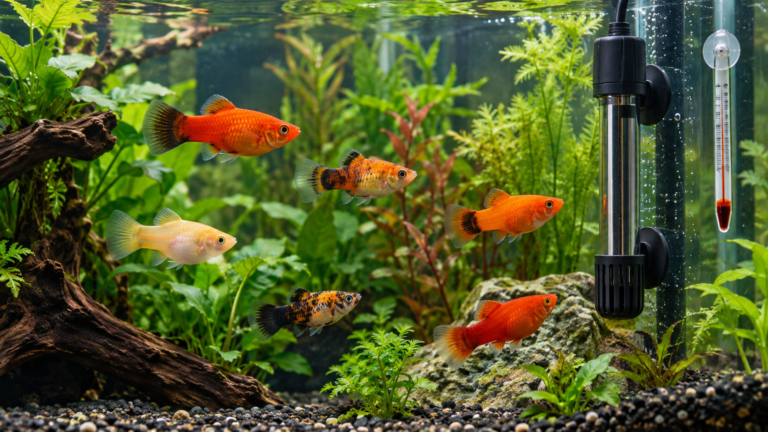
The glass body is a reason for care. Merck explains that “Most heaters are in a glass tube that may shatter if not surrounded by water, which regulates the temperature and prevents the tube from overheating.” Keep the heater fully under water at all times while it is plugged in.
Control and checking are separate jobs. Merck says “A heater will typically have a programmable thermostat that you can set to control the water temperature.” It also advises “a separate thermometer in the tank to monitor water temperature independently from the heater.” A thermometer that is separate from the heater lets you check whether the thermostat is doing its job.
Target temperature matters more than the heater model. Merck states that “maintenance of the water temperature in an appropriate range for the fish species you are keeping is critical to their health.” The University of Florida betta guide gives temperatures from the wild habitat, which is a description of where bettas live, not a tank target. This guide does not turn those habitat figures into a tank setting.
How long does a heater take to heat up?
No source opened today gives a heat-up time. None of the pages opened gives a time for a heater to warm water, or the factors that would set that time. The only timing advice in the sources is the order of setup: fill the tank first, then switch the heater on. Use a separate thermometer to see how the water temperature changes after the heater is on.
Betta filter flow rate
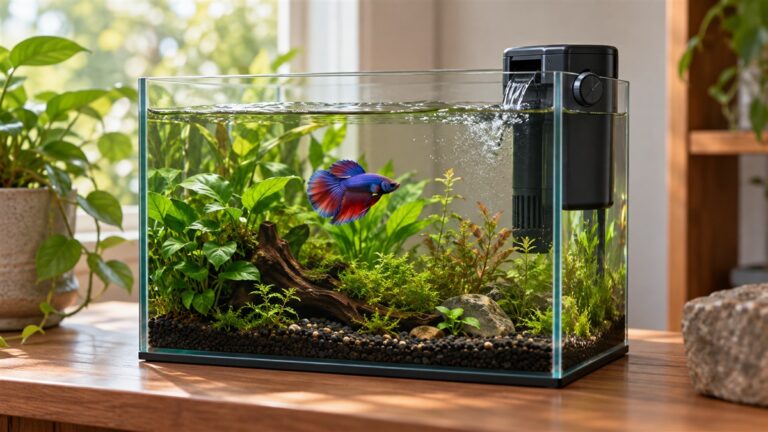
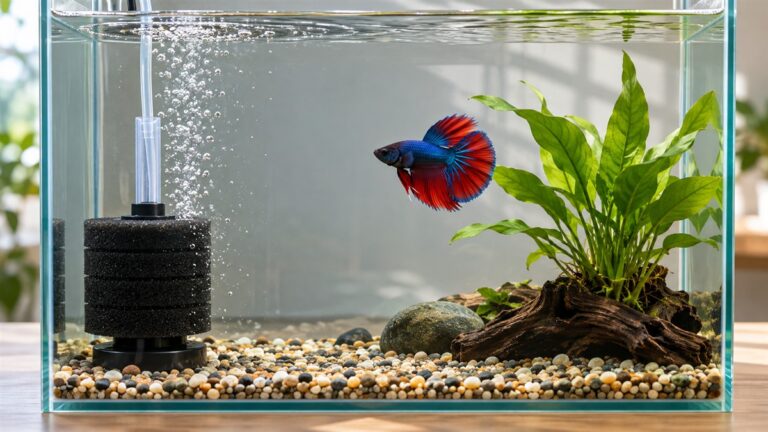
Bettas need calm water, and this is the main filter point in the sources. The betta guide states that “Bettas prefer calm water as shown by research using flow as a stressor, so heavy filtration may actually be harmful to a betta’s health and welfare.” That is a welfare statement, and it is the reason a filter’s flow matters more than its label.
Flow is a water-quality check too. Merck’s routine care list includes “filter flow (clean if needed)” among the regular checks, so a filter that is clogged or running strongly should be looked at. The sources do not give a flow rate in litres or gallons per hour that suits a betta, and this guide does not invent one.
Waste control still matters. The ammonia guide says “Fish may not eat during periods of ammonia stress, and the uneaten feed will only make the situation worse.” A gentle filter does not replace regular water changes, and the betta guide says small aquariums need “frequent water changes.”
Lighting and water temperature
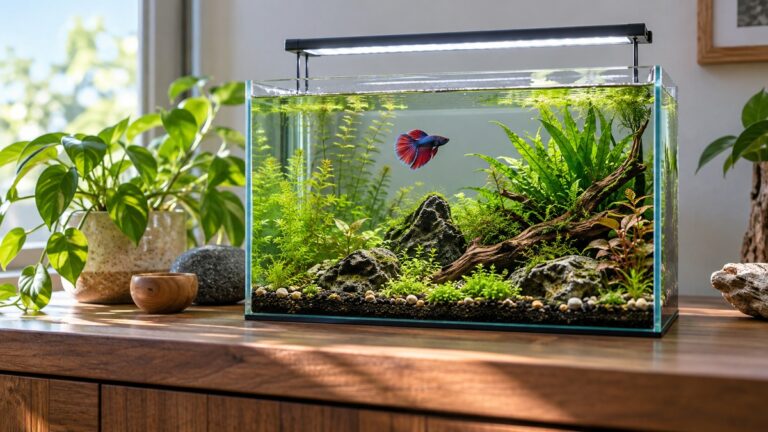
Lights and sunlight add heat and affect the water. Merck states that “Direct sunlight can also cause the water temperature in the tank to rise.” It also notes that “Plants, and floating plants in particular, can also minimize temperature changes by shading the water to keep it cool.” A tank near a window may need a thermometer check during the day.
Lights also need routine checks. The Merck routine care list includes “Check lighting” every six months. The sources do not say how long a tank should be lit each day, and they do not name a light color or intensity for bettas. Those details are outside these sources; for light timing, see the betta fish light timer guide.
How we chose
This guide uses veterinary and university extension pages. They describe setup order, temperature control, and maintenance, and they do not sell equipment. Each page was opened on 2026-10-25 by curl, and quoted sentences were checked against the text. No retail page, product listing, or review was used for facts. No product is ranked here.
What we could not verify
The sources cover setup principles, not product specifications or warm-up times. The gaps below are the points that could not be checked.
What the sources do not say
- Lid need: no source opened says that every tank requires a lid, or gives a lid height for jumping fish.
- Heater warm-up time: no source gives a time to heat a tank of any size.
- Heater wattage per gallon: not stated in any source opened.
- Betta filter flow rate: no source gives a numeric flow rate for a betta tank.
- Small tanks without heat: Merck says that “In small aquariums, such as goldfish bowls and betta tanks, neither filtration nor a heater may be required.” The sources do not say that a small unheated betta tank is a good home, and this guide does not take that line as a recommendation.
- Light schedules: no source gives daily light hours or light intensity for bettas.
Frequently asked questions
Do fish tanks need a lid?
The sources give a lid a maintenance purpose: stopping condensation and protecting lights and wires. None opened today says every tank must have one. Choose a lid for those reasons. The sources do not address jumping or escape, so that point is not covered here.
How long does an aquarium heater take to heat up?
No source opened gives a warm-up time. Fill the tank before plugging in the heater, then check the water with a separate thermometer until the reading is stable.
What filter flow rate is safe for a betta?
The betta guide says heavy filtration may be harmful, and prefers calm water. It does not give a flow rate. Choose a gentle filter, and see the low-flow filter guide for bettas for options that are labeled as low flow.
Do aquarium lights warm the water?
The sources say direct sunlight raises tank temperature, and Merck lists lighting as a maintenance check. They do not give a figure for how much a light adds to the water, so use a thermometer to see the effect in your tank.
Does a betta need a heater?
Merck states that a heater is necessary for tropical freshwater fish, and it also says that small betta tanks may not require one. Those two statements are not a full answer for bettas, which is why the sources cannot settle the question alone. The related post on whether betta fish need a heater covers the question in more depth.
Sources
- Merck Veterinary Manual, “Providing a Home for Fish,” https://www.merckvetmanual.com/all-other-pets/fish/providing-a-home-for-fish, opened 2026-10-25.
- Merck Veterinary Manual, “Routine Health Care of Fish,” https://www.merckvetmanual.com/all-other-pets/fish/routine-health-care-of-fish, opened 2026-10-25.
- University of Florida IFAS Extension, “Evolution, Culture, and Care for Betta splendens” (FA212), https://edis.ifas.ufl.edu/publication/FA212, opened 2026-10-25.
- University of Florida IFAS Extension, “Ammonia in Aquatic Systems” (FA031), https://edis.ifas.ufl.edu/publication/FA031, opened 2026-10-25.