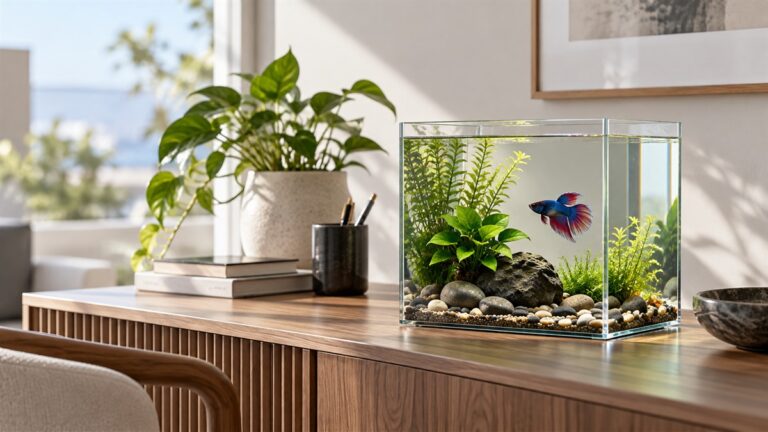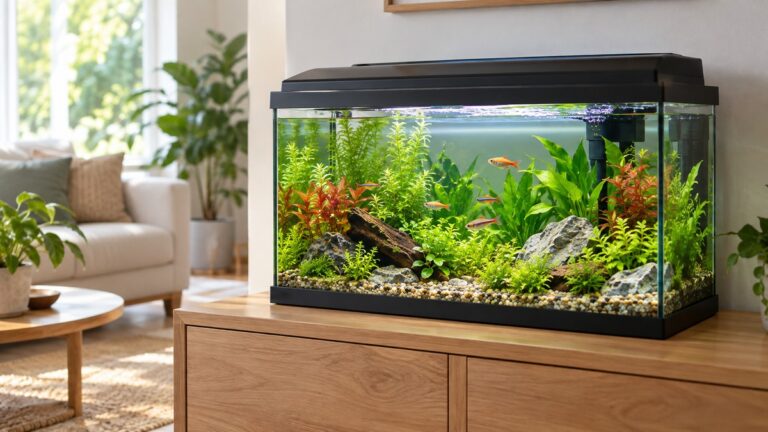
Best Air Assisted Aquarium Gravel Vacuums
As an Amazon Associate we earn from qualifying purchases.
An air assisted aquarium gravel vacuum is a gravel cleaner that uses an air pump or an air-driven action to start or move the flow, but none of the five gravel vacuums in our product file states a built-in air pump or oxygen function. The listings describe hand siphons, a squeeze bulb, a manual press design, and an electric cleaner with a stated 28 W motor. For a betta tank, choose the cleaning method first and the air feature second, and buy a separate air pump if you want extra aeration. The guide below separates what each listing says from what you still need to check.
Quick answer
- No listing in our product file confirms a built-in air pump, so treat “air assisted” as a separate purchase unless a listing states it clearly.
- For a small betta tank, a manual siphon with a priming bulb gives more control than a high-flow electric cleaner.
- Check the tank size range and the working depth before you buy, because a long hose does not mean the cleaner suits a shallow tank.
- Keep the intake away from the resting betta, and unplug the heater and filter before you start.
For broader equipment context, read our betta tank setup guide and our practical guide to whether bettas need a heater. Both explain how the tank, its equipment, and its temperature fit together, which affects when and how you should siphon.
What “air assisted” should mean
People searching for an air assisted aquarium gravel vacuum often want one tool that lifts debris from the substrate and also adds oxygen to the water. Those are two different jobs. A gravel vacuum moves water and waste out of the tank. An air pump pushes air into the water through an airline and a diffuser or sponge filter. A cleaner with a squeeze bulb may use air to prime the hose, but that does not mean it adds oxygen to the aquarium. Before you buy a combined product, look for a stated pump, an airline fitting, or an oxygen claim in the listing, and check whether the airflow is described in a specific unit.
In our product file, the closest matches are simple. The Tetra siphon uses a priming bulb. The Laifoo kit uses a siphon ball. The Carefree Fish cleaner uses a silicone squeeze bulb. The QZQ kit uses a manual press design and describes an air bag that helps create suction. The UPETTOOLS cleaner is electric and lists a water flow and water filter function. None of these is described as an air pump.
Why oxygen and debris removal are separate jobs
A gravel vacuum removes waste that settles between grains of substrate, such as uneaten food, plant debris, and fish waste. Removing that waste helps keep the water clean, but it does not directly add oxygen. Oxygen comes from surface movement, from the filter, and from plants, and an air pump is one way to add more. If your tank is well filtered and not overstocked, you may not need an air pump at all. If you do add one, place the diffuser so it does not stir the substrate you are trying to clean.
Because the two jobs are separate, the simplest approach is often to buy a gravel vacuum that suits your tank and a separate air pump that suits your filter. That keeps each device’s limits clear. Mixing them in one product can make it harder to tell whether a problem is caused by the cleaner, the pump, or the filter.
How a gravel vacuum works
A siphon works because gravity pulls water down a tube once the flow has started. The tube must be filled with water, and the outlet must sit lower than the water surface in the tank. A manual cleaner uses a bulb or a press to start that flow. An electric cleaner uses a motor to pump water through the tube. Both kinds can remove debris, but they behave differently in a small tank.
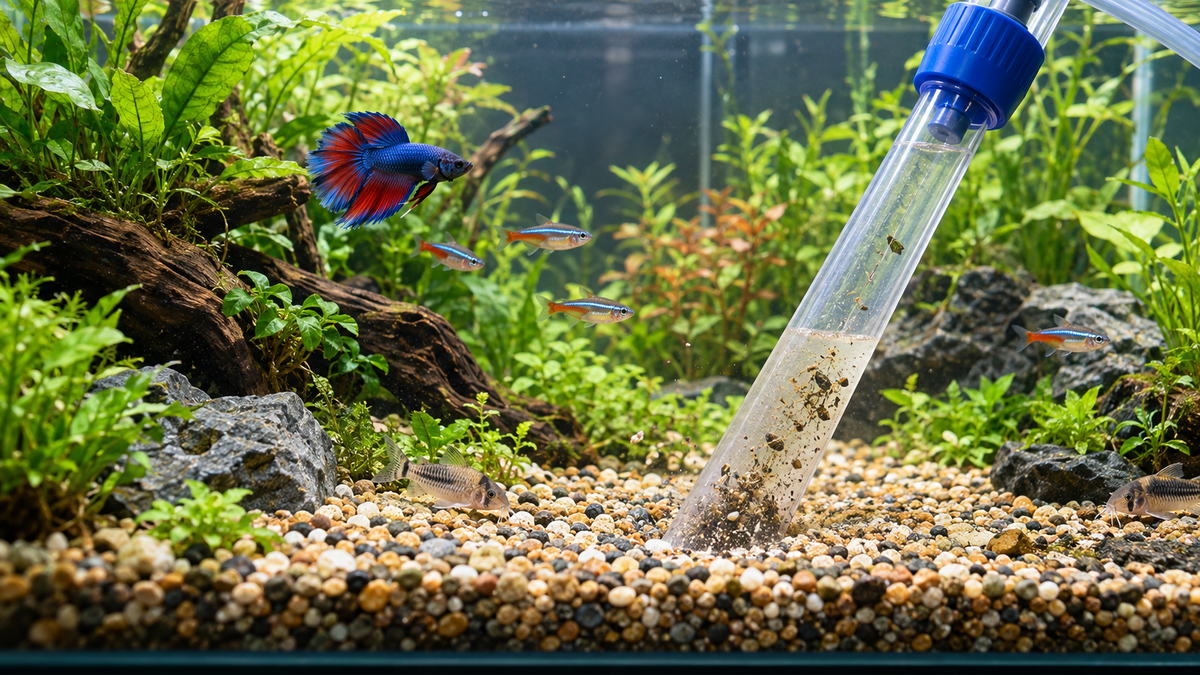
The buildyouraquarium guide describes the technique for a manual tube. It says to press the hard tube into the gravel until it reaches the bottom of the tank, to clean only a small amount of gravel at a time, and to lift the tube so the gravel settles back before moving to the next spot. It also suggests that some aquarists clean one-third of the gravel each week, rotating sections. The same guide says to repeat the process until about 30 percent of the water has been removed, and it notes that it may be impossible to clean all the gravel before reaching that mark.
Sand, fine gravel, and betta safety
Substrate type changes the technique. The buildyouraquarium guide says that sand and fine gravel can be siphoned, but that the vacuum should not be placed directly into them. Instead, hold the vacuum about an inch above the substrate and sweep it back and forth to stir up waste. This is especially important for fine sand, which can rise into the tube and clog a screen. Coarser gravel is easier to clean by pressing the tube in gently.
For a betta, the most useful rule is to keep the intake away from the fish’s resting places and to avoid pulling the fish toward the tube. The same guide says that removing fish before cleaning can be more stressful than leaving them in the tank, and that large fish can be pulled into a hard tube. If that happens, the guide says to break the suction and gently help the fish out. Work calmly, and watch the betta for several minutes after you finish.
The guide also says to unplug the heater and filter before vacuuming, and to keep the water level above the filter’s minimum fill line. A heater can be damaged if it is left out of the water too long, and a filter can malfunction below its minimum level. These precautions matter more than the cleaner’s brand.
Water change amount and schedule
A common approach is a partial water change of about 25 to 30 percent per week, combined with light gravel cleaning in a few spots each time. The buildyouraquarium guide puts the target at about 30 percent of the water. For a small betta tank, this is a manageable amount, but you should always match the replacement water’s temperature to the tank before adding it.
Some listings give a water change schedule of their own. The Tetra listing says that the siphon takes about 30 minutes to replace 30 percent of the water every 30 days. That is a monthly figure, and it may not match a weekly cleaning plan for a small tank. Use the listing as a description of the product’s intended use, not as a schedule for your fish.
Comparison table
| Brand and listing | Type | Stated size or length | Other stated details |
|---|---|---|---|
| Tetra Water Cleaner Gravel Siphon | Manual siphon with priming bulb | For aquariums up to 55 gallons | Priming bulb and bucket clip, 30 percent water change every 30 days |
| Laifoo 5 ft siphon vacuum | Manual siphon with siphon ball | 5 ft hose | Hard gravel tube with detachable filter screen, hose clip, 3-month warranty |
| Carefree Fish small gravel vacuum | Manual silicone squeeze bulb | Size S for 3 to 8 gallons; max working depth 16 inches | Gravel particles up to 5 mm, 1-year manufacturer warranty |
| QZQ gravel cleaner kit | Manual press design, no electricity | 16.5 by 6.2 by 2.2 inches | Filter net on the basket, multi-function kit, country of origin China |
| UPETTOOLS electric gravel cleaner | Electric submersible cleaner | Lifting height up to 5.9 ft | 28 W, 110 V, 2000 liters per hour, six listed functions |
The table reports only the values each listing states. Where a listing does not give a value, the cell says so rather than estimating one. None of the five rows includes an air pump or an oxygen claim.
Product picks
The five cleaners below are the gravel vacuums in our product file. They cover three branches of the decision: a manual siphon for a larger tank, a compact manual cleaner for a small tank, and an electric cleaner for a bigger job. Each card explains what the listing says and what you still need to confirm.
1. Tetra Water Cleaner Gravel Siphon
The Tetra siphon is a manual gravel siphon whose listing says it is intended for aquariums up to 55 gallons. The listing describes it as a way to make water changes easier and to remove debris from gravel. It includes a priming bulb and a clip for the bucket, which makes the setup simple. The product dimensions are 5.5 by 3.38 by 13.75 inches, and the listing gives a weight of 9.52 ounces. The listing describes a routine of replacing 30 percent of the water every 30 days in about 30 minutes.
Why choose it: A manual siphon lets you control the flow with your hand and stop it by lifting the tube. For a betta tank, that control matters, and the priming bulb gives you a clear way to start the flow without a motor. The bucket clip helps keep the outlet secure during drainage.
Limitation: The listing’s stated size is for tanks up to 55 gallons, which is far larger than most betta setups, so the tube may be longer than you need. The listing does not describe the tube’s diameter or the intake shape, which affect how gently the cleaner works in fine substrate. The “See label” text in the listing means that the included components must be checked on the package.
Skip if: You keep a small tank and want a cleaner sized for it, or if you need a tool that works in fine sand without stirring it up. Also skip it if you cannot confirm the included parts on the package.
2. Laifoo 5 ft siphon vacuum
The Laifoo siphon uses a five-foot clear PC hose, a hard gravel tube with a detachable filter screen, a siphon ball, and a hose clip. The listing describes the tube as sinkable and says it will not disturb fish or decor while it works. It says the siphon ball starts the flow after a few squeezes, without blowing into the hose. The package includes a user manual, and the listing gives a 3-month warranty that covers quality issues with a replacement or refund.
Why choose it: The detachable filter screen is a useful feature for gravel, because it helps keep larger particles from clogging the tube. The hose length gives you room to reach the far corners of a tank without moving the bucket. The listing says the tube is made to resist kinking, which helps during long cleaning sessions.
Limitation: The listing describes the hose as clear and elastic, but it does not state a tank size range, which makes it harder to judge how much water you will move at once. The 3-month warranty is shorter than the warranties on some other picks. The sinkable tube may still need care in a planted tank.
Skip if: You want a stated tank size range before you buy, or if you need a longer warranty. Skip it also if you plan to use the tube in a planted tank with delicate roots.
3. Carefree Fish small gravel vacuum
The Carefree Fish listing is for a small gravel vacuum in size S, which the listing says suits tanks from 3 to 8 gallons. It has a silicone squeeze bulb that the listing says holds its shape through repeated squeezing, and it says you can prime the cleaner by squeezing the bulb three to five times. The listing gives a maximum working depth of 16 inches and says the cleaner can work with gravel particles up to 5 millimeters across. It is made of ABS and includes a 1-year manufacturer warranty.
Why choose it: The stated 3 to 8 gallon range matches many betta tanks more closely than the larger siphons in this group. The listed gravel size gives a practical guide for what the tool can handle. The silicone bulb is a simple way to start the flow without a motor, and the listing describes it as safe to submerge.
Limitation: The listing gives the working depth as a maximum but does not describe the tube’s flow rate, so you will need to judge the speed by eye. The listing also does not state whether the tube can reach into sand without stirring it up. The “Material: Other” field in the listing is less specific than a stated material, so check the packaging if you have a concern.
Skip if: Your tank is larger than 8 gallons, or if your substrate is finer than the listed gravel size. Skip it also if you prefer a tube with a stated flow rate.
4. QZQ gravel cleaner kit
The QZQ kit is a multi-function manual cleaner that the listing says can clean gravel, wash sand, scrape algae, and perform water changes. It uses a manual press design and says no electricity is needed. The listing describes a pressure-resistant air bag that creates strong siphon pressure, and it says the filter net on the basket helps block clogs caused by gravel. The kit measures 16.5 by 6.2 by 2.2 inches and weighs 1.06 pounds. The listing gives the country of origin as China.
Why choose it: The kit covers several small tasks, which can be useful if you want one set of tools for gravel, glass, and water changes. Because it runs without electricity, it is silent and easy to use during a quick cleaning. The filter net is a practical feature for keeping gravel out of the tube.
Limitation: The listing describes the air bag as part of the suction method, not as an air pump, so it does not add oxygen to the tank. The listing’s text includes a few unclear phrases, which means the exact tube and bulb shape should be checked when the kit arrives. The listing does not state a tank size range.
Skip if: You need a stated tank size, or if you want a cleaner that adds oxygen. Skip it also if you prefer a gravel tool with a single purpose, since the kit’s many functions may make it harder to clean carefully.
5. UPETTOOLS electric gravel cleaner
The UPETTOOLS listing describes an electric submersible gravel cleaner with a stated 28 W motor, a 110 V power source, and a flow of 2000 liters per hour. The listing says the maximum lifting height is 5.9 feet. It includes six listed functions, which the listing names as water changing, sand washing, debris cleaning, water filtering, water showering, and water flow. The product dimensions are 2.76 by 5.12 by 31.5 inches.
Why choose it: An electric cleaner moves water quickly and can be useful for a larger tank or a heavy cleaning job. The stated lifting height and six functions make it more versatile than a simple siphon. The listing’s shower and flow functions may help with a rinse-and-return routine.
Limitation: The 2000 liters per hour flow is high for a betta tank, and the listing does not describe a flow control that would make it gentle. The motor also needs power and must be handled with care near water. The listing does not describe an air pump or oxygen function, so the “air assisted” label does not apply to this product.
Skip if: Your tank is small and your betta is easily stressed by current, or if you need a manual cleaner that does not need power. Skip it also if you want an air-assisted tool in the strict sense, since this listing does not state one.
Setup and cleaning routine
Before you clean, unplug the heater and filter and check that the water level is above the filter’s minimum fill line. Fill a bucket with water that matches the tank temperature, and place the bucket lower than the tank so the water drains by gravity. Prime the tube fully, then place the intake into the gravel. For a manual siphon, lift the tube slightly to start the flow, then lower it again when the water is moving.
Move the intake slowly across the substrate. Press the tube into the gravel in small areas, and lift it so the gravel settles back. For sand, hover above the surface and sweep gently. Stop after about 25 to 30 percent of the water has been removed, or sooner if the betta is stressed. Refill with conditioned water at the same temperature, then reconnect the heater and filter once the water is at the correct level.
Safety and fish welfare
A betta should never be chased with the tube. If the fish moves toward the intake, pause and let it settle. If a fish is pulled into the tube, break the suction right away and help it out gently. Watch the fish for several minutes afterward for signs of injury or distress. The buildyouraquarium guide suggests a stress-reducing product for healing, but a fish that shows injury or abnormal behavior should be assessed by an experienced fish keeper or a veterinarian.
Keep the discharge hose secured and the bucket attended. A loose outlet can spill water on the floor or on electrical equipment, and a spill is more likely than an injury in most home setups. Store the cleaner dry after use, and rinse the tube and screen so debris does not dry inside them.
How we chose these picks
We began with the reader decision, which is whether an air-assisted gravel cleaner actually fits a betta tank. We then reviewed the gravel vacuums in our product file. Each pick was kept because it represents a different branch of the decision: a manual siphon, a compact manual kit, and an electric cleaner. We did not add prices, ratings, or sales information. Listings that say “air” for a suction bulb or air bag are described as such, not as air pumps.
The comparison table reports only the values each listing states. Care guidance comes from the buildyouraquarium technique page. The other two sources listed at the end did not describe gravel vacuums, and they are cited only for the product-listing context they provide.
Internal links for further reading
For a complete tank plan, start with our betta tank setup guide, which covers the tank, its equipment, and its placement. For the heater question that often comes up during a cleaning routine, read whether bettas need a heater. Both help you decide how often to clean and what equipment to keep running.
What we could not verify
None of the listings we reviewed states an air pump, an oxygen output, or an airflow rating, so we cannot confirm an air-assisted gravel cleaner in this group. The sources we opened do not give test data for suction strength, noise, durability, or how much substrate each cleaner removes. Listings also omit tube diameter and intake shape in many cases. Check the package and manual before buying, and do not assume a suction bulb or air bag adds oxygen.
FAQ
Is there a gravel vacuum in your list that adds oxygen?
No. None of the five listings in this guide states a built-in air pump or oxygen function. If you want extra aeration, buy a separate air pump and diffuser that suit your tank.
Can I use a gravel vacuum with sand?
Yes, but hold the intake about an inch above the sand and sweep it gently. The buildyouraquarium guide says that placing the vacuum directly into fine sand stirs up waste rather than removing it.
How much water should I change at once?
The buildyouraquarium guide says to repeat the cleaning until about 30 percent of the water has been removed. For a betta tank, that is a practical target, but match the new water’s temperature to the tank before you add it.
Do I need to remove the betta before cleaning?
Not necessarily. The buildyouraquarium guide says that catching and moving fish can be more stressful than leaving them in the tank, but it also warns that a large fish can be pulled into a hard tube. Work calmly and keep the intake away from the fish.
Which cleaner should I choose for a small betta tank?
The Carefree Fish listing states a size range of 3 to 8 gallons, which fits many betta tanks. The Tetra and Laifoo siphons give more control over the flow, while the UPETTOOLS electric cleaner is better suited to a larger job.
Should I unplug the heater before using a gravel vacuum?
Yes. The buildyouraquarium guide says to unplug the heater and filter before vacuuming, and to keep the water above the filter’s minimum fill line.
Bottom line
An air assisted aquarium gravel vacuum is a useful idea, but none of the five cleaners in our product file confirms a built-in air pump. For a betta tank, a manual siphon or a compact manual cleaner gives you the most control, and a separate air pump is the honest way to add aeration. Measure your tank, check the stated size range, unplug the heater and filter, and keep the intake away from the fish.
For more setup context, revisit the betta tank setup guide and the guide to whether bettas need a heater before you buy.
Sources
- Build Your Aquarium, “How to Clean an Aquarium Using a Gravel Vacuum,” https://www.buildyouraquarium.com/freshwater-fish-tank-setup/how-to-clean-an-aquarium-using-a-gravel-vacuum/ (opened October 27, 2026). Paraphrased: the page describes pressing the tube into gravel, cleaning small areas at a time, hovering an inch above sand, cleaning until about 30 percent of the water is removed, and unplugging the heater and filter before vacuuming.
- Aqua Life, “Aquael Turbo Mini Internal Filter 320L/h,” https://www.aqualifeaquarium.com.au/aquael-turbo-mini-internal-filter-320l-h (opened October 27, 2026). Paraphrased: the page is a product listing for an internal filter, not a gravel vacuum, and was opened to check for any air-pump claim in the product context. It is not used for gravel vacuum claims.
- PetSmart, “Aquael Turbo 500 Internal Aquarium Filter,” https://www.petsmart.com/fish/filters-and-pumps/filters/aquael-turbo-500-internal-aquarium-filter-75444.html (opened October 27, 2026). Paraphrased: the page lists internal filters rather than gravel vacuums, and is not used for gravel vacuum claims.