Best Aquarium Water Test Strips for Quick Checks
As an Amazon Associate we earn from qualifying purchases.
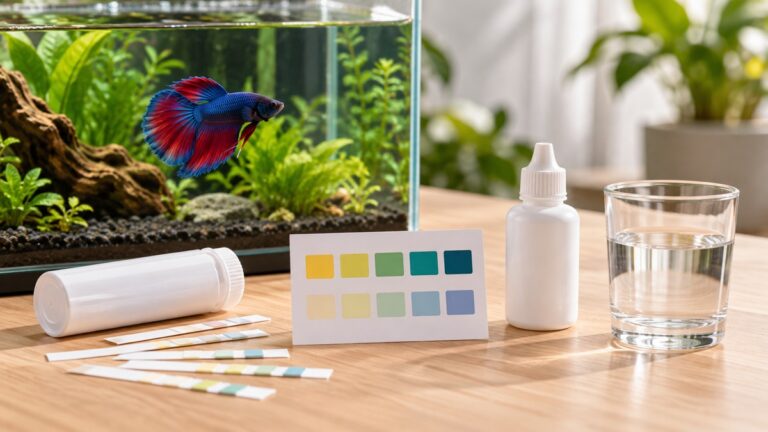
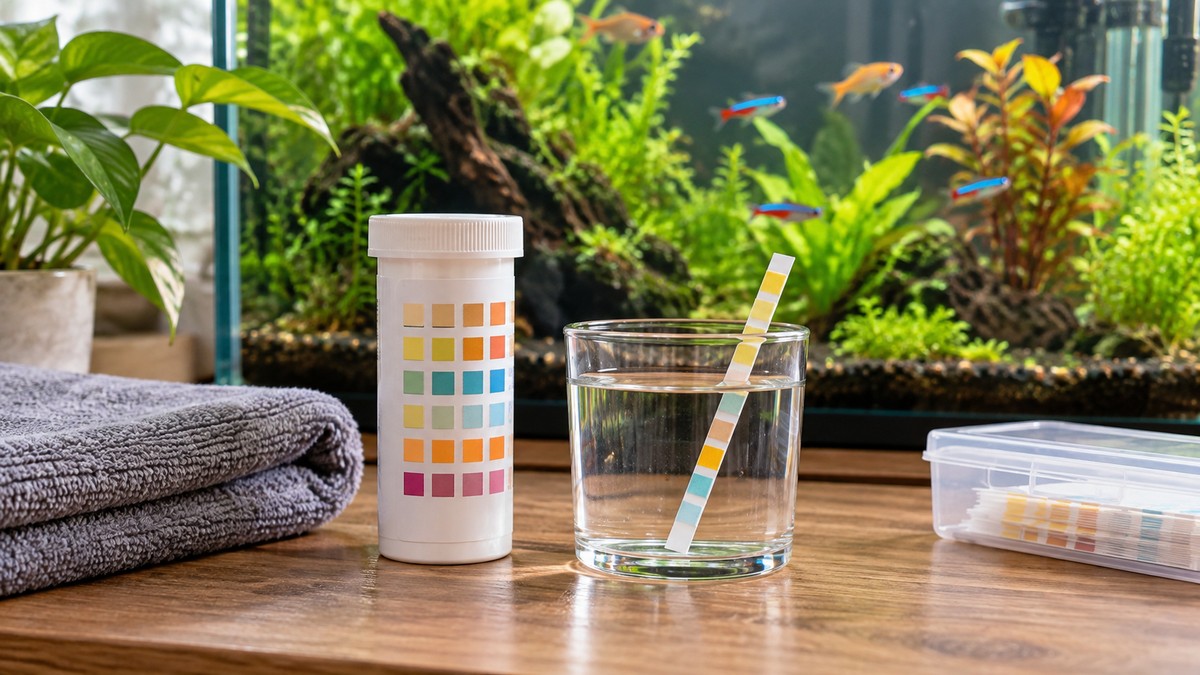
Aquarium water test strips are the fastest way to check a betta tank between water changes: you dip a paper strip, wait a short time, and compare the pads to a color chart. The best strip for you depends on which parameters it covers, how many strips come in the box and how long you wait for a reading. This guide compares seven listings using only what each listing states, so you can match a strip to the way you keep your tank.
Quick answer
- If you want a simple name-brand box with a short read time, the Tetra EasyStrips 6-in-1 listing says to dip and wait 60 seconds.
- If ammonia is your main worry in a new tank, pick a listing that tests ammonia on its own pad; the API strips, the AAwipes kits, and the two FUNSWTM-style and 12-in-1 listings with an ammonia pad all do.
- If you test often, a larger count (100 or 150 strips) means fewer reorders.
- Always check the date on the bottle and keep the lid closed, because strips are paper pads and the listings stress dry storage.
What a strip can and cannot tell you
A test strip is a screening tool. Each pad changes color when it meets the water, and you match the colors to a chart. That is quick, but it is a color match by eye, so two people can read the same pad slightly differently. Use strips for trends: is nitrite showing up, did the pH move after a water change, is chlorine present in a bucket of tap water you just prepared. If a reading looks alarming, repeat it with a fresh strip and fresh tank water before you act, and ask a fish-store specialist or an aquatic vet if your betta looks unwell. The listings in this guide describe strips as fast and easy; none of that replaces watching your fish.
Betta tanks are often small, which means water changes quickly. A few gallons can swing in ammonia or pH faster than a large tank. That is why a quick weekly dip is useful, and why a new tank needs more frequent checks. One listing in the pack says to test several times a week when starting a new aquarium and then weekly or when a problem arises. Another says to use strips weekly, after water changes or when adding new fish. A third says experts recommend testing at least twice a week. These are the listings’ own suggestions, and they agree on one idea: test more at the start.
How to choose a test strip
1. Look at the parameters, not just the number on the box
A “6-in-1” or “9-in-1” label counts pads. What matters is which pads. The listings in this guide name the following:
| Listing | Pads named in the listing | Strips in the box |
|---|---|---|
| API Ammonia Test Strips | Ammonia focus; the listing names water quality in general | 25 tests |
| Tetra EasyStrips 6-in-1 | Nitrate, nitrite, hardness, chlorine, alkalinity, pH | 25 |
| AAwipes 8-in-1 (three sizes) | Free chlorine, nitrate, nitrite, hardness, sodium chloride, total alkalinity, pH, ammonia nitrogen | 50, 100 or 150 |
| FUNSWTM 9-in-1 | Ammonia, pH, nitrate, chlorine, nitrite, hardness, alkalinity, copper (named in the listing) | 50 |
| 12-in-1 Aquarium Test Strips | Ammonia, nitrate, pH, hardness, alkalinity, chlorine, iron, copper, H2S | 50 |
| FUNSWTM 7-in-1 freshwater | Nitrate, nitrite, hardness, free chlorine, pH, carbonate, total alkalinity | 100 |
Notice that the Tetra 6-in-1 listing does not name an ammonia pad, and the FUNSWTM 7-in-1 listing does not either. For a betta keeper, ammonia and nitrite are the two readings most tied to a new or recently cleaned tank, so that difference matters. If you also use a separate ammonia test, a strip without an ammonia pad can still be useful for chlorine, pH and hardness.
2. Match the strip count to how often you test
If you test weekly, 25 strips lasts about half a year. If you follow the twice-a-week advice from the AAwipes listing, 50 strips lasts about 25 weeks and 150 strips lasts over a year. Strips in an opened bottle are exposed to air each time you open it, and one 12-in-1 listing describes its 50-strip bottle as a size that reduces long-open storage for weekly checks. Buying the largest box is not always better if you only test once a week.
3. Check the read time
Read times differ across the listings. Tetra says to dip, wait 60 seconds and read. The FUNSWTM 7-in-1 listing says to dip for 2 seconds, then wait 15 to 30 seconds. The AAwipes listings give a three-step process: dip pads 1 to 7 for 2 seconds, dip the ammonia pad separately for 5 seconds, hold the strip horizontally for 30 seconds, and read the ammonia pad after 180 seconds. A longer, more careful process is fine if you test at the same time each week, but if you want a 30-second check before work, a shorter process fits better.
4. Freshwater or saltwater
Most listings here say they work in freshwater and saltwater, and some also name ponds. A betta tank is freshwater, so this is not a deciding point, but the FUNSWTM 7-in-1 listing is described as freshwater-focused, and its page names betta fish tanks directly.
5. Unit pH range
Three listings state a pH range of 6.0 to 8.0 (API, Tetra and the 9-in-1 FUNSWTM), and the 7-in-1 FUNSWTM states 6.5 to 8.5. Bettas are usually kept within the neutral zone, so either range covers common tap water, but a strip with a narrow window cannot show a reading outside it.
The seven listings, one by one
API Ammonia Test Strips, 25-test box
This is the brand-name pick for a tank where you mainly want to see whether the water has something harmful in it. The listing says to dip the strip into aquarium water and check the colors, and it describes the strips as monitoring water quality for freshwater and saltwater aquariums. It gives a pH range of 6.0 to 8.0 and lists the box as 0.8 ounces. The listing advises dosing several times a week when starting a new aquarium and then weekly or when a problem arises. Choose it if you like a familiar brand and a small box; look elsewhere if you want many parameters on one strip.
Tetra EasyStrips 6-in-1, 25 count
One strip, six readings: nitrate, nitrite, water hardness, chlorine, alkalinity and pH. The listing says to dip, wait 60 seconds and read the results, and to use the strips weekly, after water changes or when adding new fish. It works in freshwater and saltwater. It is the simplest listing here for a keeper who wants to confirm that tap water has been conditioned (chlorine) and that the nitrogen cycle is moving (nitrite, nitrate). The listing does not name an ammonia pad, so pair it with a separate ammonia check if you are cycling a new tank.
AAwipes 8-in-1 test kit, 50 strips
The smallest of the three AAwipes sizes. All three share the same pads: free chlorine, nitrate, nitrite, hardness, sodium chloride, total alkalinity, pH and ammonia nitrogen. The listing describes high-quality fiber paper with non-bleeding colors and a sealed bottle to protect the strips from moisture. It says the kit lets you check water at home without sending samples to a lab. This size suits a single betta tank where you test about twice a week for several months.
AAwipes 8-in-1 test kit, 100 strips
Same pads and same three-step process as the 50-strip kit, with twice the strips. The listing weight is 3.17 ounces. The color is given as “100 Strips” and the material as treated fiber paper. Pick this size if you keep more than one tank or like testing often.
AAwipes 8-in-1 test kit, 150 strips
The largest AAwipes size, listed at 3.52 ounces. The same pads, the same fiber paper, the same sealed bottle. One caution that applies to every large bottle: each time you open it, the strips inside meet room air, so use it with the lid snapped shut and do not leave it in a damp bathroom.
FUNSWTM 9-in-1, 50 strips
The listing says the strips test nine parameters including ammonia, pH, nitrate, chlorine, nitrite, hardness, alkalinity and copper, and stresses a dedicated ammonia test. It is aimed at first-time users and names betta fish tanks. The pH range is stated as 6.0 to 8.0 and the listing includes a color chart, a test tube and a thermometer among its included components. If you are new to the hobby and want one purchase that covers the main nitrogen readings, this listing is the most beginner-oriented of the group.
12-in-1 aquarium test strips, 50 count
This listing covers the widest set of readings: ammonia, nitrate, pH, hardness, alkalinity, chlorine, iron, copper and H2S. It is described as usable in fish tanks and ponds, and the box includes an instruction manual. The bottle is listed at 2.3 x 2.3 x 6.1 inches and 3.2 ounces. Extra pads such as iron and H2S are useful mostly for well water or outdoor ponds; for a standard tap-water betta tank they add little, so do not pay extra attention to them unless your water source is unusual.
FUNSWTM 7-in-1 freshwater, 100 strips
This one is listed for freshwater setups, including betta tanks, tropical tanks, ponds and planted aquariums. It names nitrate, nitrite, hardness, free chlorine, pH, carbonate and total alkalinity. The read time is short (dip for 2 seconds, wait 15 to 30 seconds), the pads are described as fiber paper with no color bleeding, and the listing mentions a 2-year guarantee. The pH range is 6.5 to 8.5. The box includes strips, a test tube and a thermometer sticker. With no ammonia pad named, it is best as a general-purpose check alongside an ammonia test.
How to get a cleaner reading from any strip
The listings mostly agree on the steps, and a few habits make the color match easier regardless of brand.
- Use dry hands and a dry bottle opening. Wet fingers on the pads can start the color change before the strip touches the water.
- Follow the time on your box. The AAwipes listing says to hold the strip horizontally and not to shake off excess water, and it lists a separate dip for the ammonia pad. Strips differ, so read your own box instead of copying another brand’s timing.
- Read in steady light. Compare the pads to the chart in daylight or a bright white lamp. A colored aquarium light changes how the pads look.
- Test the same way each time. Take the sample from the same spot in the tank, at about the same time of day, so a change in color means a change in water and not a change in method.
- Test fresh tap water too. Where a listing names a chlorine pad, it is useful to check the water you are about to add, not just the tank.
- Write the result down. A short note on the date and the colors lets you see a slow drift that a single reading would hide.
Which strip fits which keeper
For a brand-new tank that is still cycling, choose a strip with an ammonia pad and plan to use it often: the AAwipes kits, the FUNSWTM 9-in-1 and the 12-in-1 listing all name ammonia. For an established small tank where you check pH and chlorine after water changes, the Tetra 6-in-1 or the FUNSWTM 7-in-1 is enough. For a keeper with several tanks or a pond, the 100- and 150-strip sizes spread the cost per test. For someone who wants the shortest wait, the 7-in-1 listing quotes 15 to 30 seconds after the dip.
Whichever you pick, strips are one input. Watch how your betta swims, eats and breathes, and if water readings are poor and the fish looks ill, ask a vet who treats fish.
Mistakes to avoid
- Testing only when something looks wrong. A weekly habit shows trends before the fish shows stress.
- Reading too early or too late. Pads keep changing, so stick to the time on your box.
- Leaving the cap off. Moisture ruins the paper pads.
- Treating a single odd pad as a diagnosis. Repeat the test with a fresh strip.
- Buying for features you will not use. Iron and H2S pads matter little for most tap-water betta tanks.
FAQ
How often should I use test strips on a betta tank?
The listings suggest several times a week for a new tank and weekly afterward, plus after water changes or when adding new fish. One AAwipes listing says at least twice a week. Start frequent, then settle into a weekly rhythm when readings stay steady.
Do I need a strip with an ammonia pad?
For a new or recently restarted tank, yes, it is the reading most useful during cycling. The API, AAwipes, FUNSWTM 9-in-1 and 12-in-1 listings name ammonia. The Tetra 6-in-1 and FUNSWTM 7-in-1 listings do not, so use a separate ammonia check if you buy those.
Are test strips the same as a liquid kit?
No. Strips are quicker; liquid kits use drops and a test tube and are a different method. Our guide to digital kits and test strips covers the choice. For this page we only look at strips.
How should I store the strips?
Keep the lid closed and the bottle dry. The AAwipes listing highlights a sealed bottle for this reason. Do not store the bottle near the tank where humidity is high.
Can the same strip be used in a pond or saltwater tank?
Several listings say yes. The FUNSWTM 9-in-1 and 12-in-1 listings name ponds, and Tetra, API and AAwipes name saltwater as well. Check the pad list: sodium chloride is named on the AAwipes strips, which suits salinity checks.
What should I do if a reading looks bad?
Repeat it with a new strip and fresh tank water. If it still looks bad, follow the instructions on your water conditioner and ask a fish-store specialist; if your betta looks sick, ask a vet who treats fish. Our page on ammonia test strips and what ammonia means in a betta tank goes deeper on that reading.
Bottom line
Pick the strip whose named pads match your problem. A cycling tank needs an ammonia pad, a settled tank needs chlorine, pH and hardness, and a busy keeper needs a short read time and enough strips to last. For a single betta tank, the 50-strip FUNSWTM 9-in-1 or AAwipes 8-in-1 listings give the broadest named coverage, while the Tetra 6-in-1 is the quick, no-fuss option.