Can Betta Fish Live in Cold Water? What the Sources Say
As an Amazon Associate we earn from qualifying purchases.
Can betta fish live in cold water? The sources checked for this guide say they do not do well in it. The University of Florida IFAS publication on betta care states that “bettas thrive in warmer water and do not do well in cold water.” Bettas are tropical fish from shallow, warm waters in Southeast Asia, so a cool tank is a welfare concern, not a minor preference. This guide explains what the sources say about cold water, why it matters for the tank, and where the sources stop.
Quick answer
- UF/IFAS says bettas “thrive in warmer water and do not do well in cold water,” so a cool tank is not the goal.
- For an unheated, unfiltered container, UF/IFAS says the room air should be kept at no less than 22°C (71.6°F).
- Merck says cold water slows the beneficial bacteria that process waste, so cold tanks need more care with waste and stock.
- The sources do not give a betta water temperature range, so any range you see elsewhere is general guidance until checked.
Why bettas are a warm-water fish
The UF/IFAS page describes the natural habitat of wild bettas. It reports, for one population in Thailand, “temperature of 29.9°C (about 86°F on average; range from approximately 27.0 to approximately 31.5°C).” These are field measurements from shallow, low-oxygen water, not tank targets. They do show that the species evolved in warm conditions, and the same publication says the betta’s physiology “allowed it to occupy shallow, warmer, low-oxygen environments.”
The UF/IFAS page also explains why warm water is part of normal betta life rather than a luxury. Bettas breathe air at the surface through a labyrinth organ, which is an adaptation to low-oxygen water. That adaptation does not make them tolerant of cold tanks. The sources do not say that a betta can adjust to a low temperature over time, so the safer reading is that cold is a risk to avoid.
What cold does to the tank
Cold water causes trouble beyond the fish itself. The Merck fish husbandry page makes a point about cooler systems that applies to any tank. It says, “The ratio of fish to area should be reduced in a cold-water environment, such as ponds and goldfish tanks, because the beneficial bacteria do not function as well at lower temperatures.” Merck is describing other cold-water systems in that sentence, not betta tanks. The principle still matters: the bacteria that process ammonia slow down when the water is cold, so waste can build up faster than the filter can handle it.
That means a cool tank needs closer attention to feeding and water quality. In general guidance, not from the sources, uneaten food and waste left in a cold tank can add to the problem, so feed small amounts and remove leftovers. The UF/IFAS publication on ammonia, FA031, explains that ammonia becomes more toxic as temperature and pH rise, which is a reason to watch the readings rather than assume a cool tank is safe.
Heat, thermostats and thermometers
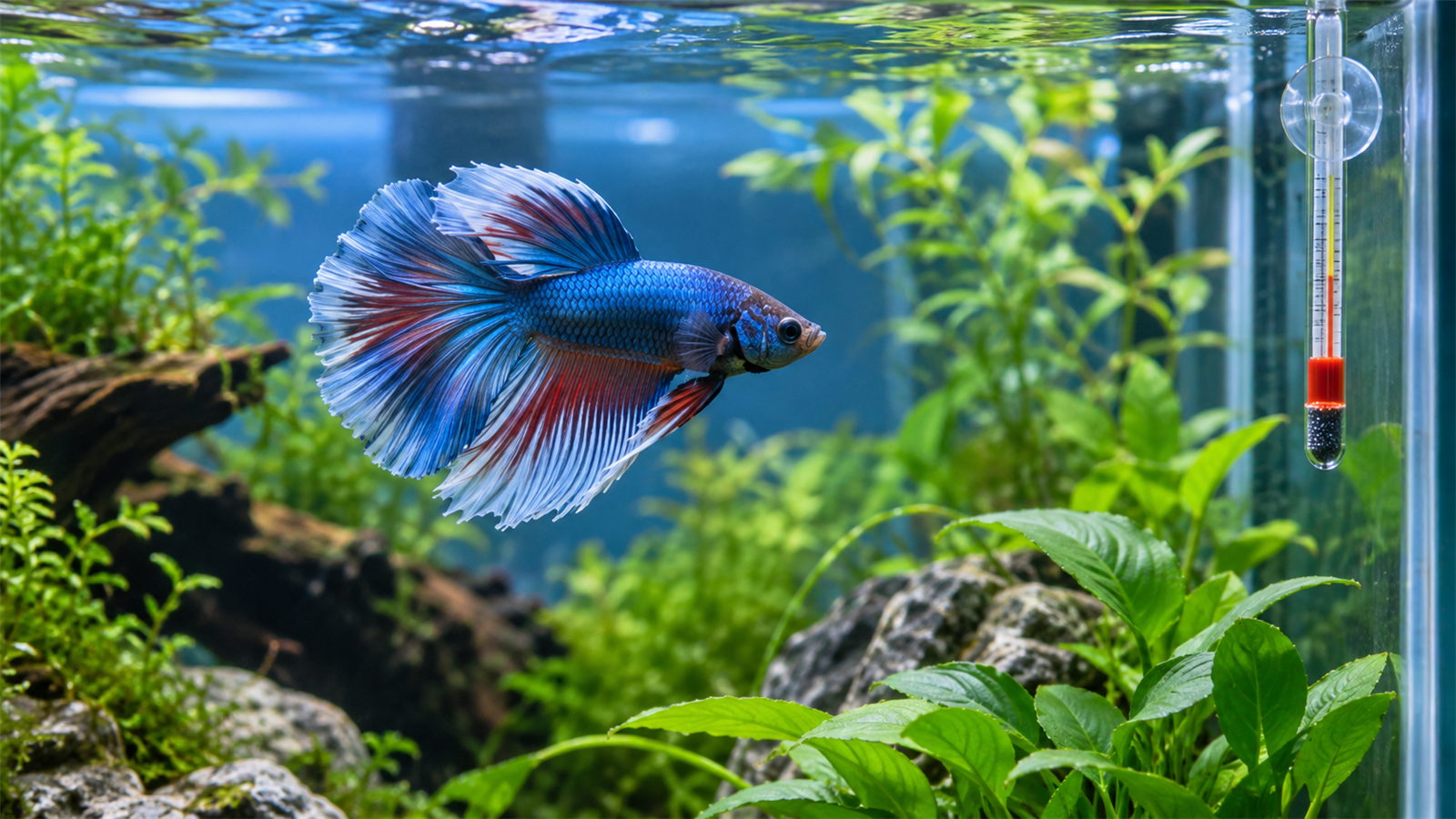
Merck describes the tools for holding a steady temperature. “A heater will typically have a programmable thermostat that you can set to control the water temperature.” It also recommends a second check. “You should also have a separate thermometer in the tank to monitor water temperature independently from the heater, because maintenance of the water temperature in an appropriate range for the fish species you are keeping is critical to their health.” A heater’s own reading is not enough on its own, so a separate thermometer is the check the sources recommend.
Merck also warns about glass heaters. “Most heaters are in a glass tube that may shatter if not surrounded by water.” Keep the heater fully submerged when it is on, and follow the manufacturer’s instructions for placement. The sources do not give a heater wattage for a betta tank, and this guide does not give one. Heater sizing belongs with the listing or manufacturer page for the specific product.
Room conditions matter too. Merck notes that “sunlight can also cause the water temperature in the tank to rise.” A tank in a sunny window can swing warm during the day and cool at night, and the thermometer shows that pattern. Plants can help buffer temperature, which Merck describes as shading the water, but a plant does not replace a heater for a cool room.
Filters and current in a cool tank
Cold tanks are often run with the heater and filter together, and the flow from the filter affects the fish. UF/IFAS states that “Bettas prefer calm water as shown by research using flow as a stressor, so heavy filtration may actually be harmful to a betta’s health and welfare.” A strong filter does not help a betta that is struggling with the current. Choose a gentle flow, and check whether the flow is adjustable before buying.
For the tank size and setup side of this question, see How Big Can a Betta Fish Get, which covers how the fish’s needs connect to the tank it lives in. For the tank size question, see Is a 5 Gallon Tank Good for a Betta.
How we chose
The sources checked for this guide are two UF/IFAS extension publications and two Merck Veterinary Manual pages. The UF/IFAS betta publication (FA212) covers betta biology and care directly. The UF/IFAS stress publication (FA005) defines stress, and the Merck pages cover heaters, thermometers and cold-water systems. Retail pages were not used. Each statement about temperature is tied to one of these pages, and anything beyond them is labelled as general guidance.
What we could not verify
The sources do not give a betta water temperature range for home tanks, and they do not say how long a betta can survive in a cool tank. The room air figure of 22°C is stated for an unfiltered, unheated container, not for a heated tank with a thermostat, so it should not be read as a tank target.
What the sources do not say
- The sources do not give an aquarium water temperature range for bettas.
- The sources do not state a threshold at which a betta’s health is at risk from cold.
- The sources do not give heater wattage or thermostat settings for betta tanks.
- The sources do not say how fast a tank should warm up or cool down.
Frequently asked questions
Is 72 F too cold for a betta?
The sources do not give a threshold at 72 F. The UF/IFAS page’s room-air figure is 22°C (71.6°F) for an unfiltered, unheated container, which is a minimum for room air in that setup. It is not a tank temperature target, and the sources do not say whether a heated tank at that water temperature is safe.
Can a betta live without a heater?
The sources describe a room-air minimum for an unheated container but do not say that a heater is always required. Merck advises a heater with a thermostat and a separate thermometer for maintaining the temperature the fish needs, which suggests that a heater is the practical way to hold a steady temperature.
Do bettas need warmer water in winter?
The sources say bettas do not do well in cold water and that they thrive in warmer water. They do not discuss seasonal changes, and they do not say how often to adjust a heater through the year. A thermometer reading each day shows whether the tank is holding steady.
Can a betta tank be too warm?
The sources describe wild temperatures of 27.0 to 31.5°C as the range in one Thai population, but they do not give an upper limit for a home tank. Merck says the temperature should be kept in “an appropriate range for the fish species you are keeping,” without naming the range for bettas.
How should the tank temperature be checked?
Use a thermometer that sits in the tank, separate from the heater. Merck recommends this approach because the heater’s own setting is not an independent reading. Place the thermometer away from the heater and the filter outlet for a fair reading, which is general guidance.
Sources
- Watson, C., et al., “Evolution, Culture, and Care for Betta splendens,” University of Florida IFAS Extension, FA212, https://edis.ifas.ufl.edu/publication/FA212 (opened 2026-10-24)
- Francis-Floyd, R., “Stress – Its Role in Fish Disease,” University of Florida IFAS Extension, FA005, https://edis.ifas.ufl.edu/publication/FA005 (opened 2026-10-24)
- Merck Veterinary Manual, “Providing a Home for Fish,” https://www.merckvetmanual.com/all-other-pets/fish/providing-a-home-for-fish (opened 2026-10-24)
- Merck Veterinary Manual, “Routine Health Care of Fish,” https://www.merckvetmanual.com/all-other-pets/fish/routine-health-care-of-fish (opened 2026-10-24)
- Francis-Floyd, R., “Ammonia in Aquatic Systems,” University of Florida IFAS Extension, FA031, https://edis.ifas.ufl.edu/publication/FA031 (opened 2026-10-24)