Best 7 in 1 Aquarium Test Strips: Which Kit Fits Your Tank
As an Amazon Associate we earn from qualifying purchases. Details
A 7 in 1 aquarium test strip kit checks seven water measurements with one dip, and the keyword fits buyers who want that exact count. Only one listing in this roundup is a true seven-way kit. The rest run from 8-way to 11-in-1, which cover more tests, so this guide ranks them by what each listing names, how long each pad takes, and how the stated counts compare. It also flags where a listing disagrees with itself, because several do.
Quick answer
If you want exactly seven tests, the seven-way kit is the only match here. If ammonia matters most, choose an eight-way kit, because the seven-way listing does not name ammonia. If you need copper or iron, a nine-in-one kit fits. If you want the widest named list, the 11-in-1 listing has the largest title promise, but its strip count conflicts inside the listing. Before you buy, count the strips in the package, check the pad timing against how you will test, and confirm the use window.
What matters for this keyword
Five things change the answer for this keyword.
Which tests the strip covers. The seven-way listing names nitrate, nitrite, general hardness, pH, carbonate, total alkalinity and total chlorine. It does not name ammonia. Many keepers want ammonia on the same strip, so check the named list before you compare counts.
Pad timing. Pads differ from listing to listing. The DIPSTIK listing says to wait 30 seconds after the dip. The EASYTEST listing reads most pads at 15 seconds and nitrate and nitrite at 60 seconds. The Yiffer listing holds pads 1 to 7 for 30 seconds and pad 8 for 120 seconds.
Stated strip count. Some listings give more than one number. Count the strips in the package before you rely on the title.
Storage and use window. Strips lose their usefulness when they stay damp. The DIPSTIK listing says to keep wet fingers out of the bottle and store strips in a cool, dry place. The SJ WAVE listing says to use opened strips within 3 months. The Yiffer listing describes an airtight, moisture-proof case.
Water type. Most listings say they work in freshwater and saltwater. Confirm that your water matches the listing before you buy, especially for a pond or reef tank.
Testing steps from the listings
The listings describe slightly different routines, so follow the order in the package that comes with your kit. Across these listings, the common pattern looks like this:
- Dip the strip in the water. The DIPSTIK listing says to dip for 2 seconds, and the AAwipes listing gives the same 2-second dip for its pads 1 to 7.
- Remove the strip without shaking off the excess water. The AAwipes listing uses that wording.
- Hold the strip horizontally while the pads develop. The AAwipes listing says to hold pads 1 to 7 horizontally for 30 seconds.
- Compare each pad with the color chart. The DIPSTIK listing says to read under natural light and to keep your hands dry before you take the strip out.
For ammonia, the timing changes. The AAwipes listing dips its ammonia pad separately for 5 seconds. The EASYTEST listing says to cut off the ammonia pad for accurate ammonia testing, so the strip is handled in two steps. The Yiffer listing holds its eighth pad for 120 seconds. Follow the package order every time, so each pad gets the timing it was built for.
Reading the color chart
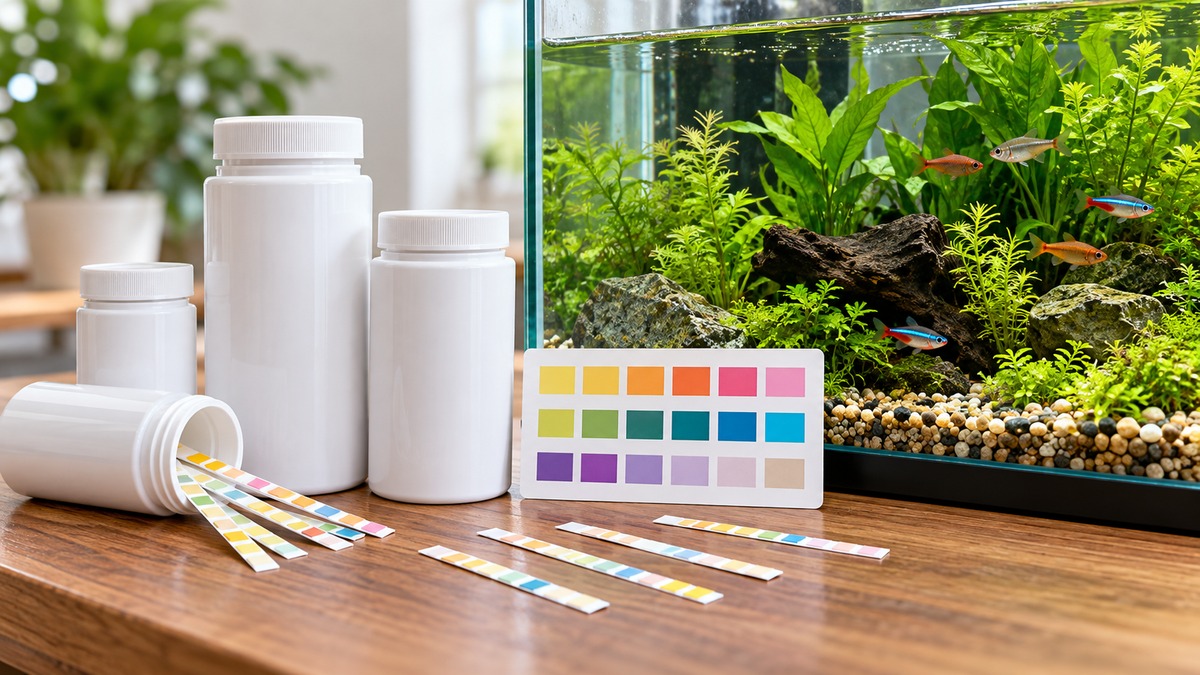
The color chart is the step most people rush. Several listings put weight on it. The DIPSTIK listing says to read the pad under natural light, and the Yiffer listing describes large color blocks and a clear comparison chart. The Caperplus listing says its color charts are easy to read. Compare each pad with the chart inside the window the listing gives for that pad, because the DIPSTIK listing describes waiting 30 seconds for the color pad to change. Reading early or late can make two pads look alike when they are not. For a dedicated chart guide, see color chart freshwater aquarium water testing chart.
Reading ammonia on a strip
Ammonia is colorless and odorless even at levels that harm fish, so a color change is the only signal a strip gives. That makes the ammonia pad the part of the kit that needs the most care. According to UF/IFAS, the toxic share of ammonia depends on pH and temperature, so one ammonia reading does not tell you how toxic the water is on its own. A good test setup includes a pH test and a thermometer for that reason.
The same guide notes that one common ammonia method can read falsely high after formalin use within 24 to 72 hours, and after some ammonia binding products and water conditioners. A salicylate-based method is not affected by those products. If you use a treatment or a conditioner, keep that in mind before you read a high ammonia result. For ammonia-specific picks, see best ammonia test strips fish tank.
Comparing the eight listings
The table below sets out the tests each listing names, the strip count it states, and the pad timing it gives. A blank cell means the listing gives no timing. For a wider look at test kits, see best fish tank water quality test strips.
| Listing | Tests named | Strip count stated | Pad timing stated |
|---|---|---|---|
| DIPSTIK, 7-way | nitrate, nitrite, general hardness, pH, carbonate, total alkalinity, total chlorine | 100 | dip 2 seconds, wait 30 seconds |
| EASYTEST, 8-way | ammonia, pH, hardness, alkalinity, chlorine, nitrate, nitrite, carbonate | 100 | most pads 15 seconds; nitrate and nitrite 60 seconds |
| Yiffer, 8-way | ammonia, pH, total alkalinity, carbonate, hardness, free chlorine, nitrate, nitrite | 175 | pads 1 to 7 at 30 seconds; pad 8 at 120 seconds |
| Palinoia, 8-in-1 | pH, ammonia, nitrate, nitrite, hardness, alkalinity, chlorine, salinity | 60 (50 plus 10 bonus) | not stated |
| AAwipes, 8-in-1 | pH, ammonia, alkalinity, hardness, chlorine, nitrate, nitrite (title and bullets) | 50 | pads 1 to 7 at 2 seconds dip and 30 seconds hold; ammonia pad 5 seconds |
| FUNSWTM, 9-in-1 | ammonia, pH, nitrate, chlorine, nitrite, hardness, alkalinity, copper | 150 in title and unit count; 100 under number of items | not stated |
| Caperplus, 9-in-1 | pH, nitrate, nitrite, carbonate, total hardness, chlorine, copper, iron, alkalinity | 50 under number of items; 1 under unit count | pH, hardness and chlorine 15 seconds; nitrate and nitrite 60 seconds |
| SJ WAVE, 11-in-1 | nine named in uses, plus ammonia in the bullets | 150 in title and unit count; 100 in included components | not stated |
How to choose
- Choose the seven-way kit if the exact count is your need and you will test ammonia with a separate product. The DIPSTIK listing names seven tests and no ammonia.
- Choose an eight-way kit if you want ammonia on the strip. The EASYTEST, Yiffer and Palinoia listings each name ammonia, and the Palinoia listing adds salinity.
- Choose a nine-in-one kit if copper matters to you. FUNSWTM names copper, and Caperplus names copper and iron but not ammonia.
- Choose the 11-in-1 kit if you want the widest title and a color chart with an eBook. The SJ WAVE listing includes both, but check its strip count first.
- Choose by pack size last. Several listings disagree on count, so confirm the number in the package before you compare prices or pack sizes.
Every choice above depends on the tests named on the listing. Read the list, then the timing, then the count.
1. Aquarium Test Strips,7-Way Freshwater Saltwater Fish Tank Pond Test(100ct) (Best for the exact 7-way count)
Specs from the listing (checked 2026-10-13):
- Item Highlight: Nitrate, Nitrite, Chlorine, Hardness, Alkalinity, Carbonate, pH
- Unit Count: 100 Count
- Material Type: Fiber Paper, Color Pad
Pros
- The listing names seven tests: nitrate, nitrite, general hardness, pH, carbonate, total alkalinity and total chlorine.
- The package holds 100 strips, and the listing says to dip for 2 seconds and wait 30 seconds for the color pad.
- The listing describes fiber paper with no-color-bleed pads, and says the strips should be stored in a cool, dry place.
Cons
- The listing does not include ammonia among its seven tests, so you need a separate ammonia check.
- The listing says test strips are not reusable, so every test uses a fresh strip.
Best for: Keepers who want the seven-test list named in the keyword and will test ammonia separately.
Skip if: You need ammonia on the same strip as the other tests.
View on Amazon (affiliate link)
2. EASYTEST 8-Way Aquarium Test Strips with Ammonia, 100PCS Fish Tank Test Kit (Best eight-way with ammonia)
Specs from the listing (checked 2026-10-13):
- Item Highlight: Aquarium Water Test Kit for Fish Tank, Pond | Test Ammonia, pH, Hardness, Alkalinity, Chlorine, Nitrate, Nitrite, Carbonate
- Number of Items: 100
Pros
- The listing names eight parameters, including ammonia, which the seven-way listing leaves out.
- The listing gives read times of 15 seconds for most pads and 60 seconds for nitrate and nitrite.
- The listing says the strips suit freshwater, saltwater, betta tanks and shrimp tanks.
Cons
- The listing says to cut off the ammonia pad for accurate ammonia testing, so the strip is handled in two steps.
- The listing gives no shelf-life or storage guidance, so check the package date before you test.
Best for: Keepers who want eight parameters, including ammonia, and a large pack from one listing.
Skip if: You do not want to cut a pad off the strip before testing ammonia.
View on Amazon (affiliate link)
3. 175-Count 8-Way Aquarium Test Strips with Ammonia-Fish Tanks&Ponds (Best large pack with ammonia)
Specs from the listing (checked 2026-10-13):
- Unit Count: 175 Count
- Item Weight: 2.8 ounces
- Item Highlight: Accurate Test Ammonia,pH, Total Alkalinity, Carbonate, Hardness, Free Chlorine, Nitrate and Nitrite
Pros
- The listing gives 175 strips, the largest pack among the eight-way and nine-way listings here.
- The listing says the pads have 6mm spacing to prevent color mixing.
- The listing names eight parameters, including ammonia, nitrate, nitrite and free chlorine.
Cons
- The listing gives 120 seconds for the eighth pad, while pads 1 to 7 take 30 seconds.
- The listing says the strips are lab-tested to ±3% accuracy, but it does not describe the test method behind that figure.
Best for: Frequent testers who want the largest pack and ammonia on the same strip.
Skip if: You do not want to wait 120 seconds on one pad.
View on Amazon (affiliate link)
4. Palinoia 8-in-1 Aquarium Water Test Strips, 60 Count (Best for salinity)
Specs from the listing (checked 2026-10-13):
- Number of Items: 60
- Included Components: 60 Aquarium Water Test Strips (50 + 10 Bonus), Color Chart, Instructions
- Item Weight: 2.99 ounces
Pros
- The listing is the only one here that names salinity among its tests.
- The listing says it works in freshwater and saltwater aquariums, ponds and other water systems.
- The kit ships with 60 strips, 50 plus 10 bonus, along with a color chart and instructions.
Cons
- Its 60-strip count is lower than the 100-strip and larger packs elsewhere in this roundup.
- The listing gives no timing for each pad, so follow the color chart and instructions in the package.
Best for: Keepers who want salinity on the same strip as ammonia and nitrite.
Skip if: You need a large pack for frequent testing.
View on Amazon (affiliate link)
5. AAwipes 8-in-1 Aquarium Test Kit for Fish Tanks – Quick & Accurate Water Testing Strips (Best sealed bottle for the 8-in-1 count)
Specs from the listing (checked 2026-10-11):
- Number of Items: 50
- Directions: /
- Included Components: Aquarium Test Kit
Pros
- The listing gives pads 1 to 7 a 2-second dip and a 30-second horizontal hold.
- The listing says the ammonia pad is dipped separately for 5 seconds.
- The listing describes a well-sealed bottle to keep the strips effective over time.
Cons
- The listing leaves its directions and warranty fields blank, so you rely on the bullets for instructions.
- The ammonia pad needs its own 5-second dip, unlike the 2-second dip for the other pads.
Best for: Keepers who want an 8-in-1 kit in a sealed bottle with a 50-strip count.
Skip if: You need written directions and a stated warranty on the listing.
View on Amazon (affiliate link)
6. Aquarium Test Strips for Fish Tank: 9 in 1 Aquarium Water Test Kit for Freshwater – 150ct Fish Test (Best for copper with a thermometer)
Specs from the listing (checked 2026-10-13):
- Included Components: 150strips,test tube, thermometer
- Warranty Description: 2 Year Manufacturer
- Unit Count: 150 Count
Pros
- The listing names nine parameters, including ammonia and copper.
- The package includes a test tube and a thermometer, according to the listing.
- The listing gives a 2 Year Manufacturer warranty.
Cons
- The listing shows 150 strips in the title and unit count but 100 under number of items. Rely on neither until the package confirms it.
- The listing gives no timing for each parameter, so follow the package order.
Best for: Keepers who want nine parameters including copper, plus a thermometer in the box.
Skip if: You need the strip count to match the pack exactly before buying.
View on Amazon (affiliate link)
7. 9-in-1 Aquarium Test Strips for Accurate Water Quality Testing (Best for copper and iron)
Specs from the listing (checked 2026-10-13):
- Number of Items: 50
- Unit Count: 1 Count
- Item Weight: 1.28 ounces
Pros
- The listing names nine tests, including iron and copper, which the seven-way listing does not.
- The listing says pH, hardness and chlorine read in 15 seconds, while nitrate and nitrite take 60 seconds.
- The listing includes a 12-month warranty.
Cons
- The listing gives 50 under number of items but 1 under unit count, so the strip count is unclear.
- The listing says the strips give up to 99% accuracy, but it does not name a method behind that figure.
Best for: Keepers who need copper and iron tests and a 12-month warranty.
Skip if: Ammonia is your main concern, since this listing does not include it.
View on Amazon (affiliate link)
8. 11 in 1 – Aquarium Test Strips | 950 Tests – 150 Strips | Fish Tank Aquariums Water Test Kit (Best widest list with a color chart)
Specs from the listing (checked 2026-10-13):
- Recommended Uses For Product: Ph, Carbonate, Total Alkalinity, Free Chlorine, Total Hardness, Nitrite, Nitrate, Copper, Iron
- Included Components: 100 Test Strips (50 in Bag, 50 in Bottle), Color Chart, eBook & Testing Tubes
- Number of Packs: 4
Pros
- The title says 11 in 1, and the bullets name ammonia, copper and iron among the tests.
- The listing includes a color chart, an eBook and testing tubes in the box.
- The listing says to use the strips within 3 months after opening.
Cons
- The listing gives 150 strips in the title and unit count but 100 test strips in the included components. Rely on neither count until the package confirms it.
- The warranty field says only shelf life, so the listing gives no warranty period.
Best for: Keepers who want the widest test list and a color chart in one box.
Skip if: You test rarely and will not use the strips within 3 months of opening.
View on Amazon (affiliate link)
Worked example: a weekly testing plan
Our planning estimate: suppose you test once a week and use one strip per test. Over 3 months, that is 13 weeks, so the plan uses 13 strips per 3 months. A 100-strip pack therefore covers 100 ÷ 13 = 7.69 of those 3-month periods, which means it lasts about seven full periods at this pace. This assumes every strip is used inside its use window, which the SJ WAVE listing describes for opened strips. If your pack has a shorter window, the number of full periods drops.
Compare that with a 175-strip pack on the same plan. The arithmetic is 175 ÷ 13 = 13.46, so that pack covers about thirteen full periods at the same pace. The count alone should not decide the choice. A larger pack only helps if you can use its strips inside the window the listing sets for opened strips.
Common mistakes
- Counting the title, not the package. Several listings give more than one count, and the title may not match the included components.
- Assuming the seven-way kit covers ammonia. Its named list leaves ammonia out, so add a separate check or choose an eight-way kit.
- Timing every pad the same way. The AAwipes ammonia pad uses 5 seconds, and the Yiffer eighth pad uses 120 seconds.
- Buying a large pack for a slow testing plan. A pack of 150 or 175 strips can outlast the use window the listing recommends.
- Leaving the bottle open. Keep wet fingers out of the bottle and store strips in a cool, dry place.
Before you open a pack
- Check the date on the package and note the use window the listing gives. For SJ WAVE, that window is 3 months after opening.
- Count the strips against the number you expect. Several listings disagree with themselves, as the table above shows.
- Keep the bottle closed between tests and keep wet fingers out of it. The DIPSTIK listing gives that instruction.
- Store the strips in a cool, dry place. The Yiffer listing describes an airtight, moisture-proof case, and the Caperplus listing describes a sealed cap that resists moisture.
- Check any extras before you start. The FUNSWTM listing includes a thermometer and a test tube, and the SJ WAVE listing includes an eBook and a color chart. Confirm they are in your box.
FAQ
Is a 7 in 1 test strip kit the same as a 7-way kit?
In this roundup, yes. A 7-way kit tests seven parameters on one strip, and the DIPSTIK listing is the only one that uses that exact count. The other kits here cover eight, nine or eleven tests.
Do I need ammonia on the strip?
Many keepers want it on the same strip, because the seven-way listing leaves ammonia out. An eight-way kit covers it, and the EASYTEST, Yiffer and Palinoia listings all name it. If you choose a seven-way kit, plan a separate ammonia check.
Are strips as accurate as liquid reagent kits?
This roundup covers strips only. Liquid reagent kits are a different product type, so this guide does not compare accuracy between the two. If accuracy is your main concern, see best most accurate aquarium test strips for a separate look at strip options.
How long do test strips last?
Check the date on the package and the use window in the listing. The SJ WAVE listing says opened strips should be used within 3 months. The DIPSTIK listing says test strips are not reusable, so each dip uses a fresh strip.
Why do the counts differ on some listings?
Some listings state two counts, such as the title and the unit count, while the included components give a third. Count the strips in the package before you rely on any single number.
Can I use these on a betta tank?
Some listings say they suit betta tanks. The EASYTEST and FUNSWTM listings both say so. A test supports a stable setup but does not replace care decisions. For symptoms, consult an experienced fish keeper or an aquatic vet.
How often should I test?
The UF/IFAS guide suggests testing ammonia once a week in a production system, and immediately any time fish appearance or behavior changes, including reduced feeding. A home tank is a different setting, but that weekly rhythm is a reasonable starting point for the planning example above.
Bottom line
Choose the kit by the tests you need, then check the package before you buy. Pick the seven-way kit only when the exact count matters more than ammonia. Pick an eight-way kit when ammonia is the main concern, and a nine-in-one or eleven-in-one kit when you need copper, iron or the widest list. Count the strips, confirm the use window, and keep the strips sealed and dry.
Sources
- UF/IFAS, Ammonia in Aquatic Systems (FA31): ammonia is odorless, so a test is the only way to know it is present; weekly testing and testing on a change in fish behavior; nitrite toxic at 0.10 mg/L
Bài viết liên quan: Best Aquarium Chlorine Test Strips for a Betta Tank, Best Aquarium Water Tester: Digital Kit or Test Strips?, Best Aquarium Nitrate Test Kit: Strips, Liquid or App?.