How Many Algae Wafers Should You Feed a Pleco?
As an Amazon Associate, this site earns from qualifying purchases. This guide contains no product links.
The person typing “how many algae wafers should i feed my pleco” wants a number, and the sources checked for this guide do not give one for pleco algae wafers. What they do give is a general feeding rule for fish, a description of what plecos eat in the wild, and a clear warning that overfeeding harms both the fish and the tank. Those points let a keeper set a sensible amount and watch the result, which is more useful than a number copied from a package.
Quick answer
- The sources checked do not give a number of algae wafers for a pleco, so no count is given here.
- The UF/IFAS publication says “These catfish consume algae, insects, detritus, and curiously, wood,” so algae is part of a pleco’s diet, but not the only part.
- Merck gives a general maintenance rate for fish: “maintenance diets are fed at a rate of 1% to 2% of body weight per day.”
- Merck also warns that “Overfeeding can lead to health problems as well as a dirty tank,” so offer a small amount and remove what is not eaten.
What plecos eat
Plecos are armored catfish, and the UF/IFAS publication on freshwater ornamental fish gives their wild diet. It says the common and gibbiceps plecos are “moderate to large fish, ranging up to about 450 mm (18 in),” while the bushy-nose plecos are smaller, “ranging up to about 130 mm (5 in).” Size matters for food. A large pleco has a bigger daily need than a small one.
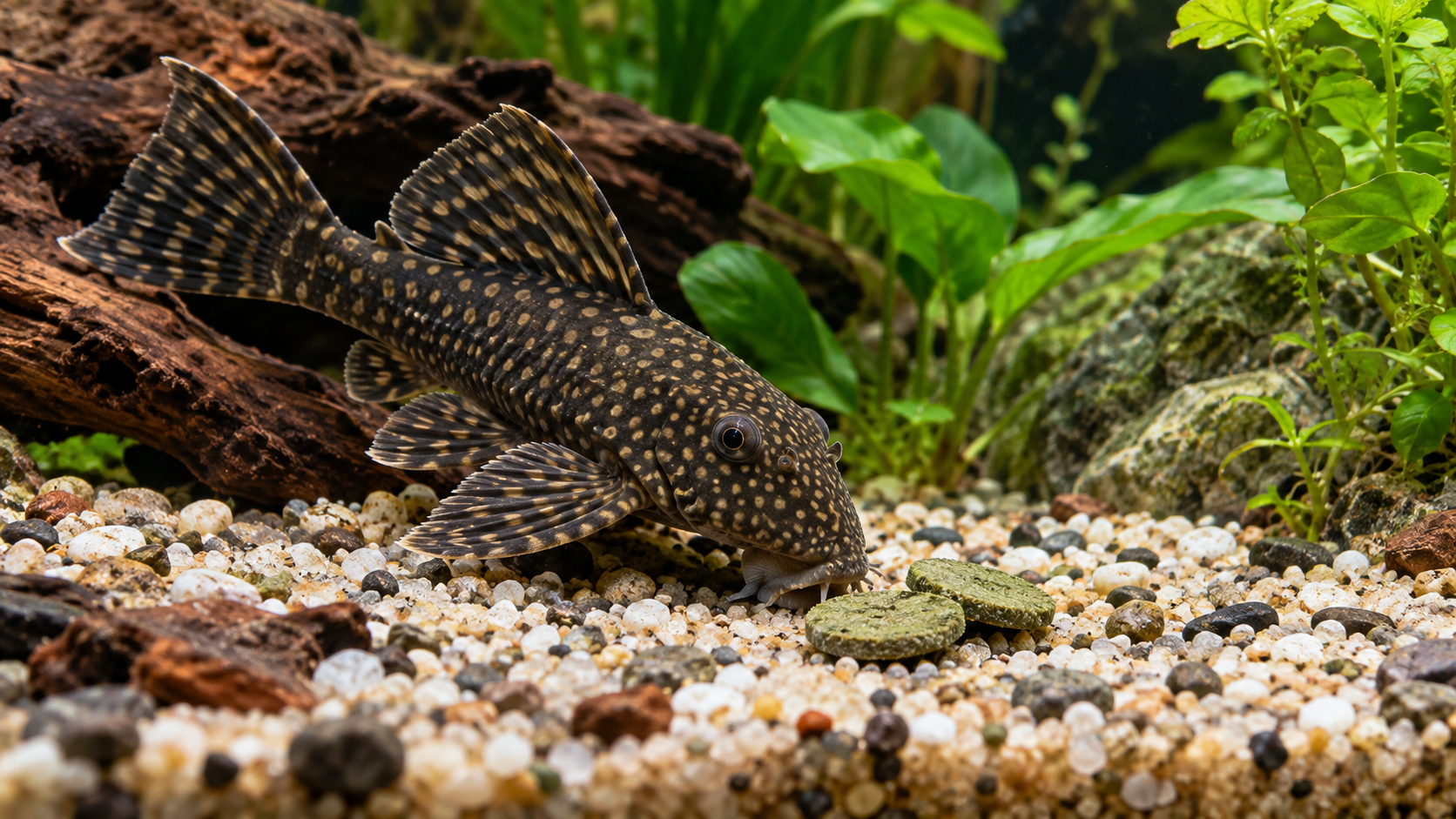
The same source says plecos “consume algae, insects, detritus, and curiously, wood.” Algae is one part of the diet, and the same source lists insects, detritus, and wood as other parts. A tank with only algae wafers may not meet every need, so a varied diet is the sensible starting point. The sources do not say what share of the diet should be algae.
The UF/IFAS text also describes where plecos live: “Many species occur in flowing water habitats.” That fact does not tell a keeper how many wafers to feed, but it does suggest that the fish is used to moving water. A tank with calm water and wafers that sit on the bottom is a different setup from a fast-moving river.
The feeding rule the sources give
The Merck chapter on providing a home for fish is the main source for amount. It says “Feeding methods and rates vary with species, age, system, and water temperature.” It then gives the rule: “In general, maintenance diets are fed at a rate of 1% to 2% of body weight per day, and growth diets at 3% to 5% of body weight per day.”
That figure applies to fish in general, not to pleco algae wafers. It also counts the total food the fish eats, not one type of food. A fish that gets most of its nutrition from a varied diet may need less wafer than a fish that gets nothing else. The rule is useful as a ceiling for a healthy adult that is not growing fast, not as a count to hand a pleco.
The rule is written in weight, so the formula is simple: daily food in grams equals body weight in grams multiplied by 0.01 to 0.02 for maintenance. A keeper who knows the pleco’s weight can use the formula. The sources do not give typical pleco weights for home tanks, so a keeper who does not know the weight should ask a specialist before using the formula.
The Merck chapter also says that “You need to know the type of diet your fish require, as well as where your fish naturally feed in the water column.” A pleco feeds near the bottom, so the wafer should sink to where the fish feeds. The chapter adds that “fish that prefer to feed at the bottom should not be fed flakes that float on the surface.” That point favors sinking wafers over floating food for a bottom feeder.
| Item | What the sources say | What the sources do not say |
|---|---|---|
| Wafer count | No count for pleco algae wafers | How many wafers a pleco should eat per day |
| General rate | 1% to 2% of body weight per day for maintenance, per Merck | A pleco-specific rate |
| Diet mix | Algae, insects, detritus, and wood, per UF/IFAS | The share of algae in the diet |
| Food position | Bottom feeders should get food that reaches the bottom, per Merck | The sinking speed of any wafer |
How to tell if the amount is right
Watch the fish and the tank. Merck says “Overfeeding can lead to health problems as well as a dirty tank.” Uneaten wafer breaks down, adds waste, and can lower the water quality. A wafer that is left over at the next feeding is a sign the amount is too large, or that the fish is getting enough from other foods. This check is a general practice, not a figure from the sources.
Look at the fish too. The UF/IFAS fish health publication says that “Healthy fish should eat aggressively if fed at regularly scheduled times.” A pleco that eats its food and looks normal is a good sign. A fish that refuses food for a time, or that looks thin or swollen, needs a closer look.
The water is the second check. The Merck disorders chapter says that “One of the most common contributors to illness or death in aquarium and pond fish is improper nutrition.” Uneaten food is one of the ways nutrition and water quality meet. A water test helps show whether the wafers are adding waste faster than the tank can handle. The sources do not give test thresholds for plecos, so a specialist should set those.
A pleco that will not eat wafers may be getting enough from the tank, or it may be unwell. The sources do not explain this, and a guide on why a pleco refuses algae wafers would need its own source. If the fish stops eating for more than a short time, call a vet who treats fish.
Variety and the rest of the diet
Merck says “One of the most common contributors to illness or death in aquarium and pond fish is improper nutrition,” and that “It is very important to learn what diet best matches the needs of your fish.” It also says “A variety of foods should be fed, with one primary dietary source supplemented with other foods that provide necessary nutrients.” For a pleco, the primary source might be a sinking food that fits its diet, with wafers as a supplement. The sources do not say which primary food is best.
Vegetables are another option. Merck says “Fresh vegetables are also a good addition to the diet of many fish.” It suggests that “Zucchini can be diced, lightly cooked, and stored in the freezer.” The same chapter says feeding vegetables “a few times a week as a supplement” provides B and C vitamins. Removing uneaten vegetable matter is important, because rotting produce fouls the water.
Keep the tank conditions in view. Good filtration and regular maintenance keep waste down. The Merck home chapter says “Filtration is important to remove waste and particulate matter.” A tank with a clean filter and a steady routine can handle a sensible amount of food better than a neglected one.
For a basic setup guide that covers tank routines and water testing, see the betta tank setup guide, and for water testing see the water quality test strips guide. Both are general fish tank posts that apply the same water checks.
How we chose
The sources in this guide were chosen because they are a university extension publication and a veterinary reference, not sellers. They were opened with curl on 2026-10-24 and read as text. The question has no product angle, so no wafer brand is recommended and no price or rating is given. The order of the sections follows the question: what plecos eat, the rule the sources give, how to judge the amount, and variety.
What we could not verify
The sources checked do not give a pleco algae wafer count, and they do not say how much algae a pleco needs. The gaps are listed below.
What the sources do not say
- The sources do not give a number of algae wafers for a pleco.
- They do not give a pleco-specific feeding rate.
- They do not give typical pleco weights for home aquariums.
- They do not compare algae wafers with other pleco foods.
Frequently asked questions
Is one algae wafer a day enough for a pleco?
The sources checked do not say. They give a general maintenance rate for fish by body weight, and they warn against overfeeding. Whether one wafer is enough depends on the fish’s size, the rest of its diet, and whether the wafer is eaten.
Should algae wafers be fed every day?
The sources do not give a schedule for wafers. Merck says that “A variety of foods should be fed,” which suggests wafers are one part of a varied diet rather than the whole of it.
Can a pleco live on algae wafers alone?
The UF/IFAS publication says plecos eat “algae, insects, detritus, and curiously, wood.” That is a reason to offer more than algae, but the sources do not say whether wafers alone are an unsafe diet.
What happens if too many wafers are fed?
Merck says overfeeding “can lead to health problems as well as a dirty tank.” Leftover wafer that breaks down adds waste to the water, which is one reason to remove uneaten food.
Does a pleco need vegetables with its wafers?
Merck says fresh vegetables are “a good addition to the diet of many fish,” but it does not say that every pleco needs them. The sources support vegetables as a supplement, and a specialist can advise on the mix.
Sources
- UF/IFAS Extension, “Freshwater Ornamental Fish Commonly Cultured in Florida,” https://edis.ifas.ufl.edu/publication/FA054 (opened 2026-10-24)
- Merck Veterinary Manual, “Providing a Home for Fish,” https://www.merckvetmanual.com/all-other-pets/fish/providing-a-home-for-fish (opened 2026-10-24)
- Merck Veterinary Manual, “Disorders and Diseases of Fish,” https://www.merckvetmanual.com/all-other-pets/fish/disorders-and-diseases-of-fish (opened 2026-10-24)
- UF/IFAS Extension, “Introduction to Fish Health Management,” https://edis.ifas.ufl.edu/publication/fa004 (opened 2026-10-24)