How to Speed Up Fish Tank Cycle: What the Sources Say
As an Amazon Associate we earn from qualifying purchases.
If you want to know how to speed up fish tank cycle, the honest answer from the sources we opened is that there is no reliable shortcut. Cycling is the process in which bacteria build up in the filter and convert fish waste into less harmful compounds. University of Florida Extension says a new biofilter needs six to eight weeks to build enough bacteria. Merck Veterinary Manual gives a shorter window of four to six weeks and says commercial products may speed things up only slightly. Neither source describes a method that reliably cuts the timeline in half, and the sections below separate what is sourced from what is still unknown.
Quick answer
- A new tank needs several weeks for beneficial bacteria to establish. UF/IFAS says six to eight weeks, and Merck says four to six weeks.
- Merck says commercial products “may speed up the process slightly, but these are not necessary for most home aquariums.”
- When ammonia shows up, the first step the UF/IFAS source gives is to reduce or stop feeding, then use water changes.
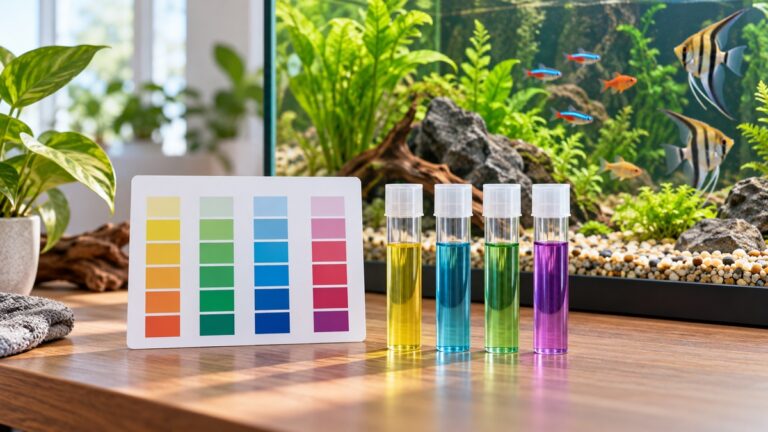
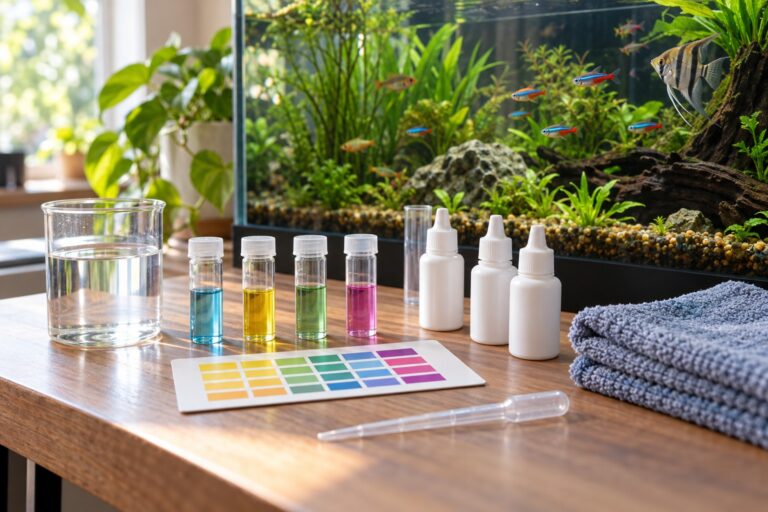
- Test the water. Ammonia is “colorless and, even at levels toxic to fish, odorless,” so a test kit is the only reliable way to know it is there.
What the nitrogen cycle is
Fish produce ammonia as a waste product. UF/IFAS describes the biological process that removes it: “A biological process called the nitrogen cycle (or nitrification) eliminates ammonia from water by converting it to a less toxic compound through a series of reactions.” In practice, one group of bacteria turns ammonia into nitrite, and a second group turns nitrite into nitrate.
The step that matters most for a new tank is nitrite. The UF/IFAS publication states that “Nitrite is toxic to fish at levels as low as 0.10 mg/L.” A tank that has ammonia but no bacteria to handle it can therefore develop a second problem as soon as the first bacteria start working.
Ammonia is also harmful at lower levels than most beginners expect. The same source says that “At low concentrations, ammonia causes stress and damages gills and other tissues.” Cycling is therefore about protecting the fish, not only about the numbers on a test strip.
Why the timeline cannot be skipped
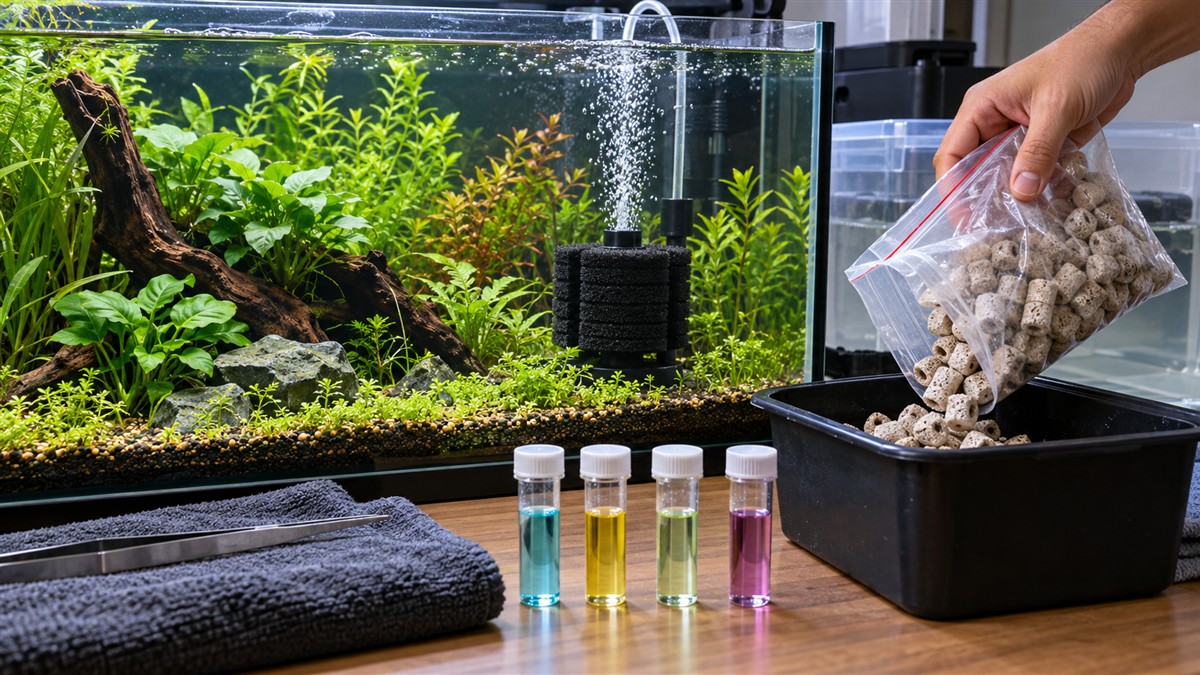
The bacteria need a surface to live on. UF/IFAS explains that in a tank, “a biological filter (“biofilter”), must be provided as a place where the bacteria can colonize and flourish.” Those bacteria also depend on conditions in the water. The source says that “Both groups of nitrifying bacteria (AOBs and NOBs) need oxygen and alkalinity to function.” If oxygen is low, the bacteria can stop working, and ammonia and nitrite rise again.
Population is the other limit. Merck explains that “Adding too many fish at once will overwhelm the available bacteria, and toxins will build up quickly.” That is why the same source advises adding fish gradually. Its wording is that “it is best to add fish gradually, 1 or possibly 2 at a time, to allow the bacterial colonies to grow to a level that can balance the amount of waste.”
The table below puts the two timelines side by side. The sources do not agree exactly, so the difference is shown rather than averaged.
| Source | Timeline stated | What it says about speeding up |
|---|---|---|
| UF/IFAS, Ammonia in Aquatic Systems (FA031) | “six to eight weeks” for a new biofilter | Ammonia-binding products help “in the short term,” but the source calls a properly sized biofilter the long-term answer. |
| Merck Veterinary Manual, Providing a Home for Fish | “4 to 6 weeks” for bacteria to develop on their own | “Commercial products may speed up the process slightly, but these are not necessary for most home aquariums.” |
What the sources say helps during a cycle
The UF/IFAS source gives a clear first step when ammonia is detected: “The first thing to do when ammonia is present in a pond or tank is to reduce or stop feeding.” Uneaten food is a major source of waste, so feeding less gives the bacteria time to catch up. The same source notes that stopping food for a short period “will not typically have a negative effect on fish,” though it is written for a wider range of fish than bettas.
Water changes are the second tool. The UF/IFAS publication says that “In tank systems, water changes and the use of ammonia-binding products can alleviate ammonia toxicity in the short term.” It adds that “for long-term management, it is best to establish a properly designed and sized biofilter.” In other words, a water change buys time, and a working biofilter is the lasting fix.
Oxygen matters too. The UF/IFAS source advises that “it is important to monitor dissolved oxygen and take steps to increase oxygen if it falls below 5 mg/L.” The sources we opened do not describe specific equipment for raising oxygen in a betta tank.
Medicines are a hidden risk during cycling. UF/IFAS warns that “Some chemicals used to treat diseases in fish, especially antibiotics, can be detrimental to the nitrifying bacteria in the biofilter.” If a fish is sick and you are considering a treatment, that warning means the water should be tested more often afterward. Do not dose medicines based on this guide. Ask an experienced fish keeper or an aquatic vet first.
How to check progress without guessing
A test kit is the only way to know how a cycle is going. The UF/IFAS source explains that “a good ammonia test kit will include a TAN test, a pH test, and a thermometer.” TAN means total ammonia nitrogen. The more toxic form, un-ionized ammonia, depends on pH and temperature, so a kit that measures only one number gives an incomplete picture.
Track readings over time rather than reacting to one result. A tank that is still cycling will show ammonia or nitrite that does not stay at zero. Once the bacteria are established, the readings should stop climbing, but this guide does not provide a single reading that proves a cycle is complete, because the sources we opened do not give one.
If you are planning a betta setup, the tank size and heater also affect how the water behaves. For tank size, see how big of a tank do betta fish need. For a broader checklist, read the best way to set up a betta tank.
When to ask for help
Merck Veterinary Manual states that “Poor water quality is the most common cause of environmental-related diseases in fish.” If fish gasp at the surface, look lethargic, or show changes in color or fin condition during a cycle, test the water first and then contact an experienced fish keeper or an aquatic vet. The sources do not give a home treatment for these signs, and this guide does not either.
Plan ahead. Buy the test kit before the fish arrives, not after the first problem. Keep a simple log of feeding, water changes, and readings. That record is useful if you need to explain the situation to a vet.
How we chose
This guide uses only sources opened on 2026-10-24: a UF/IFAS publication on ammonia in aquatic systems and a Merck Veterinary Manual page on providing a home for fish. University and veterinary references were preferred because they explain the mechanism and can be checked. Retail product pages and listings were not used. No product is recommended, and no prices or ratings are included. Where two sources gave different timelines, both are shown.
What we could not verify
The sources we opened do not answer every question a beginner asks about cycling. The gaps below are listed so you do not assume they are settled.
What the sources do not say
- Whether any specific bottled bacteria product shortens cycling in a betta tank. The sources only say that commercial products may help slightly.
- A single reading for ammonia or nitrite that proves a cycle is finished.
- How fishless cycling compares with cycling with fish present, because neither source compares the two methods.
- Whether the timelines above apply exactly to very small tanks.
Frequently asked questions
Can I add fish on day one to speed up the cycle?
The sources point the other way. Merck says that adding too many fish at once “will overwhelm the available bacteria, and toxins will build up quickly.” If you add fish, add one or two and test the water before adding more.
Does a bacteria product replace the need for a biofilter?
No. The UF/IFAS source calls ammonia-binding products a short-term help and says a properly sized biofilter is the long-term solution.
How long does a betta tank take to cycle?
The sources give four to six weeks (Merck) and six to eight weeks (UF/IFAS) for a new biofilter. Those figures are general, not betta-specific, so test the water rather than relying only on the calendar.
Should I stop feeding my fish while the tank cycles?
If ammonia is present, the UF/IFAS source says the first thing to do is “to reduce or stop feeding.” Feeding routines should be discussed with an experienced fish keeper or aquatic vet if the fish is already showing signs of stress.
Is a higher temperature a way to cycle faster?
The sources do not recommend raising temperature to speed up cycling. Their temperature guidance is about keeping conditions suitable for the species. A warm, unfiltered tank can also allow ammonia to become more toxic, because the un-ionized share of ammonia rises with temperature and pH.
Sources
- University of Florida IFAS Extension, “Ammonia in Aquatic Systems” (FA031), https://edis.ifas.ufl.edu/publication/FA031, opened 2026-10-24.
- Merck Veterinary Manual, “Providing a Home for Fish,” https://www.merckvetmanual.com/all-other-pets/fish/providing-a-home-for-fish, opened 2026-10-24.