Nitrate Water Tester: What Nitrate in Betta Tank Water Means
As an Amazon Associate we earn from qualifying purchases. Details
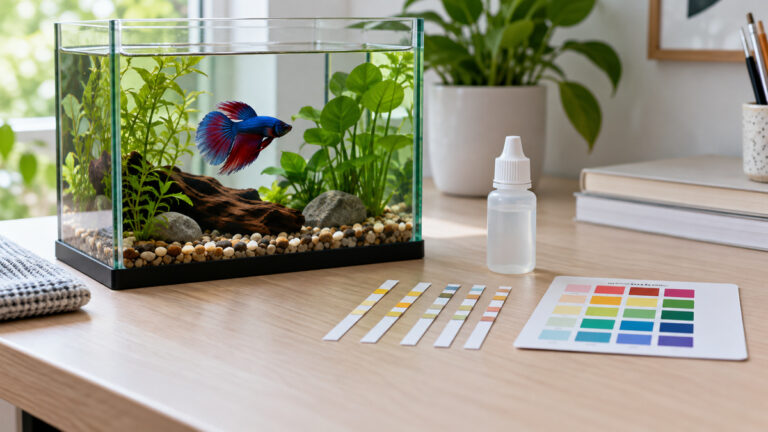
A nitrate water tester gives you a number for nitrate in betta tank water. The person typing “nitrate water tester” usually wants to know whether that number is safe for their fish and what to do if it is high. The sources checked for this post agree on three points. Nitrate is much less toxic than ammonia or nitrite. It can still build up in a closed tank with little water exchange. Water changes and plants are the main ways the sources name for lowering it. None of the sources gives a safe nitrate number for betta tanks, so treat any reading as a trend to watch rather than a pass or fail mark.
Quick answer
- Nitrate is the end product of the nitrogen cycle in a tank. UF/IFAS calls it “a less toxic by-product of nitrification.”
- UF/IFAS notes that “Traditionally, nitrate has been considered non-toxic to fish even at levels up to 200 mg/L,” and that “more recent research is showing nitrate may be more detrimental than previously believed.”
- Nitrate builds up when there is little exchange. The sources name water changes, and plants that take up nitrate, as ways to lower it.
- No source checked gives a betta-specific nitrate target. Keep a record of the readings from your nitrate water tester and watch the trend.
Where nitrate in betta tank water comes from
Fish produce ammonia through their gills and waste, and bacteria in the tank change it in stages. UF/IFAS describes the process this way: “The ammonia excreted by fish is converted to a compound called nitrite.” The same source explains that nitrifying bacteria then convert nitrite to nitrate. Merck puts it in plainer words: “Another type of bacteria then consumes the nitrites to produce nitrates.”
The order matters for reading a nitrate test. Nitrite is the step before nitrate, and it is the more dangerous one. UF/IFAS states that “Nitrite is toxic to fish at levels as low as 0.10 mg/L.” Nitrate is the step after that, and the same source describes it as the less toxic end product. A nitrate reading tells you where the tank is in the cycle, but it does not tell you how much stress the fish has already felt from earlier ammonia or nitrite.
Uneaten food and fish waste keep feeding the cycle. Merck lists the sources of waste in an aquarium as “solid wastes, such as uneaten food, decaying plant matter, and fish feces, or chemical wastes that the fish excrete” and names ammonia as the main chemical one. This is one reason the same source calls frequent water changes important in small tanks.
The nitrate numbers in the sources
The sources give a few concrete numbers. They are useful as context, but none of them is a betta target. The table below lists only what each source states.
| Value | What the source states | Source |
|---|---|---|
| 0.10 mg/L (nitrite) | “Nitrite is toxic to fish at levels as low as 0.10 mg/L.” | UF/IFAS FA031 |
| 200 mg/L (nitrate) | “Traditionally, nitrate has been considered non-toxic to fish even at levels up to 200 mg/L.” | UF/IFAS FA031 |
| 250 mg/L (nitrate) | “In closed systems with little or no water exchange, however, nitrate can accumulate to higher than 250 mg/L.” | UF/IFAS FA031 |
The 200 mg/L figure is the one most often quoted from the older view, and the same source says that view is being revised. The 250 mg/L figure describes closed systems with little or no water exchange in general, and the source does not give it as a betta number. A betta tank with a small volume and little exchange fits the general pattern the source describes, but the source does not place a betta tank on that scale.
Water changes, plants and filtration
Water changes are the lever the sources name most often. UF/IFAS says that in closed systems, “Water changes or separate denitrification systems are needed to remove nitrate from recirculating system water.” That wording is about recirculating systems, so it does not describe a betta tank exactly, but the principle carries over: exchanging water removes dissolved nitrate that the tank would otherwise keep.
Merck gives a more specific picture for small tanks. It states that “small aquariums, such as goldfish bowls and betta tanks, neither filtration nor a heater may be required,” and then adds that “more frequent water changes are needed, with more water being changed out as well—perhaps as much as 50% per week.” This site does not recommend bowls as a home for a betta, so the first half of that sentence should not be read as advice to skip the equipment. The second half, about water changes, is the part that matters for nitrate.
Plants are the second lever. Merck states that “Fortunately, nitrates can be used by plants and algae as food, or they can be removed by water filtration.” The sources checked do not present plants as a replacement for water changes, and they do not say how much nitrate a planted tank takes up, so a planted tank still needs to be tested.
Filter choice also matters for bettas. UF/IFAS says that “Bettas prefer calm water as shown by research using flow as a stressor, so heavy filtration may actually be harmful to a betta’s health and welfare.” A gentle filter that keeps the water clean without strong current fits this advice. Stronger filtration is not a substitute for water changes, and the same source says that “Aquariums of limited volume and reduced filtration should be managed to include frequent water changes so that uneaten feed as well as ammonia and other dissolved wastes are not allowed to reach harmful levels.”
Tank size is part of the picture. The site’s guidance is a heated, filtered tank of 5 gallons or more, and the internal guide on whether a 5 gallon tank is good for a betta covers that question in more detail. None of the three sources checked states the 5-gallon figure, so it is site guidance, not a figure taken from these sources. Smaller tanks often need more frequent changes to keep nitrate and ammonia from building up, which is the point Merck makes about small aquariums.
How to use a nitrate water tester
A nitrate water tester is only useful if you read it over time. UF/IFAS advises to “Keep records for all tests and monitor trends.” A single high reading after a missed water change tells you something different from a reading that climbs week after week with no change in routine. Writing down the date, the reading and the water change size makes the trend visible.
Merck recommends building testing into normal care: “Having your own testing kit also lets you include water quality testing as part of routine water changes and cleanings, including filter medium changes.” That approach fits a betta owner well, because the test and the water change happen together and the result is recorded at the same time.
Merck also states that “water quality is the most common cause of environmental-related diseases in fish.” The same source advises that “The water quality should always be tested before adding fish to the aquarium or pond to ensure that the water conditions are optimal.” If a betta is showing signs of illness, a nitrate reading alone is not a diagnosis. The sources recommend working with a fish veterinarian. UF/IFAS states that “Proper diagnostics will be facilitated by working with a fish veterinarian.”
For a kit-by-kit comparison of test products, see the internal guide Best Api Freshwater Master Test Kit Chart. This post does not rank or compare nitrate testers, because none of the sources checked does.
How we chose
The sources were chosen for this post because they cover nitrate or the nitrogen cycle directly, and because they come from a university extension service or a veterinary reference rather than a retailer. UF/IFAS FA212 is the only betta-specific source checked. UF/IFAS FA031 is written for aquaculture and aquarium systems in general, and it gives the nitrate figures used in the table above. The Merck Veterinary Manual page is a pet owner version of general fish husbandry. Product listings and retail pages were not used as sources for any fact in this post.
The selection criteria were simple. A source had to be opened and read in full on the day of writing, it had to discuss nitrate or the nitrogen cycle in a way that could be quoted, and it had to be a non-retail source. Quotes were checked against the downloaded text before use.
What we could not verify
Several parts of a nitrate question could not be checked against the sources opened for this post. They are listed below rather than estimated.
What the sources do not say
- No source checked gives a safe or target nitrate level for a betta tank. The figures quoted above come from aquaculture and general closed-system discussions.
- No source checked gives a water change schedule for a betta specifically. Merck’s “perhaps as much as 50% per week” refers to small aquariums in general.
- No source checked compares nitrate test strips with liquid nitrate test kits, and none describes a nitrate test method for betta tanks.
- No source checked says how much nitrate a planted betta tank removes in a given week.
- The sources do not say how to read a nitrate result together with pH or temperature. The only pH and temperature method in the sources checked is for un-ionized ammonia, not nitrate.
Frequently asked questions
Is nitrate in betta tank water dangerous?
The sources describe nitrate as much less toxic than ammonia or nitrite. UF/IFAS notes that nitrate was “traditionally” considered non-toxic up to 200 mg/L, and that newer research suggests it may be more harmful than that view. For a betta, the sources do not give a safe number, so the practical answer is to keep nitrate low with regular water changes and to watch the trend on your nitrate water tester.
Will live plants lower nitrate in a betta tank?
Merck says nitrates “can be used by plants and algae as food.” That supports the idea that plants take up nitrate, but the source does not say how much or how quickly. A planted tank should still be tested, and it should not be treated as a replacement for water changes.
How often should I do a water change for nitrate?
Merck says small aquariums need “more frequent water changes,” and gives a figure of “perhaps as much as 50% per week” for those tanks. The source does not set a schedule for a betta tank of a given size. A reasonable approach, consistent with the sources, is to test regularly, keep a record, and change more water when the reading rises.
Does a stronger filter lower nitrate faster?
Not according to the sources checked. UF/IFAS states that “heavy filtration may actually be harmful to a betta’s health and welfare.” Bettas prefer calm water. A gentle filter that keeps the tank clean is the sourced choice, and water changes remain the main way to remove dissolved nitrate.
Can a nitrate reading tell me if my betta tank is cycled?
A nitrate reading shows that nitrification has reached the nitrate step, but the sources checked do not say that a nitrate number alone proves a tank is cycled. UF/IFAS notes that a new biofilter “requires six to eight weeks” to build up bacteria that reduce ammonia and nitrite. Testing ammonia and nitrite as well gives a fuller picture than nitrate by itself.
Sources
- UF/IFAS Extension, “Evolution, Culture, and Care for Betta splendens” (FA212), https://edis.ifas.ufl.edu/publication/FA212, opened 2026-10-24.
- UF/IFAS Extension, “Ammonia in Aquatic Systems” (FA031), https://edis.ifas.ufl.edu/publication/FA031, opened 2026-10-24.
- Merck Veterinary Manual, “Providing a Home for Fish,” https://www.merckvetmanual.com/all-other-pets/fish/providing-a-home-for-fish, opened 2026-10-24.