What pH Do Bettas Like? Sourced Facts and Gaps
As an Amazon Associate we earn from qualifying purchases.
The person typing “what pH do bettas like” wants a number for the tank. The sources opened for this guide do not give a pH target for a home aquarium. The one measured figure they contain comes from a wild betta population in Thailand, where IFAS recorded “pH of 5.47 (range from approximately 5.28 to approximately 5.80).” That is habitat data, not a recommendation for a tank. The more useful answer is that pH should be tested and kept stable, because pH changes how toxic ammonia is, and the sources explain why.
Quick answer
- The opened sources give no home-tank pH target for bettas.
- A wild Thai habitat reading was pH 5.47, with a range of about 5.28 to 5.80, per UF/IFAS.
- Higher pH and higher temperature mean more un-ionized, more toxic ammonia, according to UF/IFAS.
- Test pH with a kit and keep it steady, since sudden swings stress fish.
The habitat figure and what it means
The UF/IFAS betta publication reports the habitat of a Thai population. It says: “Specific habitat characteristics for a betta population in Thailand are pH of 5.47 (range from approximately 5.28 to approximately 5.80), temperature of 29.9°C (about 86°F on average; range from approximately 27.0 to approximately 31.5°C), and depth of about 5.0 cm.” It also describes the habitats generally as having “an acidic pH.”
That is a field measurement. It shows the water a wild betta lived in, but it does not show what pH a betta prefers, what it tolerates, or what suits an aquarium. Water in a home tank is also set by the tap source, the filter, the substrate and the additives. A wild reading cannot be copied into a tank without a test.
Why stability matters more than a single number
The UF/IFAS ammonia publication explains why pH matters for fish. It says that “The portion of un-ionized ammonia increases with increasing pH and/or temperature,” and that “At high temperatures and high pH, there is more UIA.” UIA is the un-ionized form, which the source calls the more toxic part of total ammonia.
The same publication warns about falling pH too. It says that once alkalinity is depleted, pH can fall significantly and quickly, which can kill both fish and nitrifying bacteria. It also notes that “At a total alkalinity less than 20 milligrams per liter (mg/L), common species of nitrifying bacteria do not function effectively.” So the risk is not only a high pH. A quick drop or a quick rise is a problem too, and buffering is what keeps pH steady.
How pH links to ammonia
The IFAS ammonia publication says a pH test is part of any ammonia assessment. The relevant lines are that “a good ammonia test kit will include a TAN test, a pH test, and a thermometer,” and that “To determine UIA, three tests must be performed: TAN, pH, and temperature.” The table below lists the three inputs the source names, with what each one changes.
| Input | What the opened source says | Source |
|---|---|---|
| pH | Higher pH increases the un-ionized, more toxic share of ammonia | UF/IFAS FA031 |
| Temperature | Higher temperature also increases the un-ionized share | UF/IFAS FA031 |
| Alkalinity | Below 20 mg/L, nitrifying bacteria do not work well; pH can drop quickly | UF/IFAS FA031 |
| Tap water | pH “varies greatly from well to well or city to city” | Merck Veterinary Manual |
The Merck page also says tap water pH “varies greatly from well to well or city to city.” That is why a test on your own water matters more than any published figure.
Testing and keeping pH steady
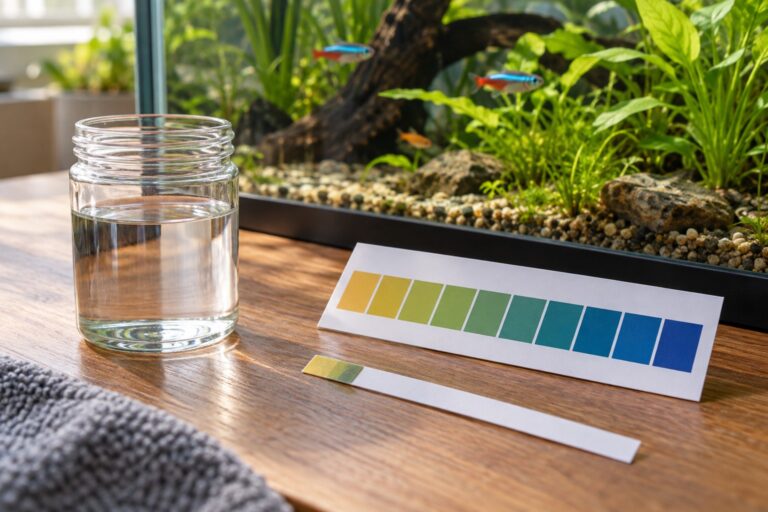
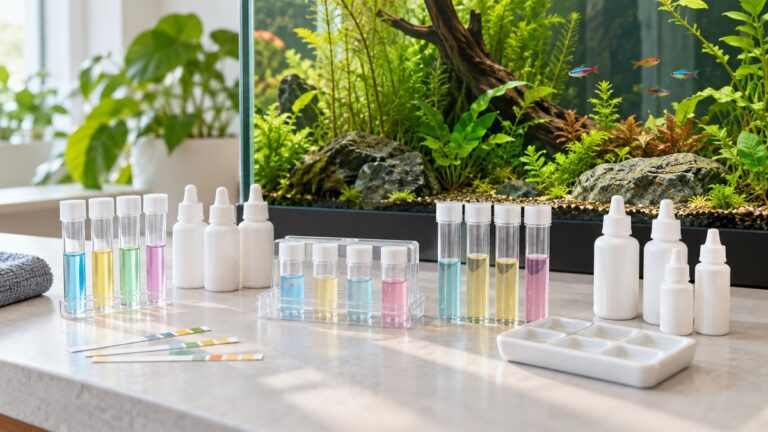
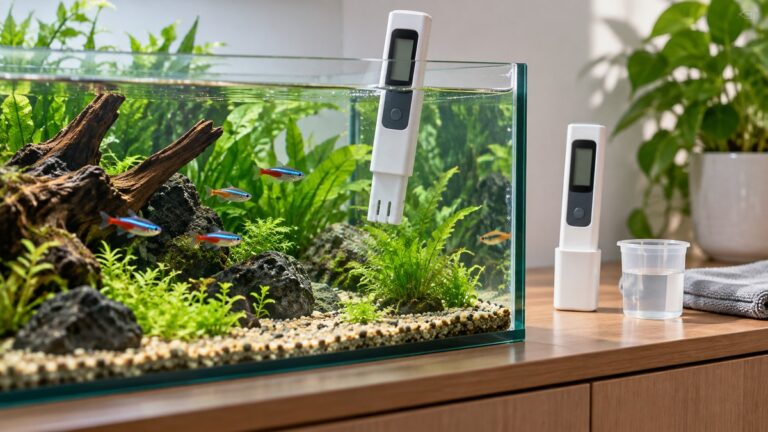
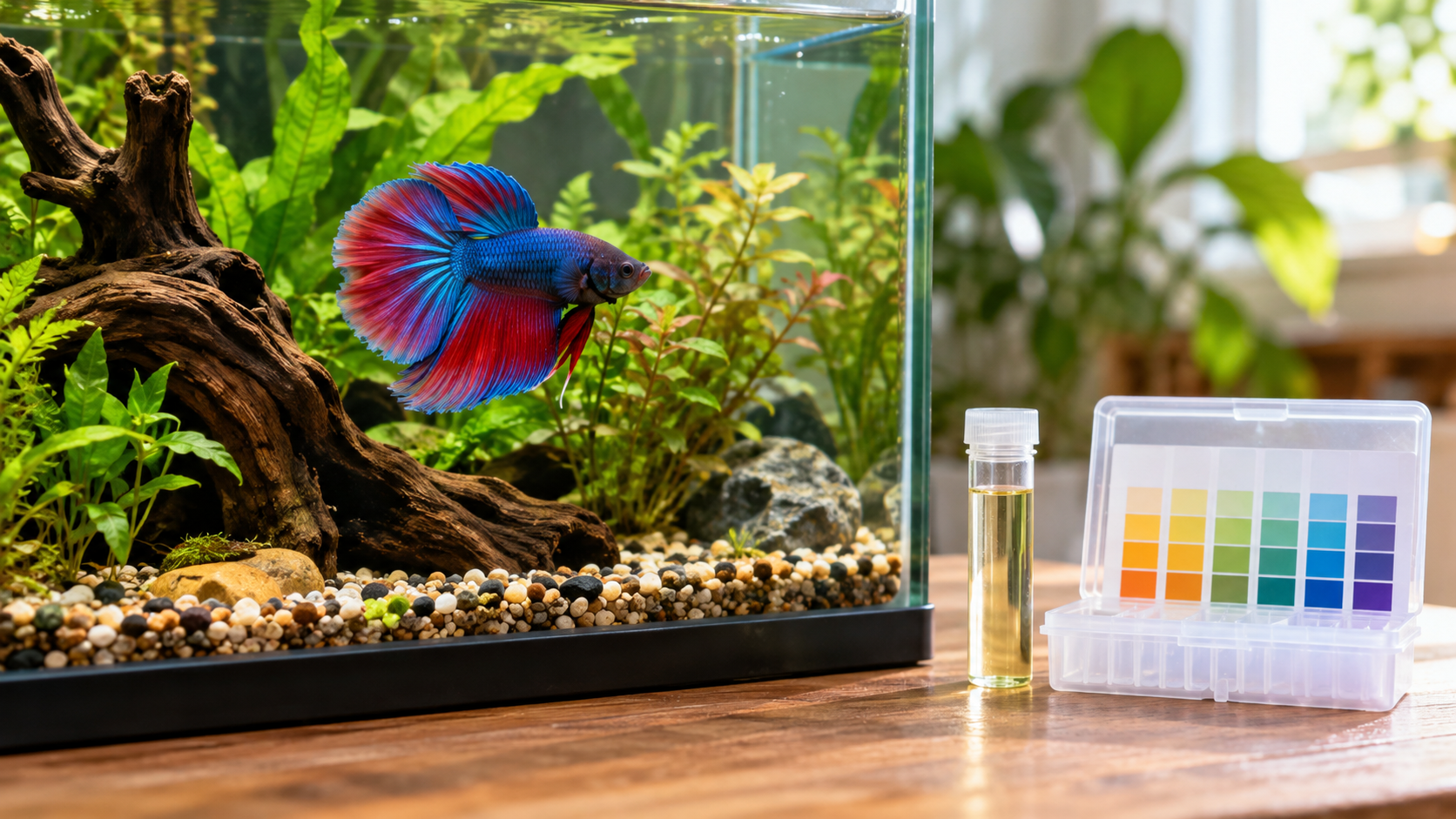
The practical step is to test. The Merck page says the level “can easily be checked with one of many easy, inexpensive, and readily available home test kits.” It also says water quality “should always be tested before adding fish to the aquarium.” A test kit that measures pH is the minimum, and the ammonia source adds a thermometer to the set.
For choosing a kit, see the freshwater test kit guide. For a thermometer, which the ammonia source names as part of the test set, see the betta thermometer guide.
Keep pH steady rather than chasing a number. The Merck page notes that commercial salts “help buffer it to keep the pH stable,” but that describes marine salt, and the page does not recommend it for bettas. Changes should be gradual, and the water used for a change should be tested first. Those steps are general guidance that follows from the sources.
Using the ammonia table with a pH reading
The IFAS ammonia publication shows how the pH reading is used. It says to “multiply the total ammonia nitrogen (TAN) by the appropriate factor selected from this table using the pH and temperature from your water sample.” The factor depends on both pH and temperature. A pH reading is therefore one input to a calculation, not a standalone result.
The sources do not say what pH level is safe for a betta, so a calculated figure cannot be turned into a sourced pass or fail for a betta tank. What the sources do support is the method: measure TAN, pH and temperature together, and read the result with the table. That is a practical way to check the water without judging from one number.
How we chose
The criteria for this guide were set before the reading. The sources had to be university or veterinary references that discuss betta biology, water chemistry or fish husbandry. Retail pages were excluded, and no product or brand is recommended. Each quotation was checked against the text of a page opened on 2026-10-24.
What we could not verify
The sources do not give a home-tank pH target for bettas. They give a wild habitat measurement and a general explanation of how pH interacts with ammonia and buffering. Any single number for a home tank needs a betta-specific source before it can be stated as a fact.
What the sources do not say
- A home-tank pH target or range for betta fish.
- Whether bettas tolerate or prefer acidic or alkaline water.
- How fast pH can change before a betta is harmed.
- Which buffer or additive is appropriate for a betta tank.
Frequently asked questions
What is the ideal pH for a betta fish?
The opened sources do not give an ideal pH for a home tank. The only figure is a wild habitat reading of 5.47 from a Thai population, which is not a target. Test your water, and keep the pH steady.
Are bettas fine in acidic water?
The sources describe the wild habitat as acidic, but they do not say bettas do well in acidic water in a home tank. The habitat fact is context. It does not settle the question.
Does pH affect ammonia in a betta tank?
Yes, according to the UF/IFAS ammonia publication. It says the un-ionized fraction of ammonia rises with pH and temperature, and that un-ionized ammonia is the more toxic form. A pH test is part of any ammonia check.
Should I add a pH buffer to my betta tank?
The sources do not recommend a buffer for bettas. The Merck page describes buffering in the context of marine salt, and the IFAS text explains that alkalinity protects pH. Whether a buffer is needed depends on the test results.
What pH test kit should I use for a betta?
The sources do not rank kits, and this guide does not name one. The IFAS ammonia text says a good ammonia kit includes a TAN test, a pH test and a thermometer. Check that a kit covers those tests before buying.
Sources
- Evolution, Culture, and Care for Betta splendens (UF/IFAS FA212), opened 2026-10-24.
- Ammonia in Aquatic Systems (UF/IFAS FA031), opened 2026-10-24.
- Providing a Home for Fish, Merck Veterinary Manual, opened 2026-10-24.