How Do You Know if a Betta Fish Is Dying?
As an Amazon Associate we earn from qualifying purchases.
How do you know if a betta fish is dying? A betta that is dying usually shows changes before it stops moving. The sources describe a group of signs that point to serious illness or poor conditions: lethargy, loss of appetite, rapid breathing, pale color, and in some diseases bloody spots or ulcers on the body. The Merck Veterinary Manual says that among parasite infections, “Other signs include loss of appetite, lethargy, and a tendency for affected fish to scratch against rocks or other hard objects.” No single sign confirms death is near, so the useful question is whether the fish is declining and why.
Quick answer
- Warning signs in the sources include lethargy, loss of appetite, rapid or shallow breathing, paleness, and bloody spots or ulcers.
- Check the water first. The UF/IFAS ammonia publication says to test “immediately any time fish appearance or behavior changes.”
- If the fish is declining, consult an experienced fish keeper or an aquatic veterinarian. The sources say emergency treatment for pet fish is not as readily available as it is for dogs and cats.
- The sources do not define a point at which a betta is dying, and they do not give a diagnosis from a photo or description.
Signs of a betta in trouble
The Merck Veterinary Manual’s disorders page lists several signs that show up across fish diseases. For many parasites, the page says “Other observations may include rapid breathing, piping (swimming near the surface of the water, trying to gulp air), flashing (scratching), and loss of condition.” Piping, where a fish gulps at the surface, is a sign of breathing trouble and is worth watching closely in a betta. Flashing, where the fish rubs or scratches against objects, also points to irritation on the skin or gills.
Lethargy is one of the most general signs. The Merck page says of one parasite that “Heavily infested fish may lose weight and appear lethargic.” Lethargy also shows up in poor-water situations. For carbon dioxide, the page says “Fish exposed to high levels of carbon dioxide appear lethargic and nonresponsive,” and adds that “Fish become pale, and their breathing becomes rapid and shallow.” A fish that sits low, does not respond, and breathes quickly is showing a pattern the sources connect with a serious problem.
Skin signs matter too. The page on bacterial disease says that Aeromonas infection, the most common bacterial infection of freshwater aquarium fish, “may show signs that include bloody spots or ulcers on the body.” Other diseases produce cotton-like growths or yellowish spots. The sources do not say which sign goes with which disease in a betta, so a spot or growth needs a proper diagnosis rather than a guess.
Check the water before anything else
Many illnesses and deaths in home aquariums start with the environment. The Merck disorders page says that “Many of the disorders and diseases that are known to occur in fish are the result of stress, poor water quality, overcrowding, and failure to quarantine any new or sick fish.” The UF/IFAS publication FA005, “Stress—Its Role in Fish Disease,” says “Poor water quality is a common and important STRESSOR of cultured fish and precedes many disease outbreaks.”
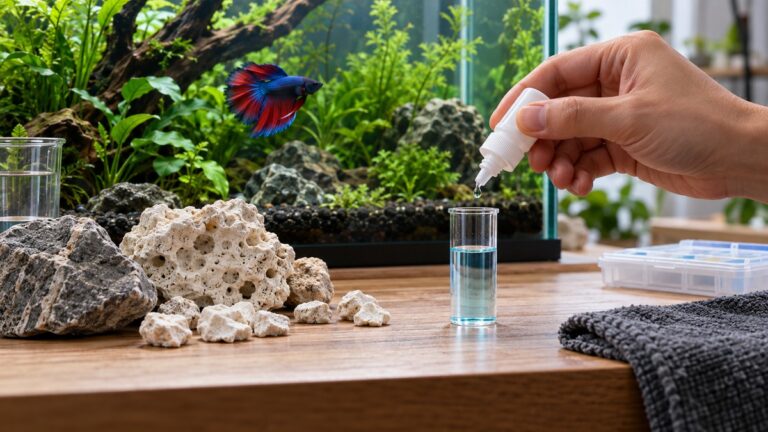
The practical step is a water test. The UF/IFAS ammonia publication, FA031, says “Ammonia is colorless and, even at levels toxic to fish, odorless. Therefore, the only way for a producer or aquarist to know if ammonia is present is to test the water.” It also says that “If fish show any signs of abnormality, water quality should be tested immediately in that individual tank.” Ammonia and nitrite are the two readings to check first. For background on what those readings mean, see what kind of water for betta fish.
Temperature belongs on the list as well. A tank that has cooled, or a heater that has failed, can produce the lethargy and poor appetite described above. The guide on whether a betta fish needs a heater explains the heater side of this.
What to do if your betta is declining
Start with what you can check today. Test the water and note the readings. Look at the fish’s appetite, breathing, color and whether it is moving normally. Remove uneaten food, since the sources say feeding problems and “water fouling” are common causes of trouble. The UF/IFAS betta publication, FA212, says “proper storage and feeding regimens—avoiding overfeeding and water fouling—as well as clean sources of live feeds are very important considerations.”
If the signs continue, ask for help from a person with fish knowledge. The UF/IFAS betta publication says “If a disease outbreak does occur, proper diagnostics, including working with a fish veterinarian, will be key to successful management.” It also gives a route to find one: “contact your local veterinarian, who may work with fish, or who may be able to recommend a colleague who does.” The American Association of Fish Veterinarians has a locator. A diagnosis from a description is not reliable, and the sources warn that “Many drugs and chemicals can do more harm than good if they are used inappropriately.” This guide does not give medication instructions for that reason.
Isolation can help with observation, but it is not a cure. The Merck page on routine health care describes quarantine as “keeping new or sick animals in a separate aquarium for a specific amount of time before joining others.” A betta that is clearly unwell should not share water or equipment with other fish.
How we chose
We chose sources that describe fish disease and water quality in general, because the sources do not give a betta-specific list of signs of death. The Merck Veterinary Manual pages on disorders, emergencies and routine care are written for fish owners and credit veterinarians as authors. The UF/IFAS publications FA005 and FA031 are university extension documents on stress and ammonia. We did not use retail pages, product listings or blog posts, and we did not use a betta forum as a factual source.
What we could not verify
The sources describe disease signs across many fish, and they do not say which signs a betta shows in each disease. They do not give a timeline from first sign to death, and they do not say how long a betta can decline before it dies. The sources also do not give a list of home remedies or a diagnostic checklist for bettas.
What the sources do not say
The sources do not say that a betta lying on the bottom is dying, and they do not say a betta with clamped fins has a specific disease. Those are common descriptions in hobby writing. They are not confirmed in the sources we opened, so do not treat them as a diagnosis. The sources also do not describe the signs of old age in a betta.
Frequently asked questions
What are the first signs a betta is sick?
The sources list loss of appetite, lethargy, rapid breathing, and loss of condition as general signs. Skin changes such as bloody spots, ulcers or cotton-like growths point to specific diseases. Any sudden change in behavior is worth checking, and the UF/IFAS ammonia publication advises testing water right away when appearance or behavior changes.
Why is a betta resting at the bottom of the tank?
The sources do not give a single cause for a betta resting at the bottom. The Merck page links lethargy to several conditions, including parasites and high carbon dioxide, so check the water and the fish together. A fish that stays in one place and does not eat should be examined by someone with fish experience.
Can a betta recover from being sick?
Some do, but the sources do not give recovery rates for betta illnesses. The Merck page notes that if a veterinarian with fish experience is nearby, some physical trauma to fish “can possibly be treated,” but it also says emergency medical treatment for pet fish is “not as advanced or as readily available as it is for dogs and cats.”
Should a sick betta be moved to a separate tank?
Separating a sick fish helps with observation and reduces the spread of disease. The Merck quarantine description supports this, but the sources do not give a single isolation period for bettas, and they do not recommend treatments for an isolated fish.
What water test readings should worry me?
The UF/IFAS publication says nitrite is “toxic to fish at levels as low as 0.10 mg/L,” and that ammonia toxicity rises with pH and temperature. Any measurable ammonia or nitrite is a reason to act, and the sources recommend testing more often until the problem is corrected.
Sources
- Merck Veterinary Manual: Disorders and Diseases of Fish (opened 2026-10-24)
- Merck Veterinary Manual: Emergencies of Fish (opened 2026-10-24)
- UF/IFAS EDIS FA031: Ammonia in Aquatic Systems (opened 2026-10-24)
- UF/IFAS EDIS FA005: Stress—Its Role in Fish Disease (opened 2026-10-24)
- UF/IFAS EDIS FA212: Evolution, Culture, and Care for Betta splendens (opened 2026-10-24)