Betta Fish Tank Setup
As an Amazon Associate we earn from qualifying purchases.
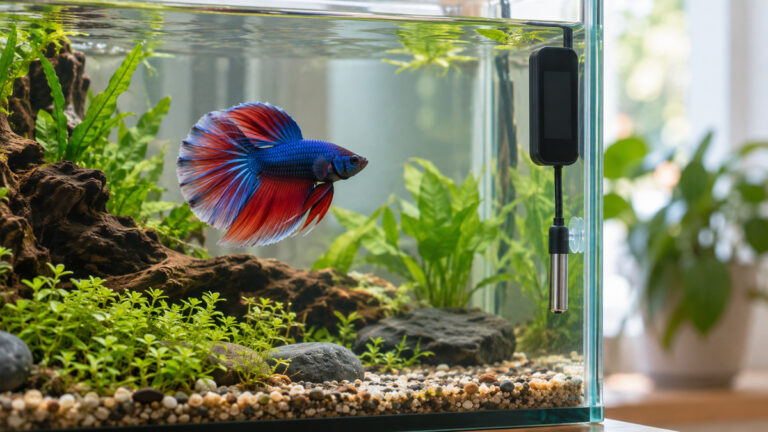
A betta fish tank setup should give the fish a heated, gently filtered tank with stable water. The UF/IFAS extension publication says bettas “thrive in warmer water and do not do well in cold water,” and it warns that heavy filtration can harm them. A Merck Veterinary Manual passage says small betta tanks may need neither filter nor heater. This guide follows the heated, filtered setup and explains where the sources disagree and what they leave out.
Quick answer
- Use a heater. UF/IFAS says bettas “thrive in warmer water and do not do well in cold water.”
- Choose a filter with low or adjustable flow. UF/IFAS says “heavy filtration may actually be harmful to a betta’s health and welfare.”
- Turn equipment on only after the tank is filled. Merck says “Filters, pumps, heaters, and lights should not be turned on until after the tank is filled with water.”
- Do not read the Merck small-aquarium line as approval for bowls. It is a general statement, and this guide does not use it to support bowls or vases.
Tank size
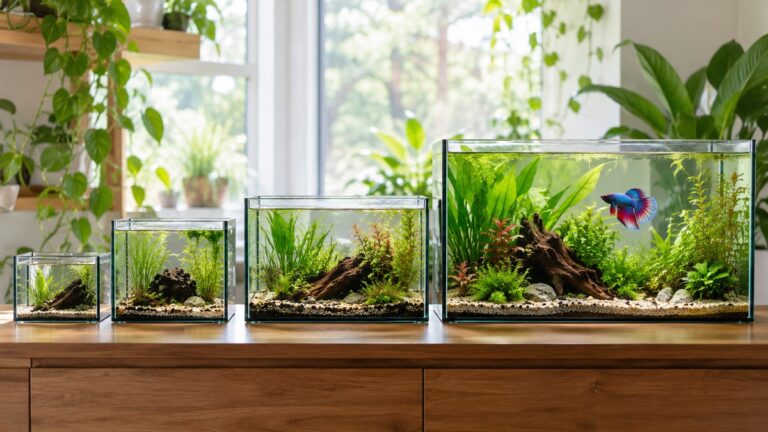
The sources opened for this guide do not give a minimum volume for a betta. UF/IFAS states that “water quality is not dependent on the size of the container, but rather on management and husbandry.” A bigger tank does not replace good maintenance. The same publication says “Aquariums of limited volume and reduced filtration should be managed to include frequent water changes,” so a smaller tank needs a maintenance plan from the first day.
The site planning rule for this guide is a heated, filtered tank of 5 gallons or more. None of the sources opened here states that number, so it is listed under what could not be verified rather than presented as a sourced fact. When comparing kits, check whether the listed capacity is total volume or usable water, because the two can differ.
Heater and temperature
UF/IFAS gives the clearest temperature point in the sources. Bettas “thrive in warmer water and do not do well in cold water.” It also gives a room-temperature threshold for one case: if bettas are kept in “an unfiltered, unheated container, the air temperature of the room should be maintained at no less than 22°C (71.6°F).” That figure applies to an unheated, unfiltered container, not to the heated, filtered tank this guide recommends. It does show that a cool room is a real risk for an unheated set.
The Merck passage points the other way. It says: “In small aquariums, such as goldfish bowls and betta tanks, neither filtration nor a heater may be required.” The word “may” makes this a possibility rather than a rule for bettas, and the same sentence names goldfish bowls as an example. This guide does not use it to support bowls, and the heated, filtered setup remains the recommendation.
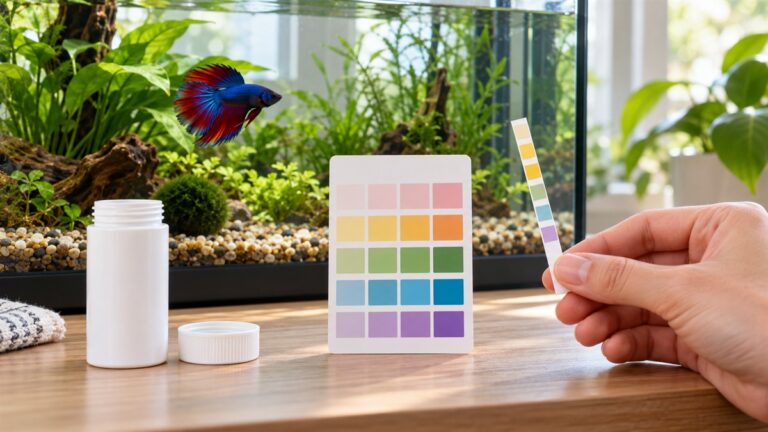
A commonly cited tank range is about 76 to 82 F (about 24 to 28 C). None of the sources opened here confirms that range, so treat it as general guidance and check the water with a thermometer. Heater wattage per gallon and adjustable settings are not in these sources. Take those details from the heater’s own listing or the manufacturer’s page.
Filter and water changes
UF/IFAS says: “Bettas prefer calm water as shown by research using flow as a stressor, so heavy filtration may actually be harmful to a betta’s health and welfare.” That points to a filter with low or adjustable flow. Merck supports filtration in general: “Filtration is important to remove waste and particulate matter.” The goal is to remove waste without a strong current. The sources opened do not give a flow rate that counts as gentle, so check whether the listing says the flow is adjustable.
Merck pairs its small-aquarium line with a water-change warning: “more frequent water changes are needed, with more water being changed out as well—perhaps as much as 50% per week.” That advice is for small tanks without filtration. This guide does not recommend an unfiltered tank, but the trade-off is worth knowing if a filter is not in use.
Placement and power safety
Plan outlet access before setup. Merck notes that there is “access to electrical outlets for the lights, filters, and pumps,” and advises that “In any case, you should consider a surge protector.” Keep the power off until the tank is full, as the quick answer above describes. These are general aquarium points from Merck, not betta-specific rules.
Decor and plants
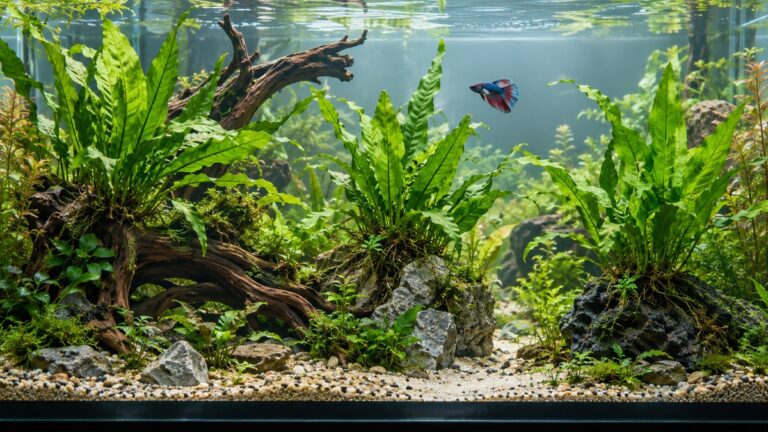
The Merck and MSD pages cover general aquarium decor rather than bettas. They say decorative objects are “not only aesthetically pleasing but also help” divide the tank and “allow fish to have their own territory.” They also advise that “Larger decorative objects, such as large rocks, coral skeletons, or driftwood, are easier to place before the tank is filled with water.” The sources do not say which decor or plants are safe for bettas. For plant options, see the live plants guide, which is a separate post and not a source for this one.
How we chose
The guide relies on non-retail sources: the UF/IFAS publication on betta biology and care, and the Merck and MSD Veterinary Manual pages on home aquariums for fish. Each quote was checked against text downloaded with curl on 2026-10-23. Retail and product pages were not used for facts. Where the sources conflict, the conflict is stated rather than resolved by picking the more convenient line. The welfare rules in the site brief set the recommended setup: heated, gently filtered, with no bowls and no vases.
What we could not verify
The points below are not covered by the sources opened for this guide.
What the sources do not say
- A minimum tank volume for bettas, including the 5-gallon figure in the site brief.
- A safe temperature range for a betta tank. The 76 to 82 F range is a commonly cited figure only.
- Heater wattage per gallon, filter flow rates, and whether a given filter’s flow is adjustable.
- Tank mates. UF/IFAS says “Males will almost immediately display aggressive behaviors” toward another male, but it gives no species guidance.
- Decor safety, sharp edges, and whether plastic or silk plants are safe for bettas.
- Plant care, including Asian water fern. No source for that plant was opened.
Frequently asked questions
What size tank does a betta fish need?
The sources opened here do not give a minimum volume, so this guide does not state one as fact. The site’s planning rule is a heated, filtered tank of 5 gallons or more, which these sources do not confirm. For more detail on size, read how big of a tank do betta fish need and what size tank does a betta need.
Does a betta fish tank need a heater?
This guide recommends one. UF/IFAS says bettas “thrive in warmer water and do not do well in cold water.” The Merck line that a heater “may” not be required for small tanks points the other way, and it does not support bowls. For the full answer, see do betta fish need a heater.
Does a betta tank need a filter?
Yes. The setup recommended here includes a gentle filter. Merck says filtration is important for removing waste, but UF/IFAS warns that heavy filtration may harm bettas. Choose a filter with low or adjustable flow, and check the listing for that detail, because the sources do not give a flow rate.
Can a betta live with other fish?
The sources opened here do not cover tank mates for bettas. UF/IFAS describes strong aggression between males, so this guide does not suggest keeping two male bettas together. Beyond that, the sources give no species guidance, and no tank-mate list is offered here.
Are plastic or silk plants safe for a betta tank?
The sources do not say. Neither the Merck nor the UF/IFAS text addresses plastic or silk plants, sharp edges, or artificial decor. Read any listing for edge or opening details before buying. For plant options, see the live plants guide.
Sources
- UF/IFAS, Evolution, Culture, and Care for Betta splendens (FA212), 2019: https://edis.ifas.ufl.edu/publication/FA212 (opened 2026-10-23)
- Merck Veterinary Manual, Providing a Home for Fish: https://www.merckvetmanual.com/all-other-pets/fish/providing-a-home-for-fish (opened 2026-10-23)
- MSD Veterinary Manual, Providing a Home for Fish (same text as the Merck page): https://www.msdvetmanual.com/all-other-pets/fish/providing-a-home-for-fish (opened 2026-10-23)