Can Betta Fish Live With Goldfish?
As an Amazon Associate we earn from qualifying purchases.
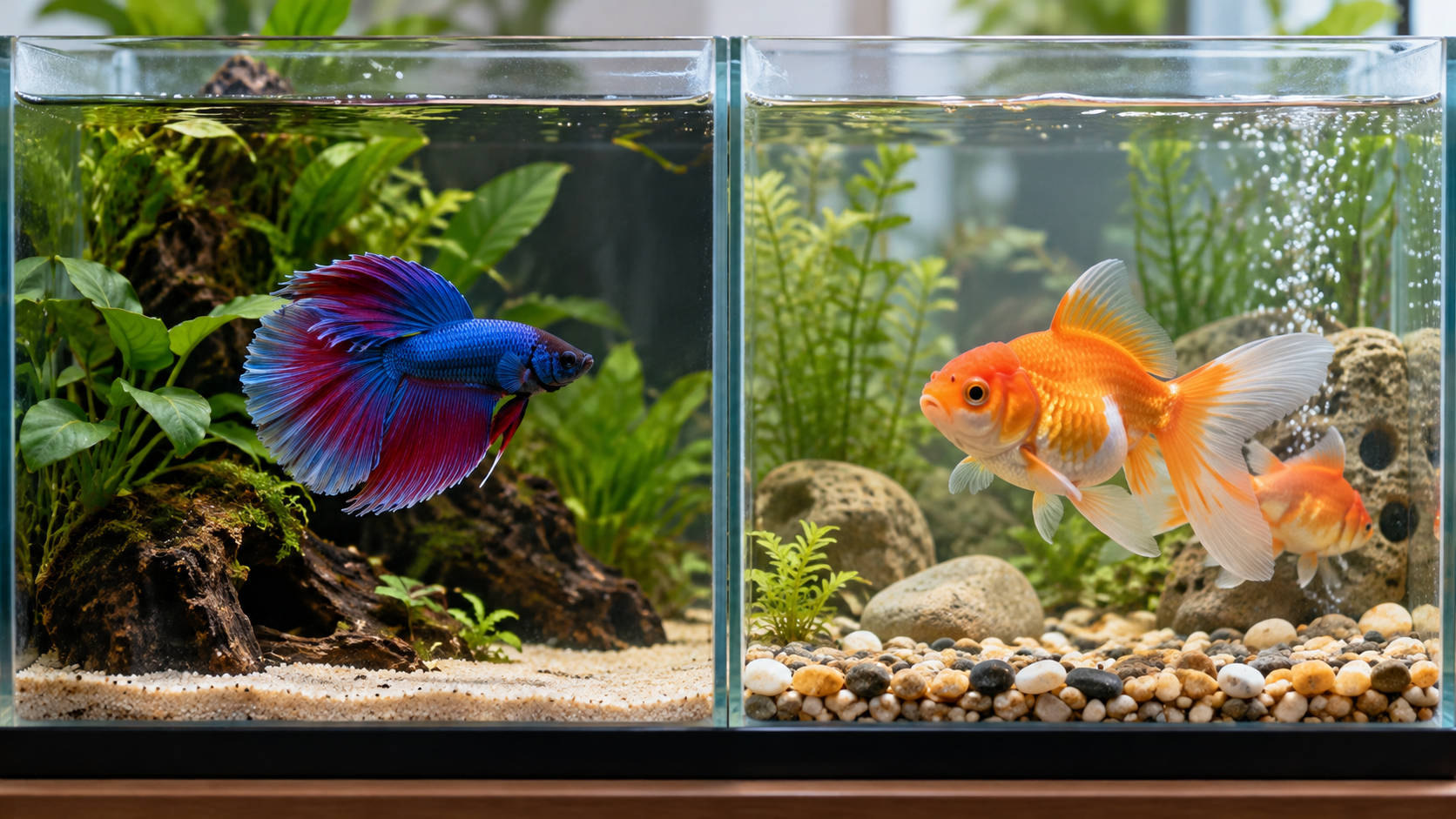
Can betta fish live with goldfish? In most cases, betta fish should not live with goldfish. The sources point to a basic mismatch: bettas are tropical fish that “thrive in warmer water and do not do well in cold water,” according to the UF/IFAS publication on betta care, while the Merck Veterinary Manual says “Goldfish and certain other temperate-water or cold-water fish do fine in water that is room temperature.” A tank that suits one species is unlikely to suit the other. The sources we opened do not study a betta and goldfish sharing a tank, so this answer rests on their temperature needs and their general notes on aggression, not on a direct trial of the pairing.
Quick answer
- The sources describe bettas as warm-water fish that do not do well in cold water, and describe goldfish as fine at room temperature.
- Merck says tropical fish need water “near 77°F (25°C),” while temperate species “do better at lower temperatures,” which makes a shared tank a conflict.
- Aggression toward new fish is a sourced general concern, and male bettas are described as highly aggressive.
- The sources do not study or describe a betta and goldfish pair, so the answer is a cautious no rather than a sourced ban.
The temperature conflict
Temperature is the clearest reason the pairing is a poor default. The UF/IFAS publication FA212, “Evolution, Culture, and Care for Betta splendens,” describes betta habitat as shallow, warm and low in oxygen. In its care section it says that “bettas thrive in warmer water and do not do well in cold water.” The same publication notes that bettas can be kept in small, unfiltered containers only if the room stays warm, since it gives a minimum room air temperature of “22°C (71.6°F)” for an unheated container.
Goldfish come from a different set of conditions. The Merck page on providing a home for fish says “Goldfish and certain other temperate-water or cold-water fish do fine in water that is room temperature.” Another Merck page, on special considerations, puts the contrast in one sentence: “Tropical fish need water kept near 77°F (25°C), while species from more temperate areas do better at lower temperatures.” A betta kept at a goldfish-friendly temperature would be running cooler than its native habitat. A betta kept at betta temperature would be warmer than a goldfish’s comfortable range.
The Merck pages add a related point about cold tanks. The page on providing a home for fish says “The ratio of fish to area should be reduced in a cold-water environment, such as ponds and goldfish tanks, because the beneficial bacteria do not function as well at lower temperatures.” That is a sourced statement about goldfish tanks, and it means a cold goldfish set-up has less biological filtering than a warm one. A betta tank needs its filter bacteria working well, and that is harder to guarantee in a tank set for goldfish.
For temperature background, see what temperature do betta fish like, which covers the warm-water target and heater choices in more detail.
Aggression and new fish
The second concern is behavior. The Merck page on providing a home for fish says that “When new fish are added to the aquarium, the current residents sometimes respond aggressively, chasing or attacking the new fish.” It also says “Aggressive behavior is stressful for all fish in the tank.” So even when two species can tolerate the same water, a new arrival can be chased or attacked. The sources describe this as a general pattern in community tanks, not a rule about any particular pair.
Betta behavior adds a specific worry. The UF/IFAS publication says that “betta males are among the most aggressive” labyrinth fishes, and it describes how males “will almost immediately display aggressive behaviors” toward other males, with fights that can progress to biting “particularly on the fins and flanks.” That description is about male bettas fighting one another. The sources do not say how a betta treats goldfish, but they give no reason to expect calm coexistence.
Goldfish are not described as a peaceful fit for the betta’s needs either. The sources do not describe goldfish as aggressive, but they describe the cold-water needs that make goldfish tanks differ from betta tanks. A tank that is a compromise between two needs is seldom the best home for either fish.
What a safer setup looks like
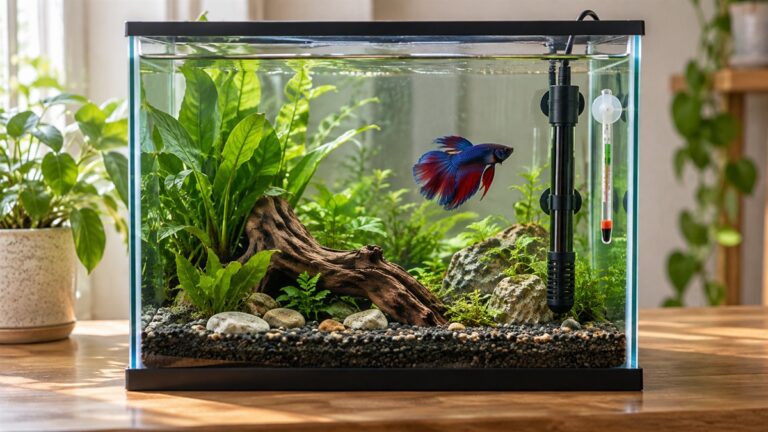
The sources point toward keeping each species in a set-up that suits it. For a betta, that means a warm tank with a thermostat-controlled heater and a separate thermometer, as the Merck page on providing a home for fish describes. It also means a filter that keeps the water clean without a strong current, since the UF/IFAS publication says bettas “prefer calm water” and that “heavy filtration may actually be harmful.” For tank volume, see how big of a tank do betta fish need.
If you want a betta and a companion in the same tank, check the companion’s temperature needs first. The sources do not describe a companion that meets both needs, so check each companion’s temperature and flow needs against a source before adding it. For companion ideas covered elsewhere on this site, see betta tank mates for a 20 gallon tank and tank mate for a male betta.
If you already have goldfish, a separate tank is the clearest path. The sources do not describe a shared set-up that satisfies both species, so a second tank, sized for the fish you keep, is the route that fits the temperature notes above. The Merck page on providing a home for fish also advises adding new fish slowly and quarantining them, because “failure to quarantine any new or sick fish” is one of the common causes of disease in aquarium fish.
How we chose
We chose sources that give a direct statement about water temperature, about aggression toward new fish, and about betta behavior. The three sources are the Merck Veterinary Manual pages on providing a home for fish and on special considerations for fish, and the UF/IFAS publication on betta evolution and care. We did not use retail pages, aquarium-kit listings or hobby forum posts for any factual claim.
What we could not verify
The sources do not study a betta and goldfish in one tank. They do not report whether such a pair has survived, failed, or been stressed. They do not give a tank size that would make the pairing safe, and they do not say which goldfish varieties would suit a warm tank. The answer above is built from temperature needs and general behavior notes, and it is labelled that way.
What the sources do not say
The sources do not say that bettas will attack goldfish, and they do not say goldfish will harm a betta. They do not describe fin nipping between these species or the outcome of a shared tank. They also do not give a minimum tank size for a betta with a goldfish, so any size figure would be general guidance and is not included.
Frequently asked questions
Can goldfish and bettas share a tank at room temperature?
The Merck page says goldfish do fine at room temperature, but the UF/IFAS publication says bettas “do not do well in cold water.” Room temperature may be too cool for a betta, so the two needs do not match well. The sources do not confirm a room-temperature tank as safe for a betta.
Is a goldfish a good tank mate for a betta?
The sources do not recommend it. They describe the temperature conflict and the general risk of aggression toward new fish. A companion chosen for a betta should meet both species’ needs, which the sources do not show for goldfish.
What happens if a betta and goldfish are kept together?
The sources do not describe the result. They describe stress from aggression in general, and they say “Aggressive behavior is stressful for all fish in the tank.” Stress is a known driver of disease in the UF/IFAS stress publication, FA005, so the safer assumption is that a mismatched pair is a risk.
Can a betta live in a bowl with a goldfish?
No. Bettas need warm, filtered and heated water, and the sources do not support a bowl as a home for a betta. The UF/IFAS publication says water quality depends on “management and husbandry” rather than container size, which means a bowl is hard to keep stable.
What should be done if a betta and goldfish already share a tank?
The sources suggest separating them. A tank set to the needs of each fish is the sourced route, and the Merck page on routine care describes quarantine as a way to prevent “the accidental introduction or spread of infectious disease.”
Sources
- Merck Veterinary Manual: Providing a Home for Fish (opened 2026-10-24)
- Merck Veterinary Manual: Special Considerations for Fish (opened 2026-10-24)
- UF/IFAS EDIS FA212: Evolution, Culture, and Care for Betta splendens (opened 2026-10-24)