How Many Blood Worms to Feed a Betta
As an Amazon Associate we earn from qualifying purchases.
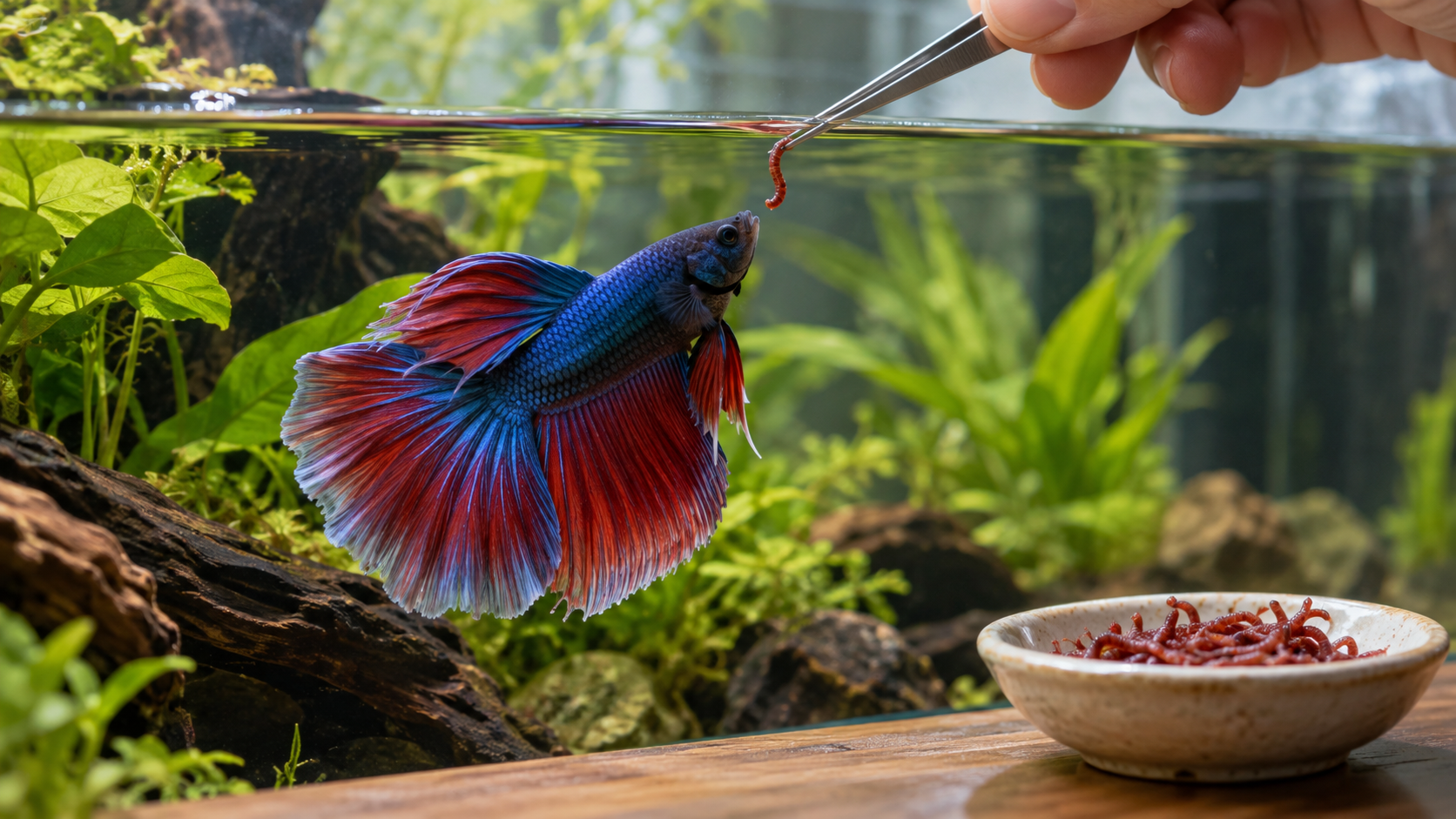
For how many blood worms to feed betta fish, the sources opened for this guide give no fixed count, so the honest answer is a small, occasional portion that fits inside a complete diet. Blood worms work as a treat. A betta’s main food should be a formulated dry diet, and live or frozen foods should only supplement it. The Merck Veterinary Manual and UF/IFAS both describe feeding in general terms, which is why the answer below is built from their guidance rather than from a worm count.
Quick answer
- No fixed blood worm count appears in the sources opened for this guide.
- Merck says live foods can lack some nutrients and can introduce parasites or disease, so they should not be the only food.
- UF/IFAS says the most common mistake is overfeeding, which can degrade water quality.
- Remove uneaten food, and remember that “one feeding per day is plenty for most pet animals.”
Why no number is given
Fish feeding guidance is usually written as a share of body weight, not as a count of items. The Merck Veterinary Manual says: “In general, maintenance diets are fed at a rate of 1% to 2% of body weight per day, and growth diets at 3% to 5% of body weight per day.” That is a rate for fish in general. The page does not single out bettas or blood worms, and it does not convert the rate into a number of worms.
Any worm count would therefore be an invented number. A count that looks precise but has no source behind it is the kind of claim this guide avoids.
What the feeding sources say
UF/IFAS, in its fish nutrition publication (FA096), gives a different maintenance figure from Merck. It says: “For maintenance, 0.5–1.0% body weight per day is adequate.” It adds: “Fish should probably be fed at least 5 days per week.” The two sources do not agree on the exact percentage, so any single figure should be read as a starting point, not a rule.
The Merck routine care page gives the practical step that matters most for treats: “Feed fish and remove any uneaten food.” Leftover food is what fouls the tank, so a portion the fish finishes is the safer target.
- UF/IFAS FA096: 0.5 to 1.0 percent of body weight per day for maintenance, fed at least five days per week.
- Merck, providing a home for fish: 1 to 2 percent of body weight per day for maintenance feeding.
- Merck, routine health care: feed fish and remove any uneaten food.
Why blood worms are a supplement
The Merck page explains the limits of live food: “Live foods, while generally a good source of protein and fat, can lack sufficient amounts of other elements and may not provide a complete diet.” It also describes a habit problem: “fish fed only live food from day one may refuse other foods.” Finally, “live foods can sometimes introduce parasites or diseases into the fish’s environment.”
The UF/IFAS page makes the same point about live feeds in general: “Cultured live foods can provide a source of high quality nutrition, but care must be taken to avoid perpetuation of infectious disease.” For a betta, that means a treat should never replace the main diet.
The Merck page recommends a base diet. It says: “Commercial dried foods, such as pellets, flakes, or granules, are a good choice because they are usually formulated to contain the proper mix of nutrients for your fish when fed properly.” It also says: “A variety of foods should be fed, with one primary dietary source supplemented with other foods that provide necessary nutrients.” In that model, blood worms are one of the supplementary foods.
A simple feeding routine
The sources support a short routine rather than a worm count. The steps below combine sourced points with general guidance, and the general guidance is labeled as such.
- Use a formulated dry food as the base of the diet, as the Merck page describes.
- Offer blood worms as an occasional treat, not every feeding.
- Remove any uneaten food after feeding, so it does not add to waste in the water.
- General guidance, not from the sources: start with a small portion and watch whether the fish eats it.
Storage matters for any commercial food. UF/IFAS says that “Feeds should be stored in a cool, dry place and should never be kept on hand for more than three months.” It also advises that “fish feeds should be purchased frequently, ideally at least once a month and more frequently if possible.” Those points apply to dry foods, and the source does not address blood worms directly.
Tank size and water care affect how much waste a given amount of food creates. The guide on how many gallons a betta fish needs covers the tank side of that equation, and the guide on the best betta heater for a 1 gallon tank covers equipment that keeps the water stable.
Signs of overfeeding or illness
Merck lists common signs of illness in fish, including “Lethargy” and “Not eating.” “Swelling or bloating” appears in the same list. The routine care page also says that some medications “need to be performed by your veterinarian, whereas others can be done at home,” which is a reason to involve a vet rather than adjust doses at home.
If a betta stops eating, becomes unusually inactive, or looks swollen after treats, check the water, remove any uneaten food, and contact a vet or an experienced fish keeper. This guide does not give medication doses.
How we chose
This guide uses only pages opened with curl on 2026-10-24. It favors a university extension publication (UF/IFAS) and the Merck Veterinary Manual because both give general fish-care guidance without product claims. Retail pages and product listings were not used for facts, and no prices or ratings appear here. Where two sources give different figures, both are shown.
What we could not verify
The sources opened do not give a bloodworm count for a betta, a bloodworm portion size, or a comparison of frozen, freeze-dried and live bloodworms.
What the sources do not say
- A number of blood worms per day, per feeding, or per week.
- A betta-specific feeding rate. The percentages above are written for fish in general.
- Whether frozen, freeze-dried or live bloodworms differ in nutrition or parasite risk. Merck and UF/IFAS discuss live foods in general.
- How long a betta should take to finish a portion.
Frequently asked questions
How many blood worms can I give my betta in one day?
The sources opened do not give a daily count. Offer a small portion as a treat, watch whether it is eaten, and remove anything left over. Blood worms are a supplement, not the full diet.
Can blood worms be my betta’s main food?
The Merck Veterinary Manual says live foods “can lack sufficient amounts of other elements and may not provide a complete diet.” Use a formulated dry food as the main diet and treat blood worms as a supplement.
Are blood worms bad for bettas?
The sources do not call blood worms bad for bettas. Merck does say live food “can sometimes introduce parasites or diseases into the fish’s environment,” so the main risks are contamination and overfeeding, not the worms alone.
What if my betta stops eating after getting treats?
Merck lists “Not eating” among common signs of illness. Check the water, remove uneaten food, and contact a vet if the fish continues to refuse food. Some treatments need a veterinarian, according to the Merck routine care page.
How often should I feed blood worms?
The sources do not give a schedule for treats. UF/IFAS says fish “should probably be fed at least 5 days per week,” and that “one feeding per day is plenty for most pet animals.” Occasional treats fit inside that routine, but they do not add a second daily meal.
Sources
- UF/IFAS Extension, “Fish Nutrition” (FA096), https://edis.ifas.ufl.edu/publication/FA096, opened 2026-10-24.
- Merck Veterinary Manual, “Providing a Home for Fish,” https://www.merckvetmanual.com/all-other-pets/fish/providing-a-home-for-fish, opened 2026-10-24.
- Merck Veterinary Manual, “Routine Health Care of Fish,” https://www.merckvetmanual.com/all-other-pets/fish/routine-health-care-of-fish, opened 2026-10-24.